The WMQ-EMSI Workshop Series is designed to identify and encourage new trends in our understanding of the history and culture of early North America. It fosters intellectual exchange among scholars working on thematically related topics that may be chronologically, geographically, or methodologically diverse. The participants are primarily mature scholars working on second or subsequent book projects; they share their works in progress with the aim of deepening and enriching their perspectives, their approaches, and ultimately the final products of their research.
2026 WMQ-EMSI Workshop: “Global Early America before 1700”
Complete the RSVP form to attend and receive the pre-circulated materials.
Friday & Saturday, January 30 & 31, 2026
Huntington Library
1151 Oxford Road, San Marino, CA
Convener:
Alison Frazier Games, Georgetown University
Was there a global early America? Atlantic approaches to early America have become commonplace, as have perspectives rooted in ideas about “vast” early America, yet little scholarship has sought to situate early America in a global context. Is such a context useful? What might it illuminate about the history of early America before 1700? This WMQ-EMSI Workshop invites scholars in history and related disciplines to explore these questions from a diverse array of methodological and geographic perspectives. Participants will discuss what global contexts might entail as broadly and creatively as possible, considering connections, comparisons, and convergences as well as shared processes or experiences.
The convener, Alison Games, will write an essay elaborating on the issues raised at the workshop for publication in the William and Mary Quarterly.
Friday, January 30, 2026
9:00 – 9:30 am Coffee
9:30 – 10:00 am
Julia Gaffield, William and Mary Quarterly
Peter Mancall, USC-Huntington Early Modern Studies Institute
Convener’s Introduction by Alison Frazier Games, Georgetown University

10:00 – 11:00 am
“The Early American Plantation in a Global Agricultural Revolution”
Comment: Michelle McKinley, University of Oregon
Chair: Peter Mancall, USC-Huntington Early Modern Studies Institute

Morning Coffee
11:00 – 11:15 am
11:15 am – 12:15 noon
“Negotiating the Wild Coast: Indigenous-European Interactions in Early Seventeenth-Century Guayana”
Comment: Scott Berthelette, Queen’s University
Chair: Julia Gaffield, William and Mary Quarterly

Lunch
12:15 – 1:45 pm
1:45 – 2:45 pm
“The Miracle of the Crab and the Conquest of the Sea”
Comment: Melissa N. Morris, University of Wyoming
Chair: Joshua Piker, Omohundro Institute

Afternoon Coffee
2:45 – 3:00 pm
3:00 – 4:00 pm
“Mona Island: Global Trade and Resistance in the Sixteenth- and Seventeenth-Century Caribbean”
Comment: Andrea Mosterman, University of New Orleans
Chair: Peter Mancall, USC-Huntington Early Modern Studies Institute

Saturday, January 31, 2026
9:00 – 9:30 am Coffee
9:15 – 10:15 am
“Amas de leche: Wetnurses in the Early Modern Iberian Empire”
Comment: Susanah Romney, New York University
Chair: Julia Gaffield, William and Mary Quarterly

Morning Coffee
10:30 – 10:45 am
10:45 – 11:45 am
“Shipboard Encounters and the Making of the Modern World”
Comment: Casey Schmitt, Cornell University
Chair: Joshua Piker, Omohundro Institute

Lunch
11:45 am – 1:15 pm
1:15 – 2:15 pm
“Ouréhouaré’s Odyssey: The Journey of a Haudenosaunee Headman Through the Seventeenth-Century French Atlantic World”
Comment: Kristie Flannery, Australian Catholic University
Chair: Peter Mancall, USC-Huntington Early Modern Studies Institute

Afternoon Coffee
2:15 – 2:30 pm
2:30 – 3:30 pm
“Neither Enslaved nor Free: The Struggle for Freedom of New
Netherland’s Black Community”
Comment: Paul Musselwhite, Dartmouth College
Chair: Julia Gaffield, William and Mary Quarterly

Final Discussion
3:45 – 4:45 pm
Moderator: Alison Frazier Games, Georgetown University
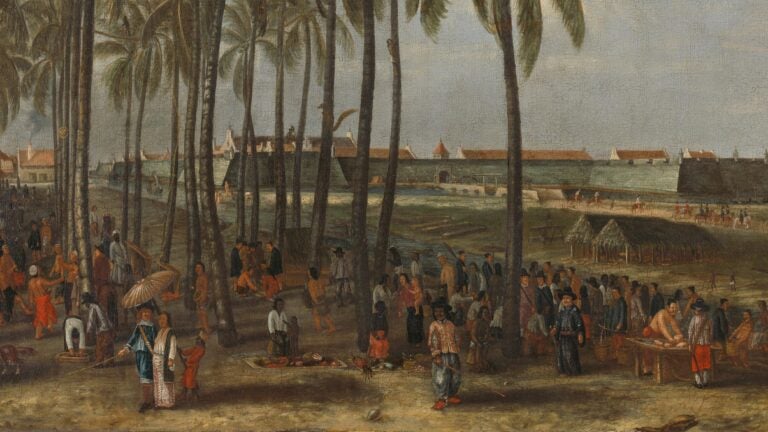
Image: Detail from“The Castle of Batavia” by Andries Beeckman, ca. 1656 Courtesy of the Rijksmuseum
The WMQ–EMSI Workshops are sponsored by the University of Southern California–Huntington Early Modern Studies Institute (with financial support from the USC Dornsife College of Letters, Arts and Sciences, the Mellon Foundation, the National Endowment for the Humanities, and Carole Shammas) and the Omohundro Institute of Early American History & Culture and are hosted by the Huntington Library and the University of Southern California.
