
Huntington Library Quarterly
The USC-Huntington Early Modern Studies Institute is proud to partner with the Huntington Library Quarterly.
The Huntington Library Quarterly (HLQ) is a peer-reviewed journal featuring original research and new perspectives on the early modern period, broadly defined (c. 1400–1800). Its content reflects an early modern world that was connected and cosmopolitan, with diverse communities and cultures increasingly linked by the circulation of people, ideas, social practices, and material objects in ways that transcend disciplinary and geographic boundaries. We invite submissions that draw on the sources, methods, and theoretical frameworks of literature, art, history, science, medicine, material culture, music, performance, and critical cultural studies, with a preference for scholarship that is broadly legible across disciplines.
HLQ’s historical focus on Britain and its American colonies has been dramatically expanded to embrace broader and more diverse fields of inquiry, including scholarship rooted in continental Europe, the African Diaspora, and the Indigenous Americas, as well as their intersections with Mediterranean, Pacific, and Indian Ocean worlds.
-
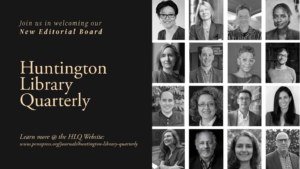
The editorial board of the Huntington Library Quarterly is staffed by sixteen eminent scholars of early modern art, literature, history, science, medicine, and material culture. They represent the best of what has made the HLQ a highly valued journal among researchers in the US, Britain, and beyond, with more than 150,000 annual article downloads. They also signal a new direction for the HLQ, which is expanding to embrace broader and more diverse fields of inquiry, including scholarship rooted in continental Europe, the African Diaspora, and the Indigenous Americas, informed by critical approaches to colonialism and power in the early modern world. As advisors and advocates, they will help guide the journal’s new editor, Brett Rushforth, as he leads the HLQ from its headquarters at The Huntington.
For more information about individual board members, click on their names below.
Susan Cogan, Utah State University
Elizabeth Ellis, Princeton University
Lynn Festa, Rutgers University
Douglas Fordham, University of Virginia
Stefan Hanss, University of Manchester
Katherine Ibbett, Oxford University
Peter Mancall, USC and EMSI
Shannon McHugh, University of Massachusetts, Boston
Jennifer L. Morgan, New York University
Jennifer Mori, University of Toronto
Noémie Ndiaye, University of Chicago
Nicholas Popper, William & Mary and Omohundro Institute
Nicholas Radburn, Lancaster University
Andrés Reséndez, University of California, Davis
Ulinka Rublack, Cambridge University
Cristobal Silva, University of California, Los Angeles -
Volume 88, Number 3-4, Fall/Winter 2025

“Layered Erasures: Vere Lynch and the First Painting of English Jamaica”
Eleanor Stephenson, 199-239
In 1672, Lady Vere Lynch (née Herbert) produced paintings of plantation crops in Jamaica. Lynch’s A Cocoa Treein the Royal Collection is the first known painting from the English colony of Jamaica and possibly the first by any British woman in the Americas. Drawing on new research conducted in Britain and Jamaica, this essay traces Vere Lynch’s artistic development and connections to the Royal Society, thereby broadening understanding of women at the Stuart court in the art and science of the period. It also examines the layered erasures hidden in the painting and archival trail, from Lynch’s authorship to the obscuring of the enslaved African laborers who planted and tended to Jamaica’s cacao. Vere Lynch’s biography and new attribution illustrate methods for uncovering women artists in colonial archives and disrupts perceptions of seventeenth-century British women artists.
Annalisa Nicholson, 241-258
In 1689, Aphra Behn dedicated her novella The History of the Nunto the exile and salonnièreHortense Mancini (Duchess of Mazarin). That dedication has attracted the curiosity of scholars, who have pointed to its queer resonances as well as to the novella’s ironic echoes with the paratextual subject, sparking speculation over the relationship between author and dedicatee. Taking this dedication as a starting point, this article revisits the connections between Behn and Mancini, two women associated with deviance, to shed new light on the vexed subject of women’s libertinism in Restoration London. While the misogynist inflections of the libertine movement have led scholars to treat women’s libertinism with suspicion, the double case study of Behn and Mancini reveals how transgressive women in the seventeenth century approached the movement themselves. Lingering on Behn’s novella and her connection to the misogynist verses in “Astrea’s Book for Songs and Satyrs,” the article reads Behn’s dedication alongside one satire to probe how Behn carved out a place for women within libertinism.
“The Case of Eyes: Two Blindnesses on the Shakespearean Stage”
Amrita Dhar, 259-285
This essay studies two blindnesses on the Shakespearean stage: the feigned blindness in 2 Henry VIand the violently inflicted blindness in King Lear. Through a reading of these blindness episodes using insights from premodern critical disability studies, this essay demonstrates that blindness on the Shakespearean stage functions to denote the limits of vision, intellection, and even justice. The appearance of blindness on the Shakespearean stage works to interrogate the very nature of theatricality. The staging of blindness equally provides readers, viewers, and audiences ways of rethinking the equation between vision and intellection that was prevalent in Shakespeare’s day and persists into our own.
“Courting the Captain: Poetry in the Journals of Seventeenth-Century English Mariners”
Jack Avery, 287-317
This article examines original and quoted poetry in journals written by four English mariners to argue that they provide exceptional insight into shipboard reading and writing practices during the late seventeenth century. Maritime poetry was marked by a continual process of reinvention, both in its initial composition and circulation, and in its subsequent inscription within broader journal narratives. These manuscripts must therefore be approached carefully by criticism, for while they record the motivations and techniques of verse writing on board ship, including its enmeshment within the complex patronage systems of the vessel, mariners only compiled their materials together later to achieve fresh objectives. Their poetry was marked by a rich and imaginative variety and reinvented the familiar conventions of landed literature to better fit conditions at sea. Prior scholarship has focused on how mariners emphasized their own labor, but this article maintains that their adaptation of popular literary forms often downplayed that element to prioritize alternative paradigms, including providential and heroic narratives. Maritime writers did not mask these transformations but expected their readers to recognize and value them for their ability to simultaneously convey the rhetoric and reality of life at sea.
Theresa Brock, 319-344
This study examines André Thevet’s Cosmographie universelle( Universal Cosmography, 1575) and Jean de Léry’s Histoire d’un voyage fait en la terre du Bresil( History of a Voyage to the Land of Brazil, 1578) to meet two objectives. First, the study shows how confession-specific concepts and practices, including around the Eucharist, influence how each writer views animals. Second, the analysis brings French texts more squarely into the scholarly conversation on confessional attitudes toward animals of the Americas, which has foregrounded Iberian, Dutch, and Danish sources. The study contends that genre and discourses of the monstrous and marvelous support these confessional readings and that intersecting ideological influences either promote or oppose colonization.
Joanne E. Myers, 345-373
This article presents two poems from the early modern archive of the English Poor Clares, one unpublished since the seventeenth century, the other found until now only in manuscript. Although devotional poetry might seem a privileged genre for understanding individual nuns’ spiritual experience, I argue instead that, when we consider the poems’ multiple appearances in the nuns’ prayer books, they are better understood as a communal devotional resource for shaping a collective identity. Tracing scribes’ recycling of these texts across the archive provides insight into how cloistered women sustained their vocation and how the convent’s textual culture supported modes of subjectivity and authorship that differ from those emergent in modernity.
-
Past issues can be accessed via Project Muse.
-
HLQ Call for Submissions:
The Huntington Library Quarterly (HLQ) is a peer-reviewed journal featuring original research and new perspectives on the early modern period, broadly defined (c. 1400–1800). Its content reflects an early modern world that was connected and cosmopolitan, with diverse communities and cultures increasingly linked by the circulation of people, ideas, social practices, and material objects in ways that transcend disciplinary and geographic boundaries. We invite submissions that draw on the sources, methods, and theoretical frameworks of literature, art, history, science, medicine, material culture, music, performance, and critical cultural studies, with a preference for scholarship that is broadly legible across disciplines.
HLQ’s historical focus on Britain and its American colonies has been dramatically expanded to embrace broader and more diverse fields of inquiry, including scholarship rooted in continental Europe, the African Diaspora, and the Indigenous Americas, as well as their intersections with Mediterranean, Pacific, and Indian Ocean worlds.
HLQ publishes four types of essays:
- Research Articles: Standard essays based on original research and interpretation in conversation with current scholarship. (8,000–15,000 words, including notes.)
- Sources: Short critical editions of previously unpublished textual or visual sources, translated into English when applicable, with a full critical apparatus and interpretive intervention.
- Assessments and Approaches: State-of-the-field, methodological, and theoretical essays that assess recent scholarship, reimagine older works from new perspectives, or suggest new directions for research. (3,000 to 10,000 words, including notes.)
- Early/Modern Connections: Essays presenting original early modern research that has enabled, supported, or shaped a specific public humanities or public interest project. (2,000 to 10,000 words, including notes.)
We also publish special issues—similar to edited book volumes—in which a group of essays connected by a common theme, topic, or approach is submitted collectively, with an introduction, by an editor or editors. If the issue is accepted for publication, the submitting editors become guest co-editors of the issue.
HLQ is published by The Huntington, a world-leading research center with vast early modern holdings in its Library, Art, and Botanical divisions. Although the journal welcomes submissions that draw directly on these resources, the location of research or source material has no influence on publication decisions.
Call for Submissions: Early/Modern Connections
The Huntington Library Quarterly (HLQ) invites submissions for a new section of the journal called Early/Modern Connections. This section will feature peer-reviewed essays that link early modern research to public humanities and the public interest. Although examples will vary widely, all successful submissions will illustrate how previously unpublished research in early modern sources has informed, or continues to inform, a public-facing project. Work benefiting historically underserved or marginalized communities is of particular interest. Essay length will vary significantly by project but will generally not exceed 5,000 words.
We anticipate submissions highlighting smaller-scale individual work as well as collaborations between scholars and performers, educators, activists, writers, artists, and public-serving institutions. We also anticipate the unanticipated and encourage anyone interested in submitting an Early/Modern Connections piece to contact the journal’s editor, Brett Rushforth.
-
https://www.pennpress.org/blog/the-huntington-library-quarterly-announces-a-new-editor-in-chief-and-editorial-board/
Two Distinguished Scholars Join Huntington’s Research Division

Huntington Library Quarterly
Volume 88, Number 3-4, Fall/Winter 2025
Latest Issue
-
Eleanor Stephenson, 199-239
In 1672, Lady Vere Lynch (née Herbert) produced paintings of plantation crops in Jamaica. Lynch’s A Cocoa Treein the Royal Collection is the first known painting from the English colony of Jamaica and possibly the first by any British woman in the Americas. Drawing on new research conducted in Britain and Jamaica, this essay traces Vere Lynch’s artistic development and connections to the Royal Society, thereby broadening understanding of women at the Stuart court in the art and science of the period. It also examines the layered erasures hidden in the painting and archival trail, from Lynch’s authorship to the obscuring of the enslaved African laborers who planted and tended to Jamaica’s cacao. Vere Lynch’s biography and new attribution illustrate methods for uncovering women artists in colonial archives and disrupts perceptions of seventeenth-century British women artists.
-
Annalisa Nicholson, 241-258
In 1689, Aphra Behn dedicated her novella The History of the Nunto the exile and salonnièreHortense Mancini (Duchess of Mazarin). That dedication has attracted the curiosity of scholars, who have pointed to its queer resonances as well as to the novella’s ironic echoes with the paratextual subject, sparking speculation over the relationship between author and dedicatee. Taking this dedication as a starting point, this article revisits the connections between Behn and Mancini, two women associated with deviance, to shed new light on the vexed subject of women’s libertinism in Restoration London. While the misogynist inflections of the libertine movement have led scholars to treat women’s libertinism with suspicion, the double case study of Behn and Mancini reveals how transgressive women in the seventeenth century approached the movement themselves. Lingering on Behn’s novella and her connection to the misogynist verses in “Astrea’s Book for Songs and Satyrs,” the article reads Behn’s dedication alongside one satire to probe how Behn carved out a place for women within libertinism.
-
Amrita Dhar, 259-285
This essay studies two blindnesses on the Shakespearean stage: the feigned blindness in 2 Henry VIand the violently inflicted blindness in King Lear. Through a reading of these blindness episodes using insights from premodern critical disability studies, this essay demonstrates that blindness on the Shakespearean stage functions to denote the limits of vision, intellection, and even justice. The appearance of blindness on the Shakespearean stage works to interrogate the very nature of theatricality. The staging of blindness equally provides readers, viewers, and audiences ways of rethinking the equation between vision and intellection that was prevalent in Shakespeare’s day and persists into our own.
-
Jack Avery, 287-317
This article examines original and quoted poetry in journals written by four English mariners to argue that they provide exceptional insight into shipboard reading and writing practices during the late seventeenth century. Maritime poetry was marked by a continual process of reinvention, both in its initial composition and circulation, and in its subsequent inscription within broader journal narratives. These manuscripts must therefore be approached carefully by criticism, for while they record the motivations and techniques of verse writing on board ship, including its enmeshment within the complex patronage systems of the vessel, mariners only compiled their materials together later to achieve fresh objectives. Their poetry was marked by a rich and imaginative variety and reinvented the familiar conventions of landed literature to better fit conditions at sea. Prior scholarship has focused on how mariners emphasized their own labor, but this article maintains that their adaptation of popular literary forms often downplayed that element to prioritize alternative paradigms, including providential and heroic narratives. Maritime writers did not mask these transformations but expected their readers to recognize and value them for their ability to simultaneously convey the rhetoric and reality of life at sea.
-
Theresa Brock, 319-344
This study examines André Thevet’s Cosmographie universelle( Universal Cosmography, 1575) and Jean de Léry’s Histoire d’un voyage fait en la terre du Bresil( History of a Voyage to the Land of Brazil, 1578) to meet two objectives. First, the study shows how confession-specific concepts and practices, including around the Eucharist, influence how each writer views animals. Second, the analysis brings French texts more squarely into the scholarly conversation on confessional attitudes toward animals of the Americas, which has foregrounded Iberian, Dutch, and Danish sources. The study contends that genre and discourses of the monstrous and marvelous support these confessional readings and that intersecting ideological influences either promote or oppose colonization.
-
Joanne E. Myers, 345-373
This article presents two poems from the early modern archive of the English Poor Clares, one unpublished since the seventeenth century, the other found until now only in manuscript. Although devotional poetry might seem a privileged genre for understanding individual nuns’ spiritual experience, I argue instead that, when we consider the poems’ multiple appearances in the nuns’ prayer books, they are better understood as a communal devotional resource for shaping a collective identity. Tracing scribes’ recycling of these texts across the archive provides insight into how cloistered women sustained their vocation and how the convent’s textual culture supported modes of subjectivity and authorship that differ from those emergent in modernity.
Image: Eunice Hooper, Sampler, c. 1790, Jonathan and Karin Fielding Collection. Courtesy of the Huntington Library, Art Museum, and Botanical Gardens, San Marino, CA.
