Division of Humanities
Think Again
You’ve heard the pitch before: the humanities teach empathy, they make you well-rounded. Both are true. But incomplete.
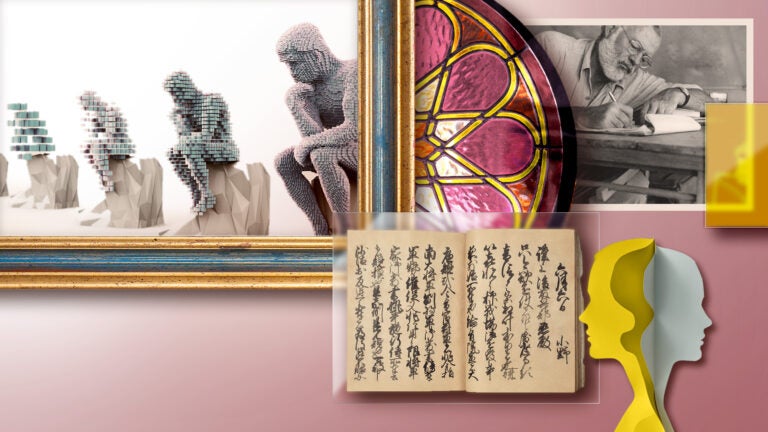
What the humanities challenge us to do is make better sense of how culture and identity get built, inherited, and revised. That matters today, not because the biggest questions changed, but because so much of what shapes who we are — our stories, our values, our sense of belonging — is now pulled in more directions, by more interests, and more algorithms built to serve them. It’s easy to settle for whatever version arrives first, loudest, or even feels the most comforting. In a world of rapid technological change and optimism for sale, challenging the status quo takes courage. It takes courage” to follow a question wherever it leads, searching for truth without bias. It takes courage to weight ideas against each other and forge a sturdier insight from what survives. An argument, a work of art, a lost manuscript, a buried history: Humanists help us learn from these truths to shape a collective way forward.
That instinct travels. You’re the lawyer who spots what a contract hides, or the Classicist who hears the same rhetoric that toppled Rome in this morning’s headlines. The great power of the humanities is in using ideas to build meaningful life for yourself, and in keeping society thinking for itself.
Where the Humanities Go to Work
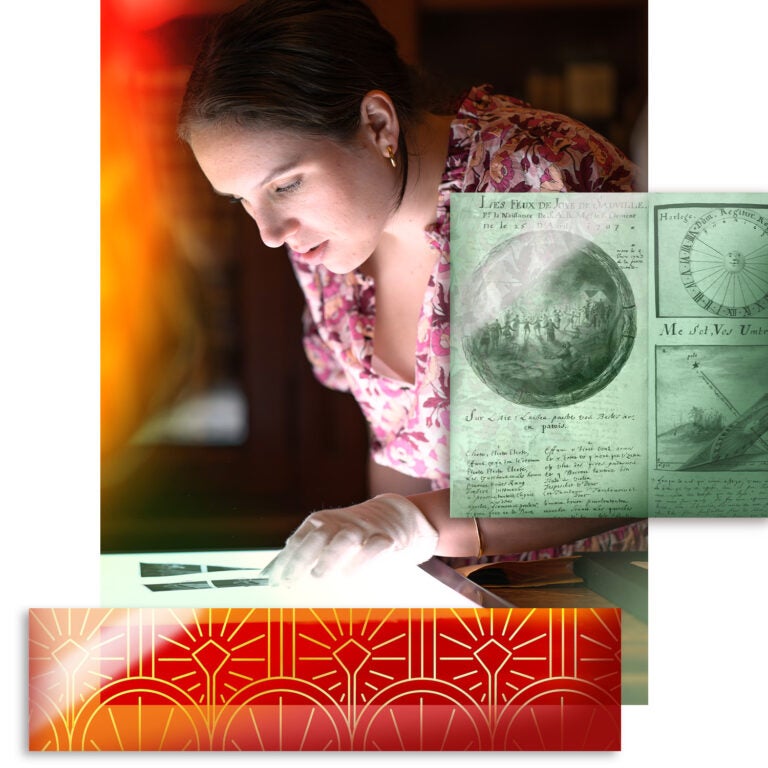
This is a place where curiosity meets purpose. Faculty work at the leading edge of their fields, uncovering new knowledge, offering new perspective, and cultivating creative expression in ways that help us make better sense of the world.
What’s New

Is AI really writing?
What should we call the words that generative AI produces? For clues, Assistant Professor (Teaching) of Writing Ryan Leack looks to some of the world’s earliest authors.

How to be grateful to someone — even when you don’t really want to
Struggling to find your sense of gratitude? Philosopher Mark Schroeder suggests thinking differently about what caused the person’s actions.

How does reading both isolate us and bring us closer together?
Reading offers unexpected forms of connection, as English professor Emily Anderson uncovers in her latest book, Shadow Work: Loneliness and Literary Life.

Can a “closer reading” improve health care?
We bring more than a list of symptoms into the doctor’s office. We bring our personal experiences, emotions, and relationships with disease. At USC, collaborators in the humanities and clinical medicine are shaping the growing field of narrative medicine. By understanding what a “closer reading” of a patient’s story might reveal — from the characters and cultural traditions they describe to the latent meaning in a moment of silence — clinicians might uncover ways to improve holistic patient care.
Centers and Institutes

The City Writes Back
When you study the humanities at USC, the entire city is your campus.
Arguably the most dynamic urban environment in the world, Los Angeles is where trends are set, cultures blend, and reinvention is part of the DNA. It’s also where many challenges affecting society are first revealed — and their solutions first imagined.
You might work with Dornsife experts who present exhibits at the Los Angeles County Museum of Art, adapt novels for Hollywood, give voice to underrepresented communities, advise innovators in Silicon Beach, consult rare books at the Huntington Library, and more. There are countless opportunities to explore what the city can teach us about the ways we live together. And you won’t just be an observer. You’ll be part of it all.

Join the Dornsife Trojan Family
Wrestling with humanistic questions that may never fully resolve is some of the most demanding work a mind can do. This isn’t just the “old stuff.” It’s exactly the thinking a moment of unprecedented change calls for.
At USC Dornsife, you’ll work alongside faculty who spend as much time drawing out what you think as sharing what they’ve found. And you’ll often leave a seminar less sure of your first answer, but better able to defend the one you land on next.
Whether you end up in a courtroom, a newsroom, a classroom, or wherever the next hard question turns up, you’ll be ready to contribute from day one. But the professional doors that open are only part of your Dornsife Way. That same Dornsife education, no matter what you study, nurtures a love of learning and gives it direction along the way. For humanities students, that direction tends to arrive early, since sitting with complex questions is already the daily work. Your degree, over time, pays off in a richer understanding of the world and a meaningful life built around what you value and who you show up for.

Humanities for the Future of AI
An AI system can generate a poem, a painting, an argument, a piece of music. The artifact itself is no longer the hard part. But it cannot (and may never) understand what any of it is for. Why does learning a language change you in a way an AI translator never could? Why does one image move people and another doesn’t? Why does a belief hold even when it can’t be proven? That kind of interpretation doesn’t come from more data. It takes experts trained to find significance that can’t be calculated. It’s imperative in this moment, not only to judge these systems but to ensure they help to bring out the best of who we are.
Intensive in Writing and Responsible AI
Through this 3-course series, students learn to write and create responsibly in an AI-saturated world. The Writing and Responsible AI Intensive situates AI as a tool requiring ethical, rhetorical, and creative oversight, directly responding to evolving issues around AI literacy. With this official credential, you’ll have a competitive edge in just about any field where the ways we communicate must rise to the moment.

About the Division of Humanities
329
Faculty
902
Undergraduate Students
342
Graduate Students
5
MacArthur “Genius” Fellows
2
Pulitzer Prize Winners
10
Guggenheim Fellows (since 2015)

The Height of Their Craft
An undisputed world-leader, the USC Dornsife Department of English celebrates the written word, the people who make it, and the ones who help us understand its power. Pulitzer winners, poets laureate, consultants to Hollywood, novelists who top bestseller lists. Alongside them are renowned experts who mentor and teach you how to read them in the first place. Critics, translators, Shakespeare scholars, essayists — all building on a storied tradition of excellence.
USC Institute on Ethics and Trust in Computing (IETC)
IETC addresses an urgent need for academic expertise in guiding the responsible development of AI — not to slow progress, but to grapple with critical questions that technology cannot: questions about justice, judgment, agency, and what we owe each other in a society where machines profoundly influence our way of living. This work begins with philosophy — both through inquiry and as a tool for thinking clearly and acting wisely. The institute is designed to shape public discourse, invite partnership with industry, and train students to bridge reflection with execution as we increasingly rely on AI for solving complex problems.

Tune In to Gender and Sexuality Studies
Go deeper into today’s most complex issues related to gender, sexuality, and the research reshaping how we understand identity.
Led by the USC Dornsife Consortium for Gender, Race, Sexuality, and Culture, a series of 10 podcasts feature scholars, writers, and activists who bring their perspectives out of the classroom into the public square.

Recent Awards and Honors

Joseph Boone
Awarded the Douglas C. Basil Award for 2025–26 from the USC Emeritus Center for his forthcoming book The Melville Effect: A Literary Afterlife Across the Arts.

Sally Pratt
Inaugural recipient of the Dornsife Humanities Award for Distinguished Service, Pratt was recently honored for her decades of work to strengthen the intellectual and institutional life of USC Dornsife’s Humanities Division.

Robin Coste Lewis
Winner of the prestigious Prix Alain Bosquet Etranger forOdyssée de la Vénus noire, the bestselling translation of Voyage of the Black Venus. Coste Lewis previously won the National Book Award for Poetry.
Alumni Voices: George Stiffman (’19)
A graduate of East Asian Studies and Cultures, “tofu-evangelist” George Stiffman currently runs Soycery, a food pop-up that’s evolved from farmers market BBQ tofu skewers into ready-to-eat cold tofu dishes. He’s now working to partner Soycery with university dining halls to give students more plant-based options.
