This list is curated by Lauren Dodds, EMSI Postdoctoral Researcher (staff).
La storia delle massime e governo della Repubblica di Venezia, descritto da un segretario di un ambasciatore di Francia a Venezia
Venice, c. 1680
USC Special Collections JN5266.A44 1680
La storia delle massime e governo della Repubblica di Venezia, descritto da un segretario di un ambasciatore di Francia a Venezia is a clandestine manuscript translation of Histoire du Gouvernement de Venise (1676). USC’s manuscript copy withholds the name of the text’s author, Abraham-Nicolas Amelot de La Houssaye (1634-1706), who, in addition to being the described secretary of a French ambassador to Venice, was a printer, humanist, and political theorist. The unknown translator of USC’s manuscript notes on the title page that this text was “copiata a caffé” (copied in a café); variations in the text indicate this translation was produced for the Venetian market of forbidden books before the publication of an Italian translation in 1681. USC Libraries Special Collections also holds the 1677 first edition of the Histoire and the 1681 printed edition of La Storia. Scholars interested in the material history of the book may also wish to view this manuscript for its elaborate seventeenth-century lace-case binding.
For more information, contact USC Special Collections.

Abregé des Principes de La Religion Chretiene du bonheur de l’home
French, 18th century manuscript
USC Special Collections BR120.A27 1700
Abregé des Principes de la Religion Chretiene du bonheur de l’home is an 18th-century manuscript primer to Christianity. The slim volume contains sixty-seven sections–each a page or two in length–on topics including happiness, Biblical history, the cardinal virtues, prayer, and the concept of grace. The brevity and simplicity of the entries suggest this text was intended for the religious education of children. In addition to the two intaglio prints attributed to Claude Duflos (1665-1727) bound with the text, three tiny paper sea creatures are loosely tucked into the book’s binding–a charming addition further indicating children interacted with the text.
For more information, contact USC Libraries Special Collections.

Demandes et Réponses: n’en faites pas ún Hasard
France, c. 1790
USC Libraries Special Collections GV1234.F73 1790
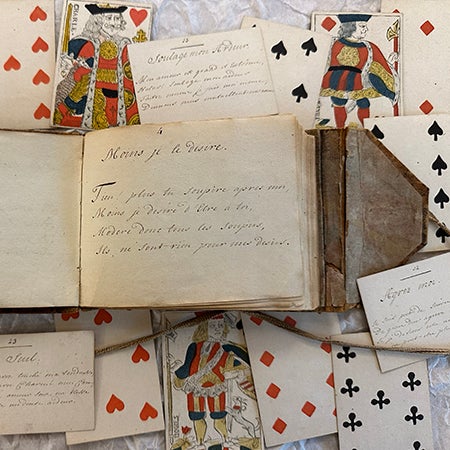
Demandes et réponses is an 18th-century manuscript game book with playing cards. This is a version of “Questions and Answers,” a popular early modern game that encouraged flirtatious conversation. Men read questions written on the verso side of the playing cards, which would then be answered by women reading their replies from the book. The USC copy of Demandes et réponses is previously unrecorded and includes all forty original playing cards.
For more information, contact Derek Christian Quezada Meneses, Rare Books Librarian, USC Special Collections.
Polygraphie et universelle écriture cabalistique
Johannes Trithemius. Translated by Gabriel de Collange.
Paris: Jacques Kerver, 1561
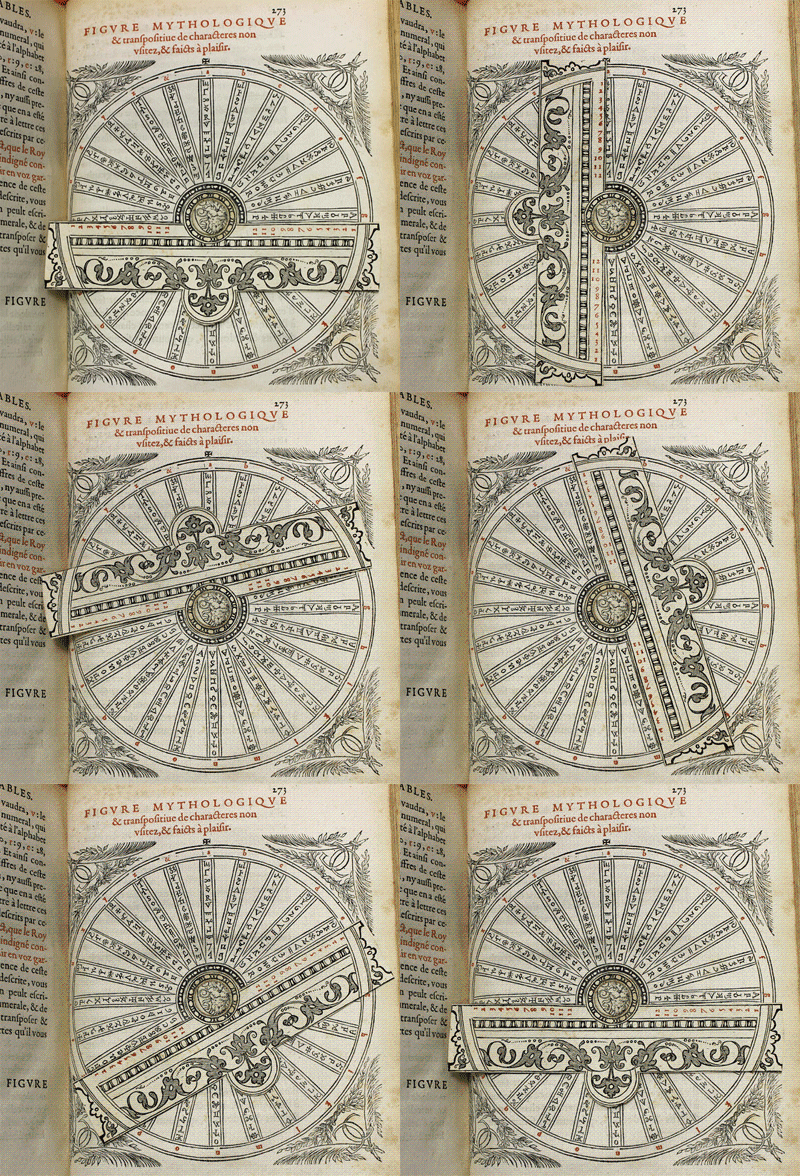
Polygraphie et universelle écriture cabalistique is a foundational work in the history of cryptography. Published in Paris in 1561, this is the first French edition of the German Benedictine abbot and polymath Johannes Trithemius’s Polygraphiae Libri (1518). Gabriel de Collange, a mathematician and valet de chambre to King Charles IX, translated and expanded the text; his additions include “Tables et figures planispheres” with 13 volvelles—paper constructions with rotating parts—for encryption and decipherment. Polygraphie introduced systematic and mathematical approaches for encoding messages that set a foundation for future developments in cryptography.
For more information, contact Derek Christian Quezada Meneses, Rare Books Librarian, USC Special Collections.
Josephi Judei Historici pre clara opera non[n] parua accuratio[n]e & diligentia rece[n]ter
Flavius Josephus, edited and translated by Robert Goulet
Paris: Jean Petit, 1519
USC Special Collections PA4222.A3 1519
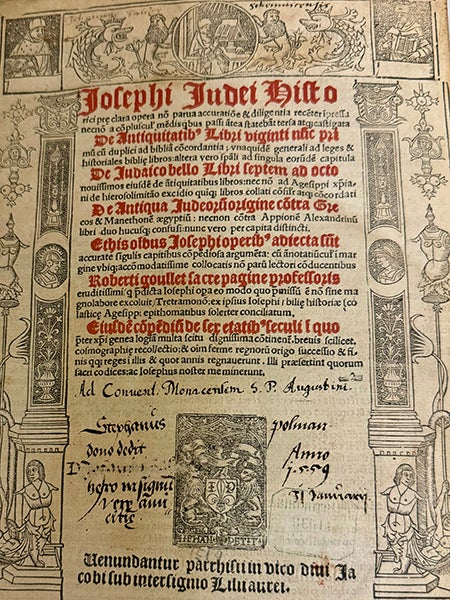
Josephi Judei Historici is a Latin edition of Flavius Josephus’s Antiquitates Judicae printed in Paris in 1519. Born in Jerusalem, Josephus (c. 37-100 CE) was a priest, scholar, and army commander. This text provides a Jewish history from Creation to the Great Revolt of 66-70 CE. Josephus was among the most popular ancient historians for early modern humanists in part because his writing provides a historical context for early Christianity. This edition of Josephus’s Antiquitates Judicae was produced for humanist scholars in and around the University of Paris; Robert Goulet, a priest and professor, translated the text, and the prominent Parisian bookseller Jean Petit published it. This may explain the inclusion of the contested “Testimonium Flavianum”—a passage in which Josephus refers to Jesus as the Messiah—which is assumed to be a later forgery.
For more information, contact Taylor Dwyer, Curator of Feuchtwanger Memorial Library, USC Special Collections.
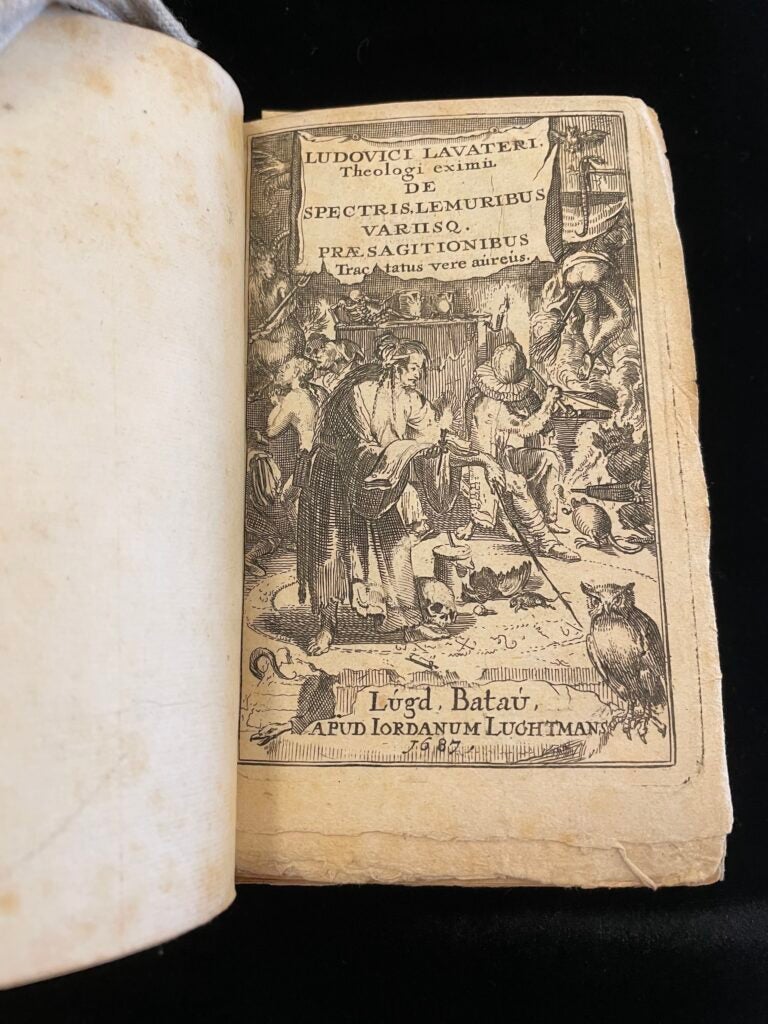
De spectris, lemuribus et magnis, atque insulitis fragoribus, variisque praesagitionibus, quae plerunque obitum hominum, magnas clades, mutationesque imperiorum praecedunt, liber unus. In tres partes distributes. Omnibus veritatis studiosis summe utilis.
Ludg. Batav. Apud Jordanum Luchtmans, Bibliopolae, 1687
USC Special Collections BF1445.L38 1687
De spectris was one of the most frequently printed and translated Protestant texts dealing with the supernatural in the early modern era. The Zwinglian theologian Ludwig Lavater (1527-1586) wrote De spectris to provide rational and theological explanations for the era’s superstitions. Lavater dismissed ghostly apparitions as misunderstood natural or psychological phenomena or as deceptions of the devil in line with Reformation theology. USC’s copy of De spectris belongs to the Feuchtwanger Memorial Library.
For more information, contact Derek Christian Quezada Meneses, Rare Books Librarian, USC Special Collections.
Le Throsne du destin, auquel chacun peut voir sa bonne ou mauvaise fortune en jettant un, ou deux, ou trois dez communs, sur quelz points quilz se puissent recontrer.
Maître C. Coturier, Paris 1632
USC Special Collections GV1303.C68 1632
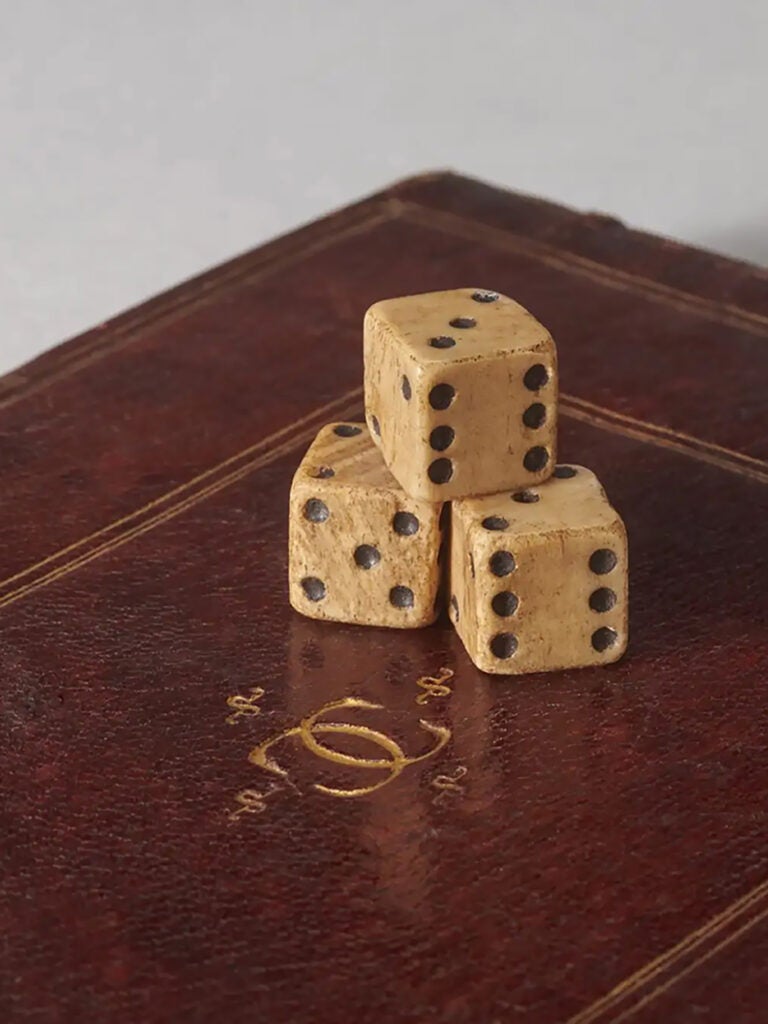
Le Throsne du destin is a seventeenth-century game book on vellum. Players cast dice to learn which of the game’s one hundred and sixty-four bawdy and scandalous fortunes – divided in half by sex (women’s fortunes on the recto side, men’s on the verso) – would be their fate. USC’s newly acquired copy of this remarkably unique manuscript includes the original bone dice necessary to play the game.
For more information, contact Derek Christian Quezada Meneses, Rare Books Librarian, USC Special Collections.