Why forests aren’t coming back near Amazon gold mines
Original story by Ileana Wachtel
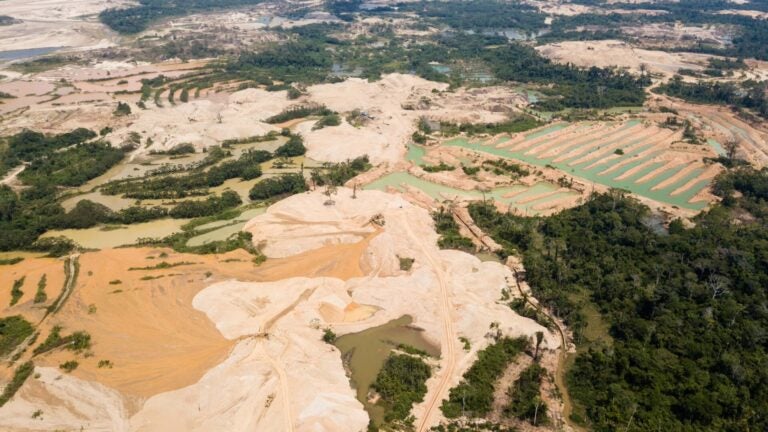
Forests in the Peruvian Amazon aren’t growing back after gold mining — not just because the soil is damaged from toxic metals, but because the land has been depleted of its water. A common mining method known as suction mining reshapes the terrain in ways that drain moisture and trap heat, creating harsh conditions where even replanted seedlings can’t survive.
The findings, published in Communications Earth & Environment, revealed why reforestation efforts in the region have struggled. One of the study’s co-authors is Josh West, professor of Earth sciences and environmental studies at the USC Dornsife College of Letters, Arts and Sciences.
“We’ve known that soil degradation slows forest recovery,” said West, who is also a National Geographic Explorer. “But this is different. The mining process dries out the land, making it inhospitable for new trees.”
VIDEO: Josh West explains the life-giving role of water in the Amazon
The research team was led by Abra Atwood, a scientist at the Woodwell Climate Research Center and a former student of West who earned her doctorate at USC Dornsife in 2023. Working with colleagues from Columbia University, Arizona State University and Peru’s Universidad Nacional de San Antonio Abad del Cusco, the team studied two abandoned gold mining sites in Peru’s Madre de Dios region, near the borders of Brazil and Bolivia.
They used drones, soil sensors and underground imaging to understand how suction mining reshapes the land. The technique, commonly used by small-scale and often family-run operations, blasts apart soil with high-pressure water cannons. The loosened sediment is funneled through sluices that filter out gold particles, while lighter material, including nutrient-rich topsoil, washes away. What remains are stagnant ponds — some as large as football fields — and towering sand piles up to 30 feet high.
Unlike excavation mining, which is used in other parts of the Amazon and can preserve some topsoil, suction mining leaves little behind to support new growth. On exposed sand piles, surface temperatures reached as high as 145 F (60 C). “It’s like trying to grow a tree in an oven,” West said.
Drone-mounted thermal cameras showed how barren ground baked under the sun while nearby forested areas and pond edges stayed significantly cooler.
“When roots can’t find water and surface temperatures are scorching, even replanted seedlings just die,” said Atwood. “It’s a big part of why regeneration is so slow.”
This research was conducted as part of the National Geographic Rolex Perpetual Planet Amazon Expedition.
Read the full story in USC Dornsife News >>
In the News
National Geographic: Behind the scenes of the Amazon expedition >>
Earth.com: Gold mining causes long-lasting damage in the Amazon >>