Your research has a story. We can help you tell it.
Through the Wrigley Institute Storymakers program, scientists become storytellers, and academic research becomes a vision that changes the world.
The Storymakers program is a weeklong intensive that trains full-time, established researchers in the art of environmental storytelling. Held in residence at the Wrigley Marine Science Center (WMSC) on Catalina Island, the program includes lectures, workshops, studio time for creating original content, and cohort-building activities. Instructors are chosen from the best in media, the arts, and publishing.
2026 Program
Dates: July 20-26, 2026
Location: Wrigley Marine Science Center, Santa Catalina Island
Notification deadline: March 15, 2026
Applications for the 2026 cohort are now closed. Please check back in December 2026 for applications to the 2027 cohort.
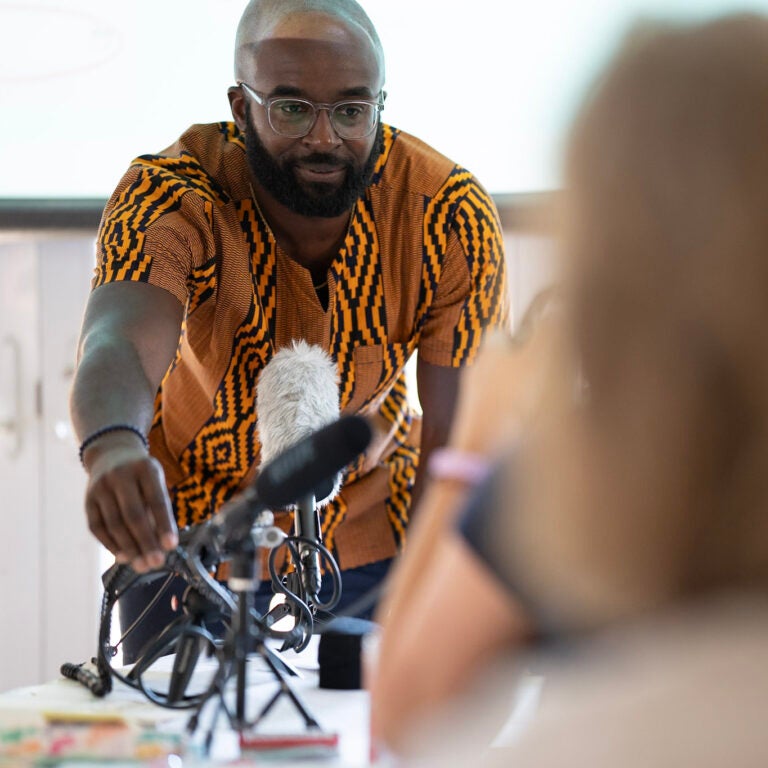
The Storymakers Experience
Brilliant researchers. Inspiring instructors. A setting where you can get away from it all, the opportunity to build lasting relationships with like-minded colleagues, and a program that will challenge your assumptions about your audience, your work, and yourself. That’s the experience Storymakers offers.

What Storymakers Is
“I am so thankful for this experience. There would not be another way for me to make this step in my career. I would never say this prior to the program, but I feel very limitless.” –Dr. Suzanne Pierre, Founding Director of the Critical Ecology Lab, National Geographic Explorer
About the Program & How to Apply
2026 Program
Dates: July 20-26, 2026
Location: Wrigley Marine Science Center, Santa Catalina Island
Notification deadline: March 15, 2026
Applications for the 2026 cohort are now closed. Please check back in December 2026 for applications to the 2027 cohort. General information about the program is below. Please also review our FAQ for more details.
-
Humanity today faces intensifying environmental catastrophes: climate change, wildfires, water shortages, biodiversity loss, and more. These are not merely scientific issues, but they cannot be solved without science. And yet, the vocabulary, communication styles, and formats that professional academics typically use are often ineffective and even counterproductive in engaging the public. So how can scientists share their knowledge in a way that moves hearts and minds and builds appetite for change?
The Wrigley Storymakers Program is designed to answer that question. Over the course of the program, you’ll learn the art of environmental storytelling so you can share your research with the public in creative and compelling ways. This program focuses especially on narrative persuasion and how to use it to build internet-friendly content that will engage and influence the widest possible audience.
Hands-on practice will cover audio production/podcasting, writing, immersive storytelling, creative time for producing original content, and feedback sessions. You’ll also participate in a variety of cohort-building activities that will help you create lasting relationships with like-minded colleagues, so you can continue to encourage and help each other in your work long after Storymakers ends.
Fellows should come to the program with a clear idea of what message, story, or ideas they want to communicate to the public, but with an open mind as to how they’ll do it. You will leave the program with a clear understanding of how to craft a compelling narrative through a variety of means and media, plus connections to a network of colleagues and professionals who can help you develop and advance project ideas.
-
Storymakers takes place at the Wrigley Institute’s satellite campus, the Wrigley Marine Science Center on Catalina Island. WMSC is located in a pristine marine reserve where you can retreat from the distractions of normal daily activity and be inspired by the beautiful planet you’re working to aid.
-
Participation is limited to full-time, established researchers studying environment- or sustainability-related topics in the natural sciences, social sciences or humanities. Applicants should have significant research experience beyond the completion of a Ph.D. or other terminal degree.
While fellows may apply from anywhere, please be aware that the program focuses on the English-speaking, North American media market, and all instruction is conducted in English. International attendees are solely responsible for obtaining all required documents for legally entering and leaving the U.S.
-
The Storymakers Fellowship includes all costs associated with program instruction, transportation between Los Angeles and Catalina Island, room and board while on the island, and hosted arrival and departure dinners. Fellows are responsible for travel to and from Los Angeles, plus arrival and departure hotels, if needed.
2026 Storymakers Fellows

Stephen Carr Hampton
Natural resource economist
California Department of Fish and Wildlife (ret.)
Project focus: Seabird restoration and climate change

Sierra Carter
Psychologist
University of Georgia
Project focus: Environmental stressors and healing in Black communities

Lisa Fazio
Psychologist
Vanderbilt University
Project focus: Why people believe misinformation about climate and the environment

Christabel Devadoss
Geographer
Middle Tennessee State University
Project focus: Environmental decision-making in rural Rust Belt communities

Nik Heynen
Geographer
University of Georgia
Project focus: Environmental challenges on Gullah Geechee lands

Catherine Hulshof De La Peña
Ecologist
Virginia Commonwealth University
Project focus: Biodiversity and climate change in tropical mountains

Lauren Kinsman-Costello
Ecosystem ecologist
Kent State University
Project focus: Water quality and nutrient cycling in freshwater wetlands

Claudia Lugo-Candelas
Psychologist and neuroscientist
Columbia University
Project focus: Prenatal environmental exposures in Puerto Rico

Nathaniel Otjen
Environmental humanist and anthropologist
Ramapo College
Project focus: Impacts of renewable energy development on nonhuman species

Shelby Rader
Geochemist
Indiana University Bloomington
Project focus: Heavy-metal environmental pollutants

Kelly Sutherland
Marine biologist
University of Oregon
Project focus: The role of plankton and gelatinous animals in ocean ecosystems

Stylianos Syropoulos
Social psychologist
Arizona State University
Project focus: Decision-making and sustainable futures
Previous Storymakers Fellows
-
Dr. Anurag Agrawal, Cornell University. Anurag’s research focuses on the ecology and evolution of interactions between plants and animals.
Dr. Karen Bailey, University of Colorado Boulder. Karen’s research focuses on human-environment interactions, climate change, and sustainable rural livelihoods.
Dr. Cynthia Chang, University of Washington Bothell. Cynthia’s research focuses on the causes and consequences of plant diversity.
Dr. Cydney Dupree, University College London. Cydney’s research focuses on social cognition, political psychology, and organizational behavior to advance our understanding of how people navigate social inequality.Dr. Thomas Gillespie, Emory University. Thomas’s research focuses on interactions among anthropogenic environmental change; biodiversity; and the ecology and emergence of pathogens of people, wildlife, and domestic animals.Dr. Lisa Graumlich, University of Washington.Lisa’s research focuses on the causes and impacts of climate change, with a special focus on using paleoecological records such as tree-rings to understand the magnitude of human impacts.Dr. Shangrila Joshi, The Evergreen State College. Shangrila’s research focuses on the human dimensions of global climate change, with a focus on environmental and climate justice, and institutions of commons governance.
Dr. Joshua Merced, Northern Arizona University. Joshua’s research focuses on the intersection of cultural economy, placemaking, and urban studies.Dr. Esther Ngumbi, University of Illinois Urbana Champaign. Esther’s research focuses on understanding the multifaceted uses of chemical signals by herbivores, natural enemies, plants and their associated microorganisms and insects.
Dr. Brent Olson, Westminster University. Brent’s research focuses on the interaction between culture, political economy, and nature.Dr. Scott Taylor, University of Colorado Boulder. Scott’s research focuses on the hybridization, speciation, evolutionary ecology, and population genomics (primarily of birds).
Dr. Carly Ziter, Concordia University. Carly’s research focuses on the intersection of landscape structure, biodiversity, and ecosystem services.
-
Dr. Shahzeen Attari, Indiana University Bloomington. Shahzeen’s research focuses on judgement and decision making to address challenges related to climate change.
Dr. Russ Benedict, Central College. Russ’s research focuses on the ecological roles of bats and tall grass prairie.
Dr. Nyeema Harris, Yale University. Nyeema’s research focuses on focusing on carnivores, protected areas, and human-wildlife coexistence through lens of inclusion and justice.
Dr. Carly Kenkel, University of Southern California. Carly’s research focuses on the ecological and evolutionary interactions of tropical reef-building coral to predict responses of reef ecosystems to global climate change.
Dr. Katherine McComas, Cornell University. Katherine’s research focuses on beliefs, attitudes, and behaviors across a variety of scientific, technical, health, and environmental risks.
Dr. Lindsay Naylor, University of Delaware. Lindsay’s research focuses on food, agriculture, and climate change, with a particular eye to power relations, resistance, and justice.
Dr. Jesse Popp, University of Guelph. Jesse’s research focuses on weaving together diverse knowledges in environmental and ecological science.
Dr. Alexis Racelis, University of Texas Rio Grande Valley. Alexis’s research focuses on sustainable food systems, agriculture, and community outreach and collaboration.
Dr. Narasimha Rao, Yale University. Narasimha’s research focuses on energy systems, climate injustice, and poverty and wellbeing.
Dr. Stacy-ann Robinson, Emory University. Stacy-ann’s research focuses on the human, social, and policy dimensions of climate change adaptation, with an emphasis on climate justice and adaptation.
Dr. Gabrielle Roesch-McNally, American Farmland Trust. Gabrielle’s research focuses on peer networks, climate change, and
sustainable agriculture.Dr. Nikki Taylor-Knowles, University of Miami. Nikki’s research focuses on evolution of immunity, wound healing,
and regeneration in corals, especially in response to climate change and other human-induced stressors. -
Dr. Ben Halpern, University of California, Santa Barbara. Ben’s research focuses on the interface of marine ecology and conservation planing.
Dr. Doug Bessette, Michigan State. Doug’s research focuses on sustainable energy, energy transitions, and community energy development.
Dr. Heather Leslie, University of Maine. Heather’s research focuses on the ecology, policy, and management of coastal marine ecosystems.
Dr. Holly Bik, University of Georgia. Holly’s research focuses on the interface between biology and computer science to explore broad patterns in marine microbes.
Dr. Jacqueline Padilla-Gamiño, University of Washington. Jacqueline’s research focuses on the ecophysiology and reproductive biology of marine organisms in a changing environment.
Dr. Jessica Hellmann, University of Minnesota. Jessica’s research focuses on the impacts of climate change on natural systems and strategies to reduce those impacts through adaptation and greenhouse gas emission reduction.
Dr. Madhur Anand, University of Guelph. Madhur’s research focuses on global ecological changes in ecosystems of regional and global scales and their implications for human-environment sustainability.
Dr. Nick Haddad, Michigan State. Nick’s research focuses on biodiversity and ecosystem service conservation in the face of global changes such as agriculture, habitat loss, and climate change.
Dr. Noa Kekuewa Lincoln, University of Hawai’i Mānoa. Noa’s research focuses on the nexus of environment, agriculture, and society in the past and the present.
Dr. Rosie ‘Anolani Alegado, University of Hawai’i Mānoa. Rosie’s research focuses on systems biology, microbial oceanography, and historical ecology to understand the influence and impact of individuals embedded in larger systems.
-
Dr. Joe Árvai, USC. Joe’s research focuses on how people form opinions and make decisions about things that have social and environmental consequences.
Dr. Elena Bennett, McGill University. Elena’s research focuses on the role of people’s relationships to one another and to nature in building a better future.
Dr. William Deverell, USC. Bill’s research focuses on the history of wildfire in the American West and the wildfire management methods used by Indigenous peoples.
Dr. Simon Donner, University of British Columbia. Simon’s research focuses on climate and how it interacts with coral reef ecology.
Dr. Ambika Kamath, University of Colorado Boulder. Ambika’s research focuses on animal behavior, ecology, and evolution.
Dr. Neil Lewis, Jr., Cornell University. Neil’s research is based in the behavioral sciences and focuses on disparities in environmental impacts and how they affect people’s health.
Dr. Vernon Morris, Arizona State University. Vernon’s research focuses on atmospheric sciences and their intersection with climate and air quality issues.
Dr. Suzanne Pierre, California Academies of Science. Suzanne’s research focuses on how climate affects plant-microbe interactions.
Dr. Chelsie Romulo, University of Northern Colorado. Chelsie’s research focuses on the management of non-timber natural resources.
Dr. Merritt Turetsky, University of Colorado Boulder. Merritt’s research focuses on ecosystem ecology, carbon cycling, permafrost science, and fire ecology.
The USC Wrigley Institute Storymakers Program is generously supported by the Lott Foundation, Delaney Dechant, and Christopher Hagenah.