
Black and Brown Solidarity Against ICE
Nationally, over 56,000 have been detained by Immigration and Customs Enforcement (ICE) since Donald Trump’s inauguration in January 2025. Immigration raids have targeted brown-skinned people on street corners, in parks, at bus stops and at work. People have been forcibly detained and arrested without probable cause. There have been a particularly large number of raids, arrests, and forced disappearances in Los Angeles, California that have targeted Mexican and Central American immigrants. In response to these arrests, large scale sustained protests took place against ICE raids in downtown Los Angeles throughout June 2025. While many might assume that these immigration raids are a “Latino issue,” many Black leaders and organizations are standing in solidarity with the Latino immigrant community.
Black leaders like Melina Abdullah of Black Lives Matter have been vocal about their opposition to ICE and their support for immigrant communities. Black civil rights organizations including the NAACP and National Action Network issued statements in solidarity with immigrant communities. These recent displays of solidarity are part of a long history of Black and Brown communities working together for racial justice. Even still, historically, the media highlights the “fragile” alliance between Black and Brown people as well as the tensions that have existed between these communities. In fact, some worry that these coalitions may only exist strategically between political elites and fail to represent the feelings of everyday people. With this in mind, we examine recent results from the 2020 Collaborative Multiracial Post-Election Survey to demonstrate that Black and Latine solidarity around issues of immigration remains strong.
The Roots of Black and Latine Solidarity
Black and Latine solidarity came together in the 1970s and 80s with the wave of civil rights protests that were taking place across the United States to demand equality and just labor conditions . In Los Angeles, the Chicano movement borrowed heavily from the Black Panther party, as the Brown Berets took center stage in many of the walkouts that were taking place in East Los Angeles. In Chicago, the Rainbow Coalition came together with the help of the Black Panthers, Young Lords, and Young Patriots. It was during this time that a political consciousness and knowledge about systematic racism grew within each of the communities, especially among its youth. While organizations like the United Farm Workers (UFW) successfully organized farmworkers, the Brown Berets advanced created a narrative around structural inequality that helped the younger generation develop a more critical understanding of discrimination and its impact on other communities of color.
Black and Latino Solidarity Today
To explore the extent to which Black and Latino people continue to feel solidarity with one another, we make use of the 2020 Collaborative Multiracial Post-Election Survey (CMPS). The CMPS is unique in its collaborative nature. Over 200 scholars across 100 different universities/colleges contributed to their survey instrument. The CMPS is particularly useful for the purposes of this research, because they oversample Black and Latine respondents. There are a total of 4,071 Black respondents surveyed and 3,529 Latine respondents. We also examine Black and Latino support and opposition for ICE.
To examine solidarity between these two groups. We analyze the extent to which Black and Latino people believe that when it comes to the treatment of Black people by the police and the treatment of Latine immigrants by immigration officials these officials are racially biased. We find that a majority of Black (70%) and Latino (54.7%) people feel that this treatment is racially biased.
Notably, Black people are significantly more likely to view the treatment of both groups as racially biased. This may stem from their understanding of systemic racism in the American context.

Source: 2020 Collaborative Multiracial Post-Election Survey
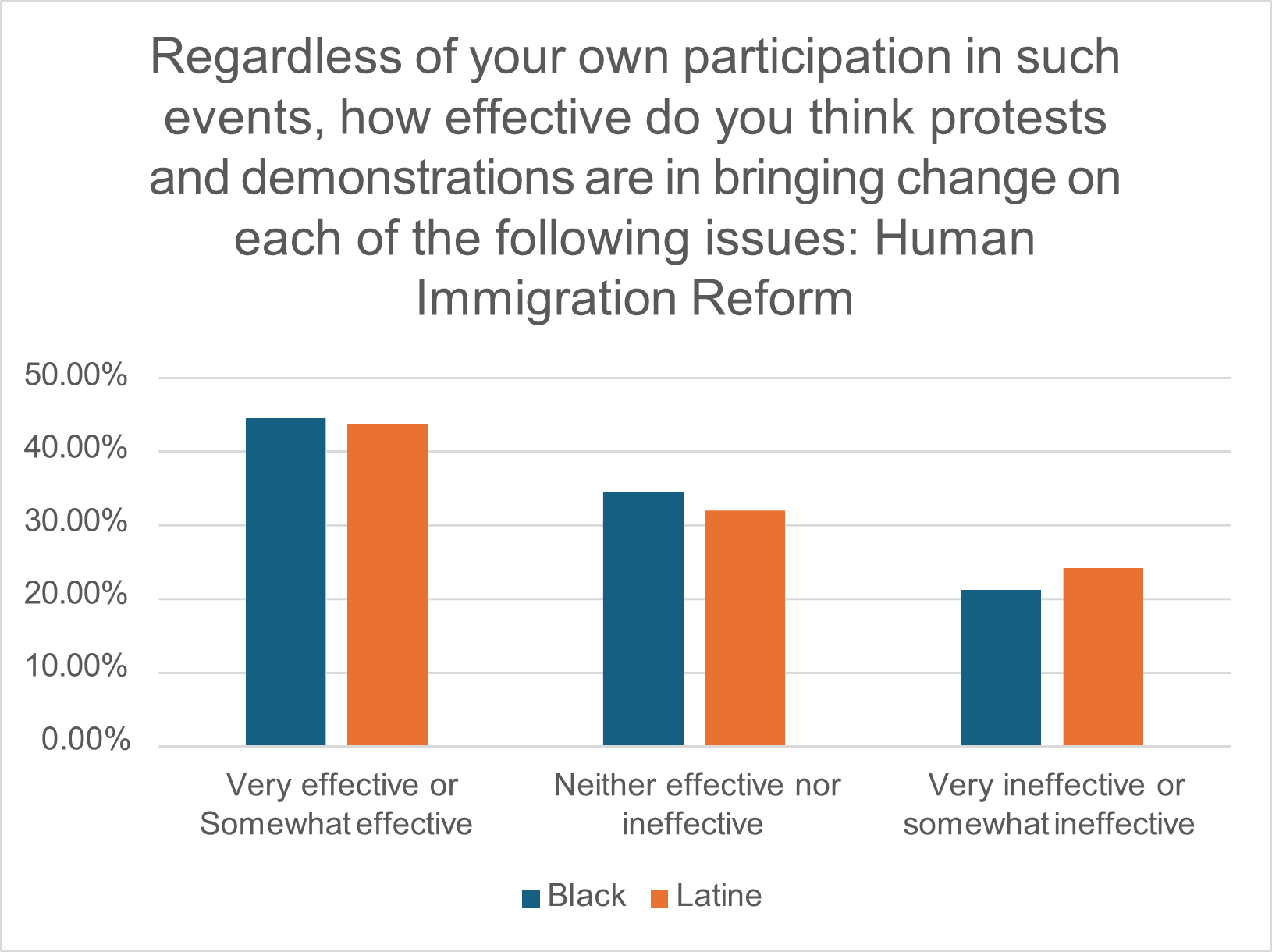
When asked whether protests and demonstrations in support for humane immigration reform are effective or ineffective, Black people (44.4%) are just as likely as Latino (43.8%) to agree that these protests are effective.
Source: 2020 Collaborative Multiracial Post-Election Survey
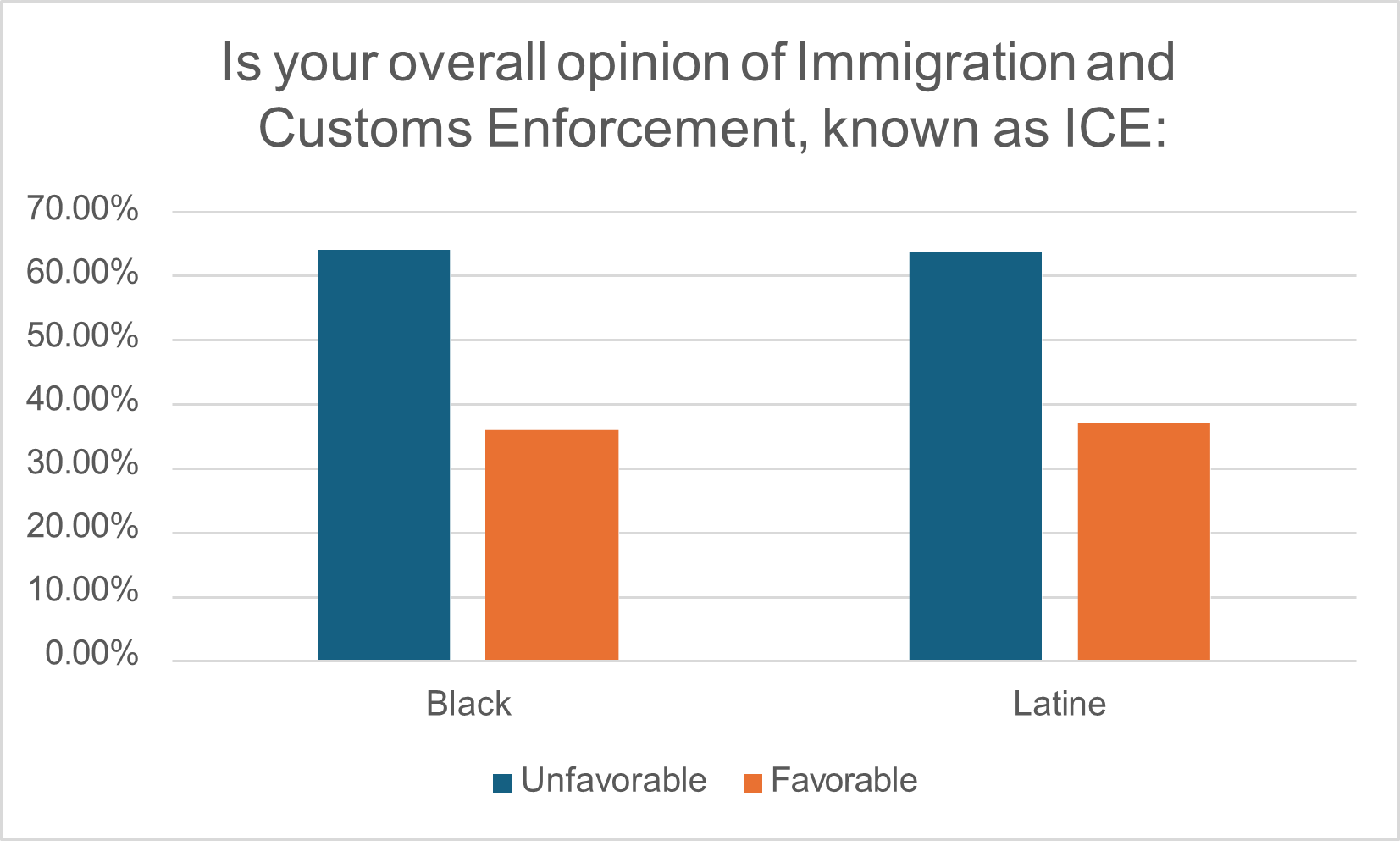
Additionally, Black (64.1%) people view ICE just as unfavorably as Latino people (63.7%). This data reveals strong solidarity from Black people when it comes to the handling of immigration enforcement in the United States.
Source: 2020 Collaborative Multiracial Post-Election Survey
As the demographics shift in the United States point to a majority minoritized population, it is important for both Black and Latine communities to realize the potential political power this growth brings. While neither Black nor Latine folks individually will be a majority, the combination of various minoritized communities will outnumber White Americans by 2045. The data from the 2020 survey shows that both Blacks and Latinos understood the racial implications of police and immigration officials on their communities. However, this was less so for Latinos on all three measures. As the Trump administration continues to target Brown folks indiscriminately, even formally suggesting that “physical appearance” can be used to determine which individuals are kidnapped regardless of actual citizenship status, we may be seeing the beginning of a new era of racial consciousness among Latinos.
While some Latinos have historically benefitted from or aligned with whiteness when it served them socially or politically, they have also struggled with deep anti-Black attitudes. These recent immigration tactics may help Latinos see that their own racial oppression at the hands of the state mirrors the struggles African Americans have faced for decades. This is an important moment towards solidarity given that both Latinos’ proximity to whiteness and anti-Black attitudes, as well as economic concerns, partly contributed to the 8 percent increase in support for Trump between 2020 and 2024. Ultimately, while Trump’s immigration strategies have intensified cruelty, fear, and division, they may be inadvertently creating a racial consciousness that will benefit Black and Latino solidarity and allyship for generations to come.
Editor’s note: This post has been updated in consultation with the authors on March 20, 2026, to revise a reference to an individual in light of information about harm that has since come to light. The edit does not change the authors’ original analysis.
About the authors:
Dr. Chaya Crowder is an Associate Professor at Loyola Marymount University in the Department of Political Science and International Relations. She is an Associate Professor at Loyola Marymount University in the Department of Political Science and International Relations. She received her PhD from the Department of Politics at Princeton University where she also received certificates in African-American Studies and Gender and Sexuality Studies. Chaya’s research and teaching interests include political behavior, race and ethnicity politics, social media and American politics as well as gender and American politics. She uses an intersectional approach in her research to explore the ways that attention to race, gender and sexuality have differential effects on political behavior. Her dissertation, entitled “Intersectional Solidarity and Public Opinion: The Impact of a Political Consciousness of Race, Gender and Sexuality on Political Behavior” explores how consciousness of the intersection of racial discrimination and gender discrimination impacts evaluations of marginalized groups. Chaya develops a theory and measurement of what she calls “intersectional solidarity,” which is defined as awareness and distress over multiple subgroups’ oppression.
Dr. Claudia Sandoval is an Assistant Professor at Loyola Marymount University in the Department of Political Science and International Relations. She earned her B.A. in Political Science from the University of California, Los Angeles. She received her M.A. and Ph.D. in Political Science from the University of Chicago with concentrations in American politics and race and politics. Her dissertation, “Conjuring Immigrant Racial Threat Narratives: Using Citizenship Status to Shape Black-Latino Relations in US Politics,” examines the plight of Blacks and Latinos for inclusion in the U.S. and analyzes how the contentious discourse around citizenship – particularly the anti-immigration narrative – has been used to strategically divide these two groups. During the 2014-2015 school year, Dr. Sandoval was a Chancellor’s Postdoctoral Research Associate at the University of Illinois at Urbana Champaign, where she taught “Latino Politics.”
Note: Dr. Claudia Sandoval provided a Spanish translation of this blog post as follows:
Solidaridad Entre Afrodescendientes y Latinos En Contra de ICE
Por. Chaya Crowder and Claudia Sandoval, Departamento de Ciencias Políticas Y Relaciones Internacionales; Loyola Marymount University
A nivel nacional, más de 56,000 personas han sido detenidas por el Servicio de Inmigración y Control de Aduanas (ICE) desde la toma de posesión de Donald Trump en enero de 2025. Las redadas migratorias se han dirigido contra la comunidad Latina en espacios públicas como parques, paradas de autobús, lugares de trabajo, y en estacionamientos de tiendas donde suelen encontrarse trabajadores jornaleros. Se ha secuestrado y arrestado a personas sin causa u ordines judiciales. En Los Ángeles, California, se ha registrado un número particularmente elevado de redadas, arrestos y secuestros dirigidos contra inmigrantes mexicanos y centroamericanos. En respuesta a estos arrestos en junio del 2025, se produjeron protestas masivas y sostenidas contra las redadas de ICE en el centro de Los Ángeles. Si bien muchos podrían asumir que estas redadas migratorias son solo un “problema Latino”, muchos líderes y organizaciones afrodescendientes se han solidarizado con la comunidad inmigrante y Latina.
Líderes afrodescendientes como Melina Abdullah, de Black Lives Matter, han expresado abiertamente su oposición a ICE y su apoyo a las comunidades inmigrantes. Organizaciones de derechos civiles afrodescendientes, como la NAACP y la Red de Acción Nacional, emitieron declaraciones en solidaridad con las comunidades inmigrantes. Estas recientes muestras de solidaridad forman parte de una larga historia de unión para la justicia racial entra las comunidades afrodescendientes y latinas. Aun así, históricamente los medios de comunicación destacan la frágil alianza entre las personas afrodescendientes y latinas, así como las tensiones que han existido entre estas comunidades. De hecho, a algunos les preocupa que estas coaliciones solo existan estratégicamente entre los políticos y no representen el sentir de la gente común. Con esto en mente, examinamos los resultados recientes de la Encuesta Colaborativa Multirracial Postelectoral de 2020 para demostrar que la solidaridad afrodescendiente y latina en torno a los problemas de inmigración sigue siendo sólida.
Las Raíces de Solidaridad Afrodescendiente y Latina
La solidaridad afrodescendiente y latina se consolidó en las décadas de 1970 y 1980 con la ola de protestas por los derechos civiles que se desarrollaban en los Estados Unidos para exigir igualdad y condiciones laborales justas. En Los Ángeles, el movimiento Chicano se inspiró en gran medida en el Partido Pantera Negra de Autodefensa, ya que los Boinas Cafés protagonizaron muchas de las huelgas que tuvieron lugar en el Este de Los Ángeles. En Chicago, la Coalición Arcoíris se unió con la ayuda del Partido Panteras Negras, la Liga de Jóvenes Caballeros, y la Organización de Jóvenes Patriotas. Fue durante este período que la conciencia política y el conocimiento sobre el racismo sistemático crecieron en cada una de las comunidades, especialmente entre los jóvenes. Mientras organizaciones como United Farm Workers (UFW) lograron organizar a los trabajadores agrícolas, los Boinas Cafés crearon una narrativa en torno a la desigualdad estructural que ayudó a las generaciones más jóvenes a desarrollar una comprensión más crítica de la discriminación y su impacto en otras comunidades de color.
Solidaridad Afrodescendiente y Latina Hoy
Para explorar hasta qué punto las personas afrodescendientes y latinas continúan sintiendo solidaridad entre sí, utilizamos la Encuesta Colaborativa Multirracial Postelectoral (CMPS) de 2020. La CMPS es única por su naturaleza colaborativa. Más de 200 académicos de 100 universidades diferentes contribuyeron a su instrumento de encuesta. El CMPS es particularmente útil para los fines de esta investigación, ya que sobre muestrea a los encuestados afrodescendientes y latinos. Hay un total de 4071 encuestados afrodescendientes y 3529 latinos. También examinamos el apoyo y la oposición de las personas afrodescendientes y latinas al ICE.
Para examinar la solidaridad entre estos dos grupos, analizamos hasta qué punto las personas afrodescendientes y latinas creen que, en lo que respecta al trato que la policía da a las personas afrodescendientes y a los inmigrantes latinos por parte de los funcionarios de inmigración, estos funcionarios tienen sesgo racial. Descubrimos que la mayoría de las personas afrodescendientes (70%) y latinas (54.7%) considera que este trato tiene sesgo racial.
Cabe destacar que las personas afrodescendientes son significativamente más propensas a considerar el trato a ambos grupos como un sesgo racial. Esto podría deberse a su comprensión del racismo sistémico en el contexto estadounidense.

2020 Collaborative Multiracial Post-Election Survey
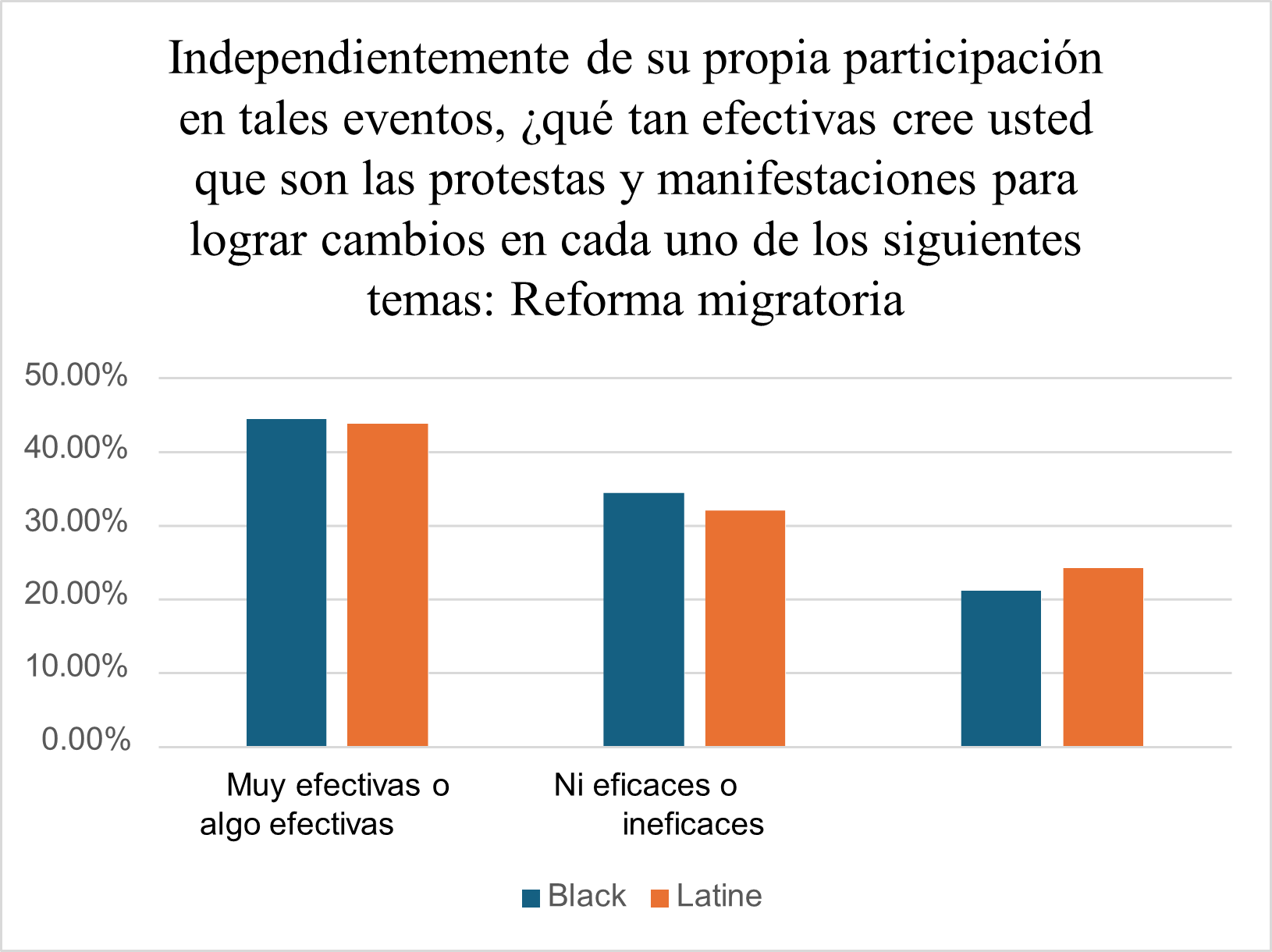
Al preguntarles si las protestas y manifestaciones en apoyo a una reforma migratoria humana son efectivas o ineficaces, las personas afrodescendientes (44.4%) tienen la misma probabilidad que las latinas (43.8%) de estar de acuerdo en que estas protestas son efectivas.
2020 Collaborative Multiracial Post-Election Survey
Además, las personas afrodescendientes (64.1%) tienen una opinión tan desfavorable de ICE como los latinos (63.7%). Estos datos revelan una fuerte solidaridad entre personas afrodescendientes con respecto a cómo se aplica la ley migratoria en Estados Unidos.

2020 Collaborative Multiracial Post-Election Survey
A medida que el cambio demográfico en Estados Unidos apunta a una población mayoritariamente minoritaria, es importante que tanto las comunidades afrodescendientes como las latinas se den cuenta del poder político que este crecimiento conlleva. Si bien ni las personas afrodescendientes ni las latinas individualmente constituirán una mayoría, la combinación de diversas comunidades minoritarias superará en número a los estadounidenses blancos para 2045. Los datos de la encuesta de 2020 muestran que tanto las personas afrodescendientes como las latinas comprendían las implicaciones raciales de la policía y los funcionarios de inmigración en sus comunidades. Sin embargo, esto fue menos evidente para los latinos en las tres medidas. Mientras la administración Trump continúa atacando indiscriminadamente a las personas de color, incluso sugiriendo formalmente que la “apariencia física” puede usarse para determinar qué individuos son secuestrados, independientemente de su estatus migratorio, podríamos estar presenciando el comienzo de una nueva era de concientización racial entre los latinos.
Si algunos latinos históricamente se han beneficiado o se han alineado con una jerarquía blanca cuando les ha beneficiado social o políticamente, también han lidiado con profundas actitudes anti-afrodescendientes. Estas recientes tácticas migratorias podrían ayudar a los latinos a comprender que su propia opresión racial a manos del estado refleja las luchas que los afrodescendientes han enfrentado durante décadas. Este es un momento importante para la solidaridad y unión entre los dos grupos, dado que tanto la proximidad de los latinos a la blancura como las actitudes anti-afrodescendientes, así como las preocupaciones sobre la economía, contribuyeron al aumento del 8% en el apoyo a Trump entre 2020 y 2024. Si la estrategia migratoria de Trump se basa en la crueldad, el miedo y la división, podría estar creando inadvertidamente una concientización racial que beneficiará la solidaridad y la alianza entre personas afrodescendientes y latinas para las próximas generaciones.