“The Deep End”
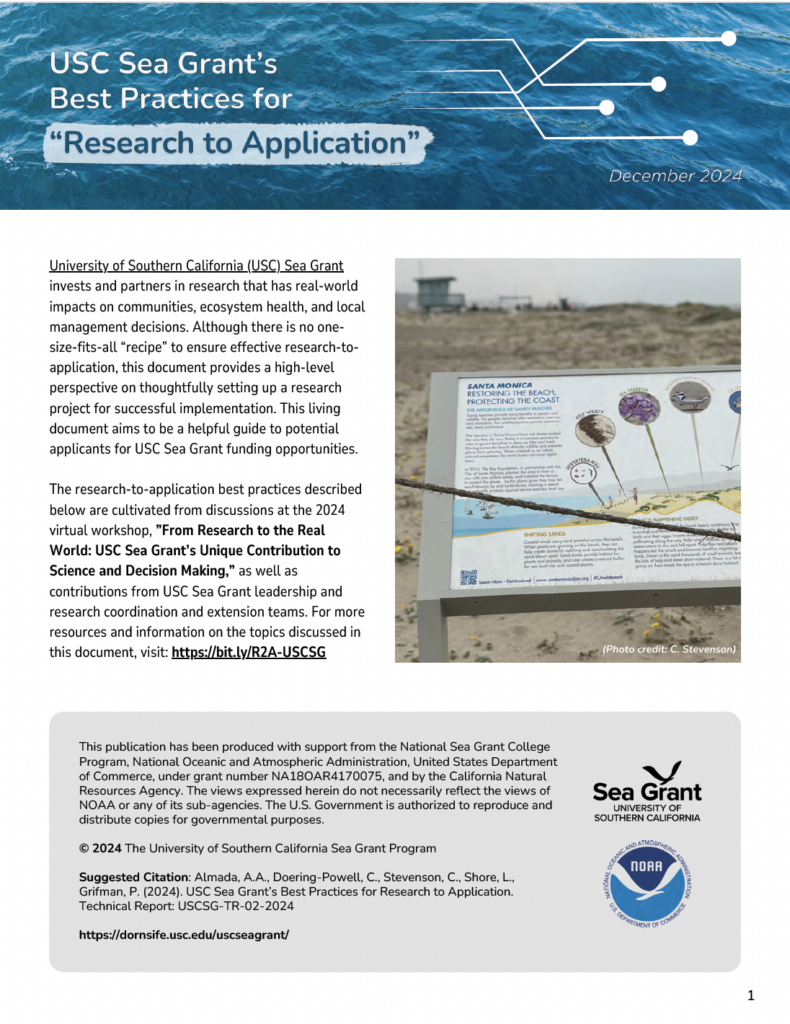
Charlie Doering-Powell worked on our USC Sea Grant’s Best Practices for Research to Application Guide.
“How do you feel about being thrown into the deep end this summer?” This was a real question I received leading up to the summer of 2024 from the mentor I’d been working with for the past year, as a result of securing the USC Wrigley Environmental Communications internship in the summer of 2023. The question came from Dr. Amalia Almada, Science, Research and Policy Specialist at USC Sea Grant, a federal-university partnership that has been at USC for over 50 years.
I’m so grateful to have been given the opportunity to work with USC Sea Grant far beyond the expected duration of my summer internship, but I have to admit, reading that sentence sent real chills down my spine. “Not great,” I thought to myself, but I trusted Dr. Almada and I trusted my abilities, so what’s the worst that could happen? And, to be fair, she did attach an upside-down smiley emoji at the end of the question. Definitely less daunting.
Dr. Almada asked me later in the email how I’d feel about taking on more of a project management role in relation to compiling conference proceedings from a webinar that USC Sea Grant held earlier in the year: the “From Research to the Real World Workshop.” I had truly zero experience in a project management role, no prior knowledge of what the conference actually pertained to, and (most importantly) no idea what conference proceedings were. After some googling, though, I got the gist. I got the run-down from Dr. Almada as to what her expectations were and some jumping off points for me to get started, and then I hit the ground running.
I watched the recording of the conference. And then I watched it again. And again. And plenty more times over the course of the summer. In the peak of my work, I could have told you the exact order in which the researchers presented their projects, forward and backward. My first watch was simply to take detailed notes on the projects and what they achieved. The second watch was specifically for combing through to find any and all of the practices that each of the presenters mentioned that helped them translate their research into real-world applications (termed “best practices” as I learned). The third watch and beyond helped me verify certain details I wrote down, searching for any missed best practices, and looking for visuals to grab that could be helpful to include in the final document.
It took many, MANY iterations and brainstorming sessions with my mentor and lots of feedback from other USC Sea Grant researchers, educators, and communicators to help finalize the document. We started by grouping best practices together that served the same end purpose (in the end, divvying up the list into three sections: How to Scope a Project, How to Produce Results, and How to Share Findings) for ease of comprehension and to mirror the natural progression of a research project from start to finish.
I wrote, edited, and submitted the working document to Dr. Almada and other Sea Grant staff over and over and over. We ideated on very granular details, like the specific language we wanted to use in reference to practices or projects, which case studies we felt would add the most helpful context to the sections (if any at all), and if we wanted to include any visuals or graphics to explain our document visually. From my previous science communication work, I knew the document and the information enclosed needed to be succinct and straightforward without leaning too “technical,” steering away from jargon, so the granular work was necessary.
It truly was a crash course for me. With the sheer number of iterations, edits, and re-writes we did over the course of the project, I definitely learned the value of stepping away from my work and coming back later with fresher eyes. It’s easy to get caught up in the minutia of projects (especially as a self-proclaimed perfectionist), but taking a break truly helped me reframe my mindset and come back with new ideas that helped immensely in advancing the document. I learned mountains about how to write in scientific contexts over the year prior, but I found myself refining my science writing skills even further as a contributor to this project (especially in a managerial-type role), which was wholly rewarding.
I learned even more about the importance of reaching out to those around me when I needed help, had questions, or wanted advice regarding any part of the project. In the beginning, I assumed that, since I was coming at this project from a managing role, I’d be expected to be hyper-independent in my work, which simply isn’t the reality of the majority of working roles (but ESPECIALLY as an intern). I learned so much about the type of role I was undertaking by reaching out to my mentor and other colleagues – in fact, it gave me a renewed sense of independence by the end, regarding how I can manage projects in the future.
Most importantly, though, I learned a lot about exactly how fear surrounding an assignment or project can (and arguably should) be reframed as being a learning opportunity, and that growing as a professional requires getting uncomfortable in your position and learning on the job. I’m so proud of myself for how I performed from start to finish as a contributor to the final document, and I’m really looking forward to similar opportunities in the future. So much so that I don’t think I’d need to be thrown into the deep end – I’d happily jump in again and again to continue growing and honing my skills.