
Wealth out of Waste
I first discovered University of Southern California Sea Grant (USCSG) through a course I took on campus, California Coastal Zone Analysis. As part of the class, I delivered a 15-20 minute presentation on USC Sea Grant, and in the process, became deeply inspired by its wide range of science-driven initiatives. Most importantly, I was drawn to the organization’s unique role in bridging the gap between government policy and community action. Therefore, when I got an email in my inbox titled “USC Sea Grant Marine Plastics Intern Application,” I immediately grabbed the opportunity with both hands. Since joining the team, I’ve gained invaluable skills that have deepened my understanding of environmental outreach and strengthened my leadership skills.
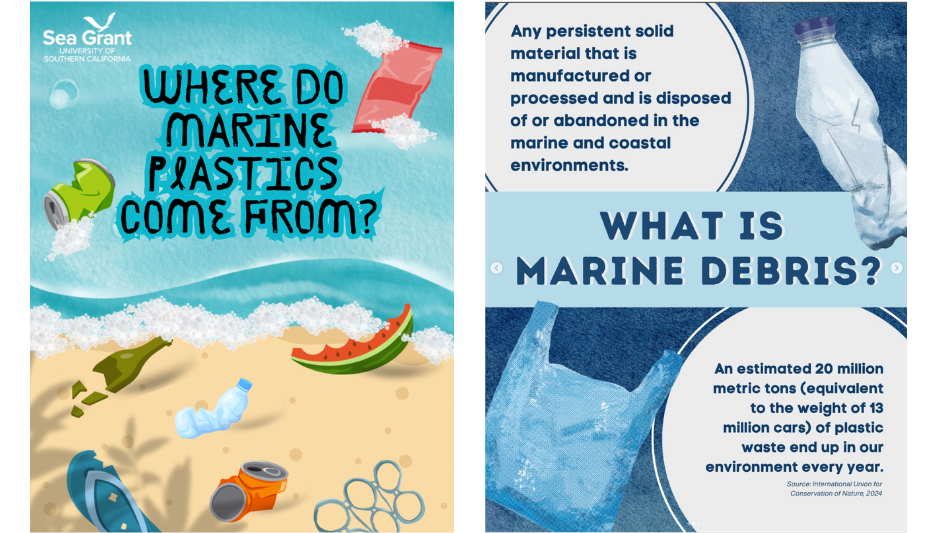
This position allowed me to experience the best of both worlds—gaining hands-on experience through a federally funded university partnership with Sea Grant, while also working with a nonprofit organization, Heal the Bay. For my USCSG work, my main responsibilities included creating educational outreach materials and writing a blog post about the problem of marine debris in our Los Angeles oceans. I experimented with different designs and levels of communicative complexity to cater to a large variety of audiences. In addition to outreach, I was also in charge of collecting and transporting plastic samples to Dr. Williams’s lab on USC’s campus, where they are working on a project in partnership with USC Sea Grant that works on converting waste into wealth. The lab is in the process of creating a methodology to take the energy and carbon that is trapped in marine plastics to feed microbes that create the enzymes and proteins we use in laundry detergents and blue jeans dye.
This brings me to the second part of my internship. In order to collect these materials for experimentation, I needed to help host and attend beach cleanups that Heal the Bay organized. Specifically, I helped host two of their “Nothin’ But Sands” beach cleanups for the months of March and April (Earth Month). These experiences taught me a great deal about collaboration, leadership, and volunteering. My primary duties included setting up the different supplies, separating recyclables from the waste, and educating the volunteers on the dangers of microplastics through talks.

The beach cleanups turned out to be the most memorable parts of my internship because of the heartwarming participation by the LA community. To my surprise, during our March cleanup, we had an astonishing 327 passionate volunteers who were all there to improve the health of our Los Angeles coasts. This participation was even more impressive during Earth Month (April) when so many companies, schools, and LA residents were eager to show their love for our planet. As a result, we were able to garner the support of 901 participants to help clean up the Santa Monica beach after the devastating wildfires in LA. From both of these cleanups combined, Heal the Bay was able to collect a total of 580 pounds of debris that would have otherwise ended up in the ocean or inside a marine organism. The satisfaction of seeing the real-life impact of our actions, conversing with like-minded individuals, and raising awareness of environmental issues with the next generation is something that I will cherish even after this internship ends.

Throughout these experiences, I have a newfound appreciation for the role of scientific communication and local-level initiatives. I have always assumed that broad scope national level initiatives is where “real” environmental work happens, however now my eyes have opened to the many different levels of environmental action and how these actions supplement large-scale policy. These regional organizations, like USCSG or Heal the Bay, are great examples of places that can really connect to the local community and gauge how the average resident feels about their local coasts and environment. Overall, I am extremely grateful for the opportunity to have a lead role in an internship position that was able to merge science and social science for the betterment of our planet.