Pornpailin (Pauline) Meklalit
How did you become interested in the EASC Graduate Fellowship?
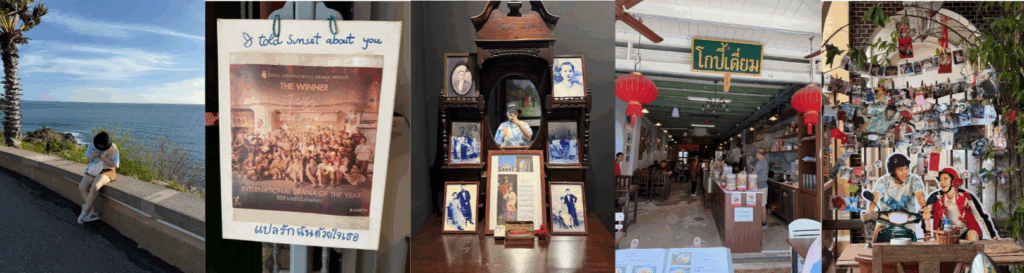
I became interested in the EASC Graduate Fellowship because it perfectly aligns with my growing interest in East and Southeast Asian media flows, especially the rise of cross-regional media tourism shaped by Thai Boy’s Love (BL) series. My earlier research, inspired by the paper I wrote for the Local/Global Asia: Tourism, Travel, and Modernity class, led me to see the need for on-site fieldwork in Phuket to understand how media-induced tourism functions as a form of secular pilgrimage. The fellowship’s emphasis on supporting Asia-focused research makes it an ideal opportunity for me to deepen this project.
What is your research focus?
My research explores the intersection of media, tourism, fan practices, and rituals, especially how contemporary East and Southeast Asian popular culture, like Thai BL series, creates new forms of secular pilgrimage. In this paper, I analyze how fans and tourists interact with filming locations through practices, spatial rituals, and affective performances, and how these activities reshape and redefine notions of authenticity, sacredness, and belonging in a post-religious era. My work also aims to contextualize these practices within broader transnational cultural flows, examining how media from countries like Thailand circulate regionally.
In what ways did the EASC Graduate Fellowship impact or help your research?
The EASC Graduate Fellowship helped advance my research by first enabling a short but intensive ethnographic trip to Phuket, where I visited key filming locations. Being physically present in these spaces allows me to observe how tourists and fans interact with them in real time. Feedback from the academic conference that I attended just before the trip, supported by the fellowship, helped me refine the conceptual tensions between religious and secular “pilgrimage.” This shaped the guiding questions for my fieldwork and pushed me to refine my analysis of ritual, authenticity and spatial practices. The fieldwork unexpectedly revealed the ambiguity between tourism and fandom within Phuket’s heavily commercialized, heritage-rich environment. This led me to consider new questions about authenticity, sacredness and how to distinguish pilgrimage from travel.
Can you share any anecdotes about your fellowship experience?
Of course! One memorable aspect of my fellowship experience was that my mother and sister-in-law tagged along with me during this trip. Balancing family interactions while conducting research created unexpected moments of negotiations, especially when I needed to maintain focus on observations while they were approaching the trip with a tourist mindset. This contrast actually became analytically productive that the boundaries between leisure and devotion are much more blurred than I anticipated. As I moved between heritage sites and filming locations, I found myself unable to distinguish where fan pilgrimage ended and general tourism began. Watching my mother and my sister-in-law engage with the sites as tourists highlighted how easily these modes overlap in real life.