Center Research Fellow Victoria Sanford presents on forced disappearances during the Guatemalan genocide
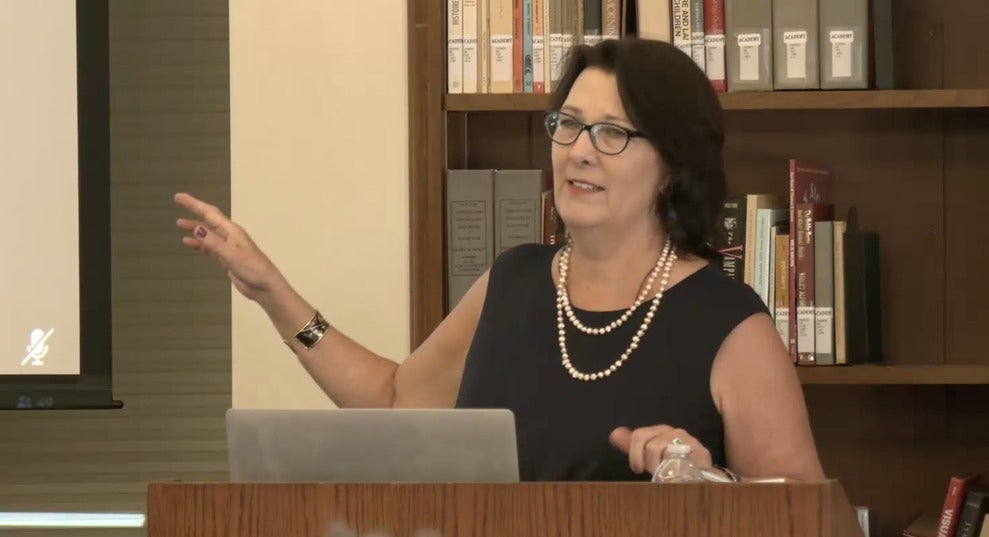
On April 9, 2025, Victoria Sanford, Lehman Professor of Excellence in Anthropology (Lehman College and the Graduate Center, City University of New York) and 2024-2025 Center Research Fellow at the USC Dornsife Center for Advanced Genocide Research, gave a public lecture at USC about her research on the Guatemalan genocide. In this lecture, she shared the story of Dr. Marvyn Perez, one of 5,000 children abducted during the 1980s, to address documentary evidence and historical memory surrounding the genocide.
Professor Sanford began with a brief overview of her research trajectory as a preface to the discussion of her current project. She began studying the genocide in 1994, when she worked with the Forensic Anthropology Foundation of Guatemala during the exhumation of one of the first clandestine cemeteries in Guatemala. Her work with the Foundation became the basis for her first book Buried Secrets: Truth and Human Rights in Guatemala (2003). Coincidentally, the book was published the same year that General José Efraín Ríos Montt, the Guatemalan dictator responsible for unprecedented levels of violence during the genocide, was up for reelection.
Professor Sanford then introduced her current project, “Friends Who Disappear,” which examines the forensic evidence and public memory of forced disappearances in Guatemala. Disappearances began to occur in the mid-20th century, but the first mass disappearance did not happen until 1966. In 1966, 28 members of the Guatemalan Labor Party (PGT) were disappeared as part of Operación Limpieza. To eliminate the left’s political participation in the government, the military, paramilitaries, and police worked together to carry out the abductions under the pretext of terrorism. The Guatemalan government denied any involvement or knowledge of the disappearances and did not pursue any course of action despite promising to do so.
The abductions and subsequent executions, however, are corroborated by declassified CIA reports that explicitly state that Guatemalan authorities had secretly executed communists and terrorists. As an aside, Professor Sanford mentioned that this and other documents she would reference during the talk can be found in the National Security Archives as well as USC’s Special Collections.
Professor Sanford next turned her attention to Dr. Marvyn Perez, one of 5,000 children who were disappeared by the authorities during the genocide. Marvyn and his two sisters were abducted in 1982 after Marvyn was found to be involved in a student organization that advocated for equal access to education. After distributing leaflets with friends, he was apprehended by national police in a coordinated mass abduction of 16 Guatemalan students. Marvyn and his friends were subjected to days of torture before police handed them over to the death squad who would transfer them to a clandestine jail.
Relatives of the disappeared children formed organizations such as the Families of the Disappeared, the Mutual Support Group, and the Association of Families Detained to search for the missing and protest the disappearances. In addition to the organizations’ protests, media coverage brought increased attention to the disappeared students. Marvyn’s father, who worked at the newspaper El Imparcial, informed a reporter of his missing children. Public outcry grew as the stories – without identifying bylines (to protect the authors) – began to appear more regularly despite censorship laws.
This prompted General Rios Montt to respond with an amnesty decree on June 1, 1982. However, the announcement was quickly followed by a message stating that those who refused to surrender would be executed. 13 of the 16 children who had been abducted were eventually released after continued public outrage, increased media coverage, and mounting pressure from various government factions.
Professor Sanford then shared another declassified report, which explicitly addresses the release of the children, sent by the U.S. Embassy in Guatemala to the U.S. Secretary and Department of State. The report questions the decision to abduct (rather than arrest) the children but notes that the students were not killed and are now in the custody of their parents. Yet, the report makes no mention of the three children who remain missing to this day.
The story of Marvyn Perez and his sisters is notable not only because of their survival. In addition to the now declassified documents, Marvyn’s testimony reveals the chain of command and joint action required to carry out these abductions. Importantly, Professor Sanford argued, this is further verified by the “regurgitation” of the disappeared via the very administrative system that had kidnapped them. As such, she argued that the Guatemalan government is responsible in a myriad of ways including the commission and tolerance of the crimes as well as the refusal to investigate, prosecute, and sanction those responsible. The Truth Commission in Guatemala states that roughly 200,000 people are dead or were disappeared as the result of the genocide. Roughly 5,000 of them were children.
Professor Sanford closed with photographs from a march in 1986, when people protested the disappearance of their loved ones. She commented that Guatemalans continue to protest and that Marvyn carries on the fight for justice in both the Guatemalan and Inter-American courts. While the process has been arduous, Professor Sanford said she is hopeful about finding justice in the Inter-American Court of Human Rights.
Discussion stemming from the Q&A addressed the conditions for the childrens’ release as well as distinctions between rural and urban communities. In response, Professor Sanford noted that the disappearance of Spanish-speaking Indigenous people was a calculated move intended to prevent political organizing. These individuals often held the role of interlocutors in their respective communities, and massacres frequently happened once those people could no longer serve as intermediaries between their communities and the authorities. The discussion ended with a question about what justice might look like for both individuals who have never returned and those who have.
Read more about Professor Victoria Sanford here.