Outfox an island fox? It might be harder than you think
Original story by Ileana Wachtel
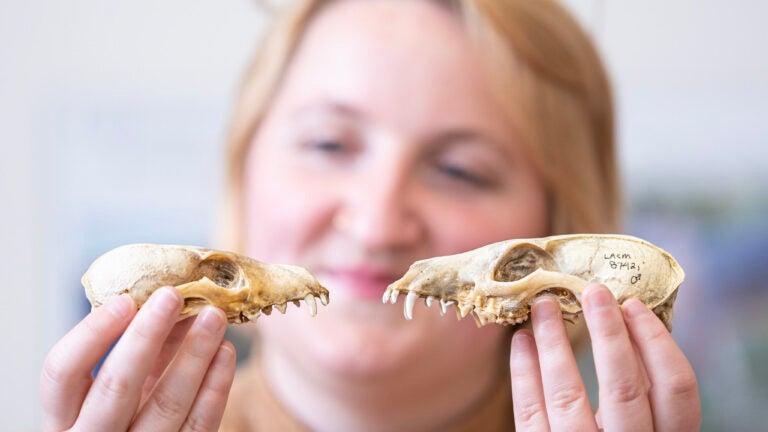
For decades, scientists believed animals on islands evolved smaller brains relative to body size to save energy. But most Channel Islands foxes — tiny predators no bigger than a house cat – defied that rule, evolving larger brains than their mainland cousins.
These findings, published in PLOS One by researchers at the USC Dornsife College of Letters, Arts and Sciences, suggest brain size may hinge less on isolation and more on the demands of survival.
Island syndrome refers to a suite of traits including reduced size, brain shrinkage, loss of flight in birds and tamer behavior. Until now, island brain size has been mainly studied in fossils of herbivores, which face different pressures than carnivores. The island fox provided an opportunity to bridge that research gap.
Lead author Kimberly Schoenberger said the results upend long-held assumptions about how animals adapt to island life. “It was most surprising to discover that island syndrome isn’t one-size-fits-all,” said Schoenberger, a PhD candidate in biology. “When we looked at carnivores like Channel Island foxes, the pattern of smaller brains didn’t hold.”
Channel Islands offer a natural experiment
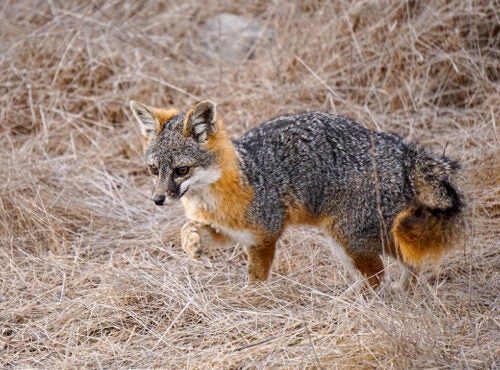
The Channel Islands, an eight-island chain off the California coast, six of which are home to foxes, offered researchers a rare natural experiment to test whether island syndrome holds true across environments. The biologists compared the brains of foxes from those six islands with mainland gray foxes — their closest living relatives and likely ancestors — as well as with one another.
The analysis revealed that the brain-to-body ratio appeared to be shaped less by isolation or island size alone — long thought to drive island syndrome — and more by local habitat conditions.
On five of the islands — Santa Cruz, Santa Rosa, Santa Catalina, San Clemente and San Miguel — foxes had relatively larger brains despite their smaller bodies. Their brains also showed slightly deeper folds and ridges in areas tied to motor control and spatial processing, traits that may help the foxes navigate rugged terrain and compete for food and shelter, especially on two islands where they share space with rivals like the spotted skunk.
San Nicolas Island, the most remote and resource-limited of the six, was the exception. There, foxes had smaller relative brain sizes. With no predators, little biodiversity and limited food, researchers believe the animals faced fewer cognitive demands and may have conserved energy for basic survival rather than retaining traits like enhanced motor coordination or spatial processing.
“The Channel Island foxes show that brain size reduction is not a universal feature of island life,” Schoenberger said. “It depends on the pressures each species faces.”
This study was funded by the Offield Family Foundation through the USC Wrigley Institute, and by the USC Women in Science and Engineering Graduate Fellowship.
Read the full story on USC Dornsife news >>
Learn more about Wrigley Institute research >>
Related Stories
Earth.com: Island foxes evolved bigger brains to help them survive >>
Collaboration is the lifeblood of island fox research >>
Wrigley Institute experts seek to save threatened species >>
USC, Natural History Museum collaborate on island fox research >>