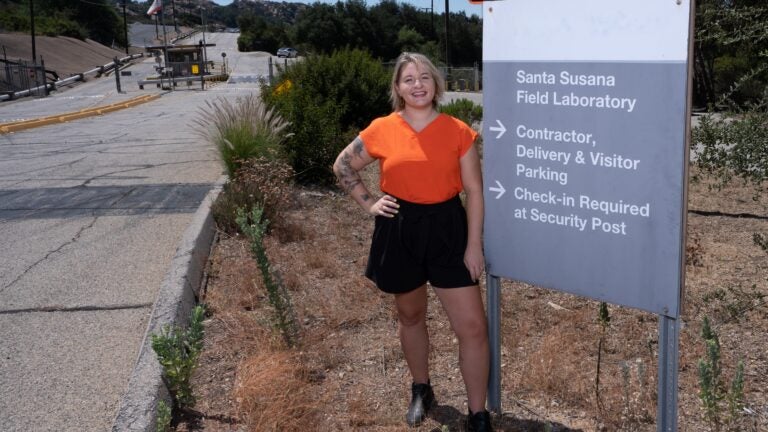
2025 Wrigley Institute Graduate Fellow Jenna Blyler spent this summer working on two distinct projects. The first project was a health risk study focused on the residents of wealthy communities near the Santa Susana Field Laboratory Superfund site (one of the most contaminated sites in the U.S. due to decades of nuclear and chemical activity) to understand how they perceive risks and how they protect themselves. The second was a climate terminology study which examined whether responses to “climate justice” might be more favorable among residents of climate-impacted and Democratic-leaning Los Angeles County, especially low-income residents who would stand to benefit the most from climate justice initiatives (Nick Neumann/USC Wrigley Institute).
Familiar harms, familiar terms
Since visiting the Georgia Aquarium this summer, I’ve wanted to call something in my line of work orange cup coral. The acidic orange animal is considered invasive, which means it spreads more than it should, and if permitted, overruns native plants and animals. Its encroaching style and doomy color were immediately familiar not because I study marine life, but because I study risk. I’d seen that same shade on atomic-age comics, on the hazmat suits I wore most of this strange summer, on various warning labels, and on nearly every cancer heatmap and emergency document I’ve encountered in my research. I saw it again, more personally, on the mementos of a retired aerospace engineer. But I don’t think I would have recognized it as a color of risk if not for a local poet’s contagious preoccupation with the Santa Susana Field Laboratory (SSFL), one of the country’s earliest rocket and nuclear test sites turned Superfund¹.
I said it was a strange summer. I got a tattoo in a church, ordered pizza at a hotdog stand, caught my hair on fire, and wrote about plants that mine metals. But if “strange” to you means “unfamiliar” rather than “ill-fitting,” then none of it was all that strange. Radiation is something I think should be strange to people in the “unfamiliar” sense of the word. But people near the SSFL live in an environment that was exposed to more than 400 times the Cold War-era radiation of Three Mile Island²; and know it. The closer you get to the neighborhood on the map, the darker the cancer clusters appear in, you guessed it, orange cup coral. Odd, then, for some of America’s wealthiest families to live near a place so punishing, but they do. Recent calamities like the Titan submersible implosion or the rebuilding of homes in the Palisades fire zone make the question of how wealthy people perceive risk even more relevant. But it’s a hard question for psychologists to answer, since most risk research focuses on people with limited means.

With the help of a graduate fellowship from the USC Wrigley Institute for Environment and Sustainability, our lab took the SSFL as an opportunity to test whether a trusted risk model (one that predicts how likely people are to protect themselves) holds up in a wealthy context. And it does, mostly. We did find, however, that the wealthier someone is, the safer they think they are. As a result, they do less to avoid contamination. There’s more to it, but that’s the first paper I worked on this summer.
The second paper follows by asking whether this wealthier, possibly more influential group attempts to protect themselves in other ways, such as through lawsuits, advocacy, or even storytelling in Hollywood. Do they trust the government and those responsible for the cleanup? It’s a fair question, I think, since an extensive cleanup agreement was made nearly 20 years ago and not much has happened since. Recent changes at the EPA make the prospect of a proper cleanup even more uncertain, and the findings of these studies all the more pressing.
Psychologists have shown time and again that the words we use for the same subject can change how we feel and respond to it. That’s why I first described the hazmat suits and cancer heatmaps in orange cup coral rather than, say, atomic apricot or toxic tangerine. Alliterative names for the color orange might not demonstrate this point well enough so consider the terms “climate change” and “climate justice.” The first describes shifts in any weather over time. The second points to the people most harmed by those shifts.
If you’re like Los Angeles residents, (and you might be, since a national study reports a similar finding for most Americans) terms like “climate change” and “global warming” feel much more familiar than “climate justice” even though we all live in communities where record heat, floods, storms, or wildfires disproportionately affect poorer people. In our research, we found that Angelenos were not only unfamiliar with the term “climate justice,” but they also did not consider the issue concerning or urgent. When we looked at how income related to these responses, the only consistent difference we found between low income and high income residents was that high income residents were more supportive of climate policies, regardless of the language used. This could be because wealthier people feel they have more influence in society, or because poorer people are more concerned with putting food on the table than clunky stuff like carbon pricing³. Whatever the reason, it’s true that when communicators use familiar language like “climate change” and “global warming,” they have a better chance of motivating green attitudes and behaviors. Use what people know. That’s the third paper.

In a book I just finished⁴, poet Rainer Maria Rilke wrote that sickness brought on by an unfamiliar encounter can improve a writer, and that a writer should give in to it. Hemingway might have called this “the romance of the unusual.” This idea, along with the studies we’ve been working on, has me thinking about what we notice or ignore because it feels familiar, and why we so often confuse familiarity with safety. Like the families who live near the SSFL, each of us likely suffers a familiar harm and the question of what to do about it. With problems like these, I suppose it’s true that plain language helps us to name what’s going on and believe that change is possible. I can’t argue with that, but as a writer, I want to. Permit me to say that perhaps, every now and then, a writer’s duty is to offer their beloved reader an ill-fitting word like orange cup coral to make the familiar a little less so.
—–
¹ Superfund sites are hazardous waste sites that cause unacceptable risks to human health and the environment. The EPA identifies groups responsible for the pollution (which, in the case of the SSFL is Boeing, NASA, and the Department of Energy) and puts pressure on them to clean it up.
² In 1979 at the Three Mile Island nuclear plant in Pennsylvania, a cooling malfunction caused part of the core to melt in Reactor 2. Reactor 2 was destroyed and radioactive gases were released into the atmosphere. Though most health studies show that the radiation travelled a short distance from the plant and did not cause extensive or prolonged health problems for the public, it is considered by some to be the worst nuclear disaster in American history. This could be because Cold War-era secrecy concealed many of the incidents at the SSFL until the 90s.
³ Carbon pricing is a tool governments use to slow down climate change. Governments charge companies for the carbon dioxide they release and incentivize cleaner energy use. If you want to learn more about it, Dr. Joe Árvai and Dr. Aitor Marcos Diaz have some work on this.
⁴ Letters to a Young Poet.
—–
Jenna Blyler is supported by the Diane Sonosky Montgomery and Jerol Sonosky Graduate Fellowship for Environmental Sustainability Research