
2025 Wrigley Institute Graduate Fellow Jason Tuấn Vũ, a PhD candidate in the USC Dornsife Department of American Studies and Ethnicity, examines the relationship between war legacies and climate change in contemporary Vietnam (Courtesy of Jason Tuan Vu).
Not Over Yet: War, Climate, and the Future of Vietnam
On my first-ever research trip to Vietnam, I was confronted with two extremes. First, while staying in Saigon to visit historical landmarks related to the U.S.-Vietnam War, I experienced scorching hot temperatures that marked one of the warmest summers in Vietnam to date. Later, as I prepared to make my way to the capital city of Hanoi, I experienced a daylong delay in my flight caused by a major thunderstorm in northern Vietnam. I had come to Vietnam as an early PhD student to study the legacy of U.S. aerial warfare in Vietnam, but between sweltering heat and torrential downpour, I found my attention increasingly drawn from the wartime past to the present reality of environmental ruin that was unfolding right before my eyes.
When I returned home to the U.S., I became interested in knowing more about the impacts of global climate change in Vietnam. Upon further reading, I learned that Vietnam was ranked by the World Bank as one of the most climate vulnerable countries in the world, with inclement weather patterns that were becoming increasingly severe and unpredictable. Vietnam, for its part, was struggling to cope with the impact of these dire trends, all while continuing to pursue an aggressive agenda of economic development that was rendering the country even more vulnerable to natural disasters every year. Indeed, with record highs in temperature and rainfall being regularly set and broken, the impacts of climate change on Vietnam have shown no signs of slowing anytime soon.
Even as I spent more time researching contemporary environmental issues in Vietnam, I did not lose sight of my initial focus on the lingering consequences of the U.S.-Vietnam War. Indeed, the war’s ongoing impact has remained all too relevant as people continue to be maimed and killed by deadly toxins and explosives deployed over half a century ago. As much as I could not ignore Vietnam’s present climate vulnerability, I also could not forget how the violence of war was still reaching into the present. In fact, I soon came to realize that the country’s past and present of environmental degradation were actually more connected than I first anticipated.

On October 7th, 2020, central Vietnam was hit with the first of nine tropical storms that continued well through November. With high winds and torrential downpour, thousands of Vietnamese were forced to evacuate as record rainfall caused severe flooding and landslides. Alongside this destruction, the storms also brought about a lesser known consequence; as a result of soil erosion in Quang Tri and Quang Binh provinces, multiple unexploded ordnances dating back to the U.S.-Vietnam War were unearthed in close proximity to nearby communes. Fortunately, locals were able to work with mobile clearance teams to neutralize these explosives before they could cause any damage. Had these operations not been possible, the devastation caused by these storms could have been much worse.
When I first encountered this story, I was struck by how perfectly it captured where my mind was already heading: Vietnam was indeed entering into an increasingly precarious future, one where past and present forms of environmental ruin did not simply overlap but even exacerbated one another to the detriment of all forms of life. At the same time, the fact that these bombs were safely neutralized before causing any harm gave me a sense of hope; even in the midst of persisting military violence and environmental degradation, there was still something that could be done.
The hope I found in this otherwise worrying tale is what has driven me in my current work as a scholar of militarism, ecology, and development with a focus on postwar Vietnam. Inspired by the story of the unearthed explosives, my dissertation examines the intersection of war legacies and climate change in the context of postwar spaces such as former battlegrounds and bomb craters. In particular, I chart how these spaces have been revitalized and repurposed over time through the efforts of different local, national, and international actors. While recognizing the benefits that have resulted from such transformations in the land, I am also wary of how these processes are connected to Vietnam’s rapid development in years, a process that has brought about major economic growth while also bearing its own environmental consequences.
Between past and present forms of environmental ruin, my research would appear pretty bleak. Nevertheless, I have continued to find hope in my work through my visits to different postwar spaces and the encounters I have shared with those who live and work in them.
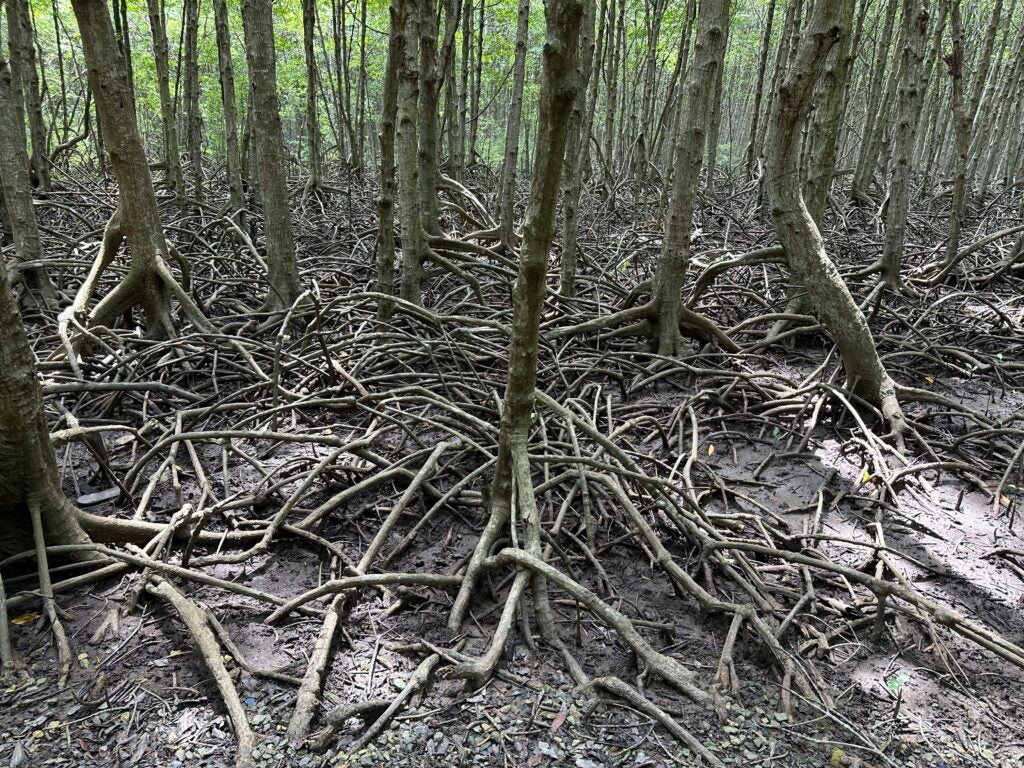
This summer, I have had the opportunity to return to Vietnam and visit Can Gio, a key hideout for Vietnamese communist forces during the U.S.-Vietnam War. In response to their presence among the area’s large mangrove forests, U.S. forces sprayed over 2.5 liters of the deadly chemical Agent Orange to clear out the dense foliage that served as cover for Vietnamese troops. By the end of the war, more than half of Can Gio’s once lush mangrove forests were completely decimated, leaving the area an arid shell of its former self.
Can Gio’s story did not end there, however. In 1980, local authorities pushed for the area’s revitalization by replanting mangroves and moving in wildlife such as monkeys and crocodiles from neighboring provinces. Through these efforts, Can Gio once again became a thriving ecosystem that was even designated Vietnam’s first Mangrove Biosphere Reserve by UNESCO in 2000. Beyond international recognition, Can Gio continues to serve as Saigon’s “green lung,” helping to manage some of the city’s infamous air pollution and acting as a natural barrier against storms and flooding. Indeed, as the picture above shows, Can Gio is no longer the barren wasteland that was left in the aftermath of the U.S.-Vietnam War; instead, its rich mangrove forests now serve as a crucial ecosystem that sustains local biodiversity while also providing protection from inclement weather and rising sea levels.
Along with going to Can Gio, I have also had the opportunity this summer to connect with PeaceTrees Vietnam (PTVN), a non-governmental organization that conducts demining operations in Quang Tri and Quang Binh provinces. Historically, these provinces experienced some of the worst violence of the war due to their proximity to the former Demilitarized Zone that once separated North and South Vietnam. Even after the war, they have continued to suffer greatly due to the ongoing presence of unexploded ordnances (UXOs) heavily concentrated in the area.
The work of PTVN remains vital to ensuring the safety of local communities still marked by the violence of war. At the same time, my studies this summer have allowed me to delve deeper into the adverse effect of climate change on the organization. Speaking with staff, I learned of how the growing unpredictability of weather conditions has hindered demining efforts in the past year, including floods and landslides that have prevented clearance teams from accessing their field sites.

In response to the impacts of climate change, PTVN has begun to adapt its activities to be more environmentally conscious. This has included everything from re-assessing the carbon footprint of demining activities to incorporating content on climate change into risk education programs on UXOs. Though relatively recent, PTVN’s growing environmental awareness is a heartening development especially as environmental protection in Vietnam becomes more and more necessary.
The impacts of climate change in Vietnam are continuing to intensify while efforts to address them often face difficulties and limited resources. Nevertheless, the work of environmental care carries on in both small and large ways, from raising environmental consciousness among local communities to reforesting former battlegrounds.
Reflecting upon my experiences this summer, I continue to find the same sense of hope that first moved me to pursue my current project. In fact, this hope has even deepened through my encounters with restored environments and those whose labors have made them possible.
To be sure, there is a lot I have learned that is rightfully concerning. The impacts of climate change in Vietnam are continuing to intensify while efforts to address them often face difficulties and limited resources. Nevertheless, the work of environmental care carries on in both small and large ways, from raising environmental consciousness among local communities to reforesting former battlegrounds.
The consequences of war and climate change may linger on, but the care I have witnessed will surely endure as well. Its story is far from over.
Jason Vu is supported by the Diane Sonosky Montgomery and Jerol Sonosky Graduate Fellowship for Environmental Sustainability Research.