
2026 Wrigley Institute Graduate Fellow Ayon Das sets up a polyvinyl chloride (PVC) repurposing reaction using an air-sensitive catalyst inside a nitrogen-atmosphere glovebox. (Courtesy of Ayon Das)
Repurposing Poly(vinyl chloride) Waste Through Catalysis: Finding New Value in an End-of-Life Plastic
Is Plastic a Problem?
Before we start exploring the question, let’s take a moment to consider how many items we interact with in our day-to-day lives are made of plastic. We may easily notice that we hardly spend a day without using a plastic item. To simplify this further, imagine that each person on Earth only uses and disposes of one plastic item per day. That would still amount to approximately 8.3 billion pieces of plastic waste generated daily. If you’re thinking, “We can recycle them!”, can we truly recycle ALL of them?
In reality, only a small fraction of plastic waste is currently recycled. The reason behind this issue is not only the lack of public awareness or management infrastructure but, for many plastics, also lies in the chemical structure of the polymer used to make the plastic item.
What is PVC and why is it important?
Before going further, let’s clarify the distinction between the terms “polymer” and “plastic.” A polymer is a long molecule made up of repeating chemical units. When combined with additives and processed, it can be turned into a plastic material that we use in our daily lives. Poly (vinyl chloride) (PVC) is a polymer commonly used to make water pipes, electrical cables, window frames, hospital equipment, and many other everyday products. It is the third-most mass-produced polymer in the world. Currently, there is no single plastic that can completely replace this polymer across all its applications, especially at a competitive price.
What makes PVC so special? Compositionally, PVC contains approximately 57 wt% chlorine, which contributes to some of the polymer’s remarkable properties, such as rigidity, excellent chemical resistance, inherent flame retardancy, and mechanical robustness. However, what makes PVC stand out is also what makes it problematic: the chlorine that contributes to its durability also makes it challenging to recycle. When most of the common recycling methods are applied to PVC, substantial amount of hazardous hydrochloric acid (HCl) is always produced as a byproduct.
There is another challenge as well. Commercial PVC is rarely made from pure PVC alone. Manufacturers often add plasticizers to make it flexible, stabilizers to improve its stability during processing and use pigments and other additives to provide different colors and properties. Because different PVC products contain different combinations of these additives, sorting and recycling them becomes even more complicated. As a result, many recycling centers in the United States reject PVC waste or waste plastic mixed with PVC. Consequently, PVC that is not recycled may end up in landfills or the environment. Thus, although PVC is a highly useful polymer, its end-of-life management remains a significant concern.
Where Chemistry Meets Sustainability
We, in the Fieser Group at USC, often get excited by the thought that perhaps this challenge can be turned into an opportunity. Our research approaches this question from two different directions. One part of the group focuses on designing new polymers that are easier to break down at the end of their lives. The other side is actively working on converting the PVC plastic into various other useful materials. Over the last few years, we have developed strategies to remove the chlorine from PVC in environmentally-friendly ways to leave behind fully and partially chlorinated polymers that can be used for a new life. This approach not only reduces plastic waste but also creates value from a material that is often considered difficult to recycle.
When all chlorine is removed by our methods, a polyethylene-like product is obtained. This is important because polyethylene (PE) is the largest mass-produced polymer and is one of the most-recycled materials. However, the PE recycling stream often contains PVC as an impurity, since consumers put PVC in the recycling bin even when they shouldn’t. Our method aims to preserve this important waste stream.
Aiming to Give PVC a Second Life
As a Ph.D. student in chemistry at USC, I am drawn to inorganic chemistry and the importance of catalysis in modern life. Catalysis, which is used to speed up and decrease the cost of reactions, is critical to many commercial applications, from the synthesis of pharmaceuticals to fertilizers. I was attracted to the Fieser Group’s research that applied catalysis to a modern challenge, plastic pollution. Since I joined the group in January 2024, I have been working on developing different ways to convert PVC to a PE-like polymer by different metal catalysts. I have tried to understand how the various metal-based catalysts influence the reaction, what are the limitations of each method, and how we can surpass the challenging side reactions to obtain the desired product. One exciting thing about catalysis is that small changes to the catalyst through adjusting the metal center or the chemical environment around it can have a big impact on its performance.

When catalysis is applied to polymers, it can be challenging, as these materials have complicated solubility. When molecules are dissolved, we can use many techniques to understand what the catalyst is doing. This challenge has pushed me to learn new polymer characterization techniques that allow me to better understand what the catalyst is doing.
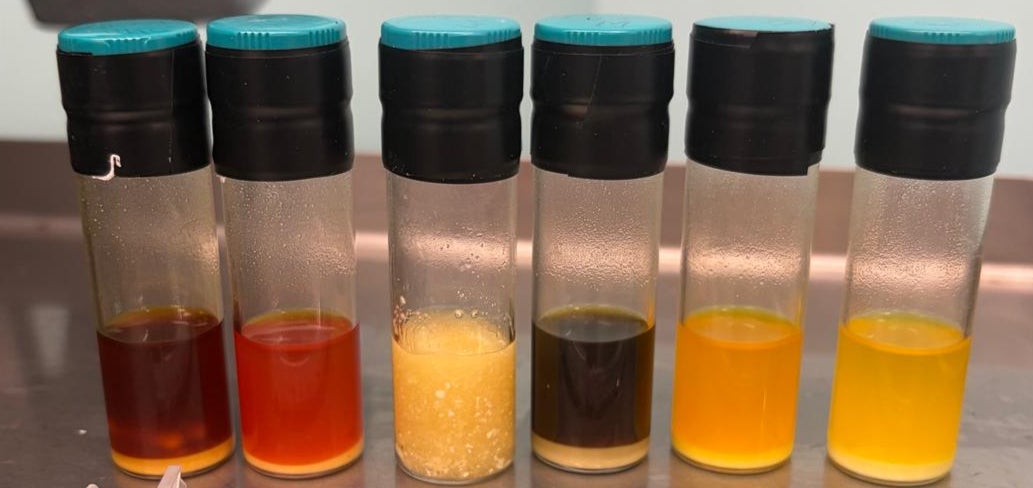
So far, I have been able to work on three projects, using different metal ions (rhodium, iridium, and nickel) that all dechlorinate PVC. Each catalyst has an undesirable side reaction that makes the product not quite the same as polyethylene, which I am working hard to overcome. While most of my reactions used the pure PVC polymer, it has been really exciting to extend my work to true commercial products, such as toy lizards, vinyl records, and PVC pipe. To our delight, under the developed reaction conditions, most of the commercial items having various additives respond very well. Our work presents a significant improvement on the management of PVC waste in comparison to past works in the literature.


Working on these products made me excited to take on the challenge of converting PVC to other value-added polymers, with a particular emphasis on materials that are hard to synthesize from other routes. This plan can be helpful in both dealing with waste PVC and making a desirable product. Some past works tried to achieve this; the conversions were limited by very low conversion, enforcing the challenge of this project. I am to use my current knowledge from my past work to mitigate some of the challenges seen by others, which is my current research direction. Currently I am working on these areas and identifying new challenges along the way. However, I am always gaining new information, which gives me the hope to try the next reaction. As my PI always says, only about 10% of the experiments we perform eventually appear in a research paper—the other 90% are what make those successful experiments possible, which always drives me further.
Working throughout the summer has given me some directions to synthesize new materials from PVC, which were hard to make before. I am very optimistic about this new opportunity, and by the end of this academic year I will definitely be able to reach close to the goal.
A Note of Gratitude
At the end, I want to express my heartfelt gratitude to the Wrigley Institute for Environment and Sustainability for considering my application and selecting me as a 2026 Wrigley Institute Graduate Fellow. Throughout the spring semester, I enjoyed different programs hosted by the Wrigley Instiute. I found the guest speaker sessions to be both informative and inspiring. I particularly appreciated the speakers who shared their personal career journeys and discussed the different paths available in academia and industry. Learning about their experiences, challenges, and advice was especially valuable. I am also grateful for the opportunity to meet and connect graduate students from different disciplines. Interacting with people from diverse academic backgrounds allowed me to view problems and ideas from a fresh perspective, which made this experience even more meaningful.
Ayon Das is supported by the Diane Sonosky Montgomery and Jerol Sonosky Graduate Fellowship for Environmental Sustainability Research.