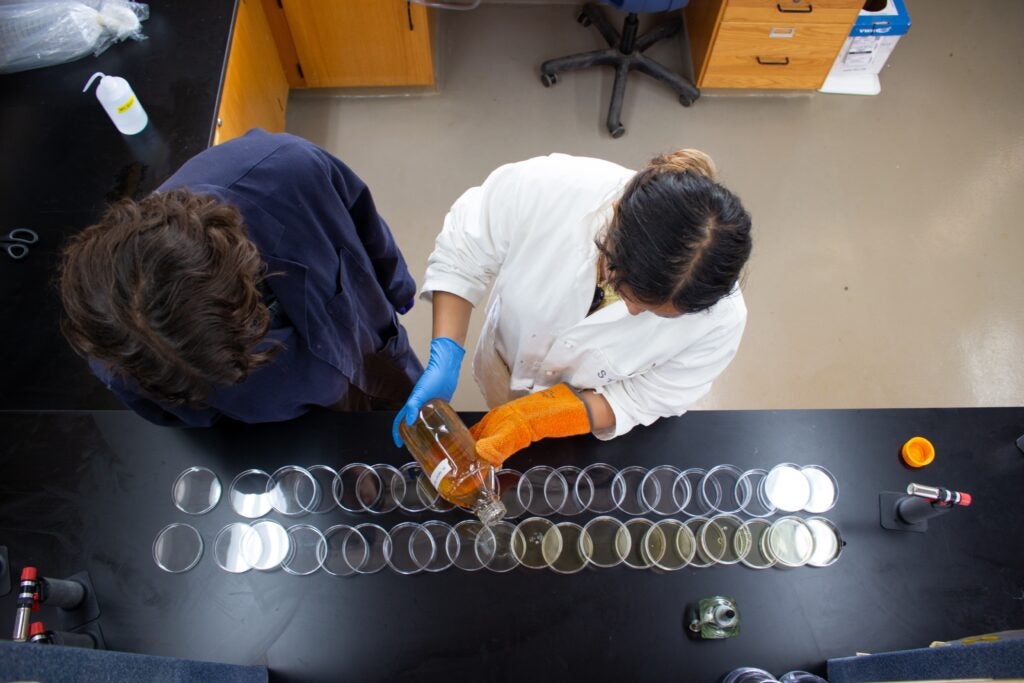
2025 Zinsmeyer Summer Research Program Intern Sedona Silva examines a flask containing kelp gametophytes in a laboratory at the Wrigley Marine Science Center. This summer, Silva explored the whether introducing juvenile giant kelp with certain microbes will enhance their growth and survivability (Anya Jiménez/USC Wrigley Institute).
Exploring Kelp, Microbes, and Collaboration on Catalina Island
My name is Sedona Silva, and I’m a senior at USC majoring in environmental studies with a marine biology minor. This past summer, I had the amazing opportunity to live and conduct research on Catalina Island at the Wrigley Marine Science Center (WMSC) for 10 weeks. Working under Dr. Sergey Nuzhdin and PhD candidate Bernadeth Tolentino, my goal was to analyze and harness the microbial partners of giant kelp to promote kelp growth and resilience. As a scientific diver who had been working in the Nuzhdin Lab for the past year, I had a lot of experience with kelp, and one might even say I had a spiritual connection to the organism.
I’ve always been interested in symbiotic relationships and the unspoken agreements between organisms that often go unnoticed by the human eye. Just like humans depend on our microbes in our body for essential functions such as digestion and immune regulation, seaweeds also host an extremely diverse microbial community which have been shown to assist in a variety of symbiotic functions. These include nutrient uptake, protection from pathogens, and phytohormone production. In exchange, the microbes receive a constant source of carbon from the seaweed blades. Interactions with microbiota are vital to seaweed function—the macroalgae and its associated microbiome are often referred to as a single entity, called the holobiont. It’s even been proposed that certain microbes have evolved alongside seaweeds, making them distinct from their free-swimming marine counterparts. Before learning about the kelp microbiome, I had always conceptualized kelp as a standalone organism, and this concept of the holobiont fundamentally changed my perspective on not only seaweed, but life as a whole.
The motivation fueling my research is the fact that kelp forests worldwide have experienced large-scale declines in recent years, accelerated by marine heatwaves, coastal development, and other anthropogenic impacts. Traditional restoration methods are costly and unable to match the decline of wild kelp populations. At the same time, national interest in seaweed aquaculture has increased in recent years. My lab is particularly interested in giant kelp’s potential as a sustainable source of biofuel. Hence, there are both ecological and economic motivations to find more efficient ways to grow kelp.
With this in mind, my primary research questions were:
1. What microbial taxa can be isolated from wild giant kelp sourced from Catalina Island?
2. Can inoculating juvenile giant kelp with bacteria enhance their growth and survivability?
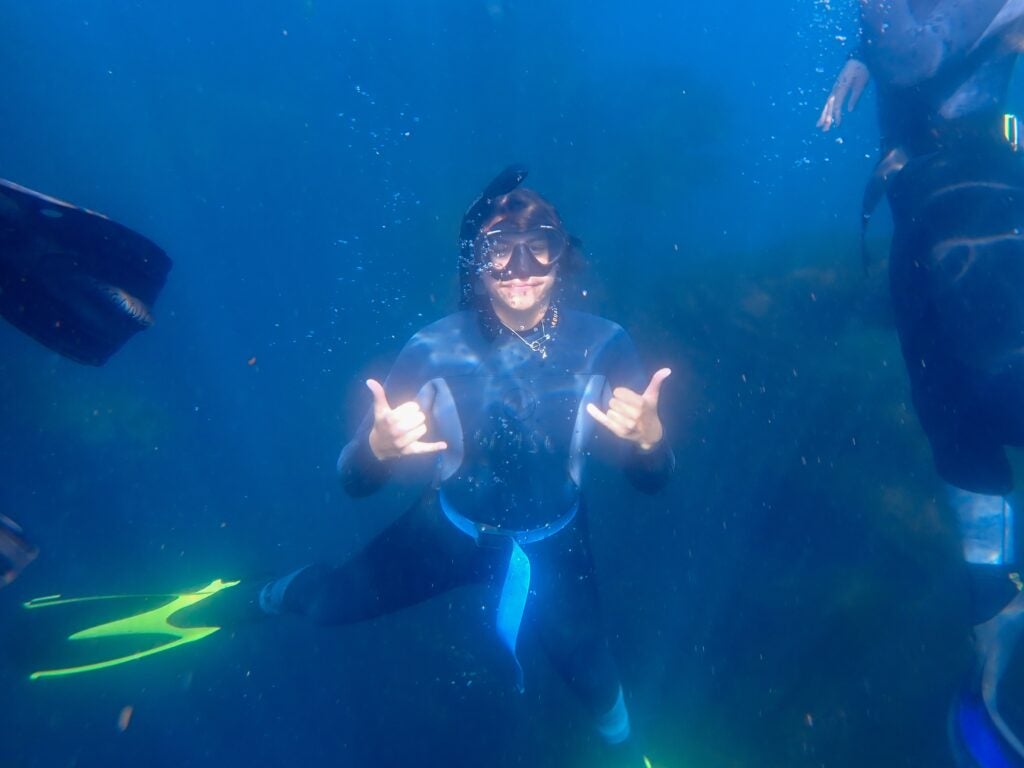
Under the guidance and patience of my mentor, I was thrown into the deep end of microbiology, learning techniques such as bacteria isolation, DNA extraction, PCR, and much more. I went scuba diving in the beautiful kelp forests right outside WMSC to collect kelp blades and reproductive tissue, called sori, which enabled me to grow my own baby kelp in a controlled environment. By the end of the summer, I isolated and sequenced 24 unique species of bacteria from kelp blades and conducted an inoculation experiment on juvenile kelp. My results were promising for the potential benefits of microbial inoculation, and thanks to this opportunity, I was able to secure a fellowship in the Nuzhdin Lab to continue my research.
My gains from this summer went way beyond just my research project. An unexpected yet foundational aspect of my time at WMSC this summer was interacting with the diversity of researchers, students, and professors visiting the island for various purposes. A Catalina Residential College Julymester creative writing class called Writ in Water, taught by Dr. Katie Ogle, was especially formative in broadening my perspective on my research and science in general. Hearing the class’ poems inspired by the natural world reminded me of the importance of incorporating art and creativity into science, and it even inspired me to write a few poems of my own. Science is taught to us as a discipline that must be objective, void of emotion and personal feelings. I’ve always struggled with this as someone who feels so emotionally tied to their work and the organisms I study. The Julymester’s writing, along with the many other multidisciplinary interactions I had on the island, brought another layer of purpose and meaning to my work.
In the little down time that I had this summer, I also got to backpack all 38 miles of the Trans-Catalina trail with fellow interns Kate and Anya, help out with Kate’s eel trapping project, and immerse myself in the unique environment of the island. Whether encountering herds of bison on the trail or schools of barracuda in the water, I was continuously delighted and inspired by the island.
Although my future after undergrad is still uncertain, the Zinsmeyer Summer Research Program provided me with a more tangible concept of what it’s like to be a graduate researcher. Learning from the graduate student mentors about their experiences was extremely valuable, especially as someone who wants to pursue a career in research. All in all, I would like to express my sincere gratitude to the Wrigley Institute and the Zinsmeyer Family, whose funding made this incredible experience possible.