
Navigating Climate Politics and Media Clicks
Long before I understood the science of climate change, I recognized that nature mattered. Spending much of my childhood fascinated by plants and wildlife, and much of my teenage-hood immersed in environmental documentaries and climate stories, I developed a deep sense of urgency about protecting our environment. After all, a healthy planet is what makes life as we know it possible.
My name is Lilly, and I’m an environmental studies major, minoring in cinematic arts, psychology, and risk management. This summer, I had the incredible opportunity to work as an Environmental Communications Intern through the USC Wrigley Institute for Environment and Sustainability. First off, I want to thank Kathryn Royster, Jessica Dutton, and the Wrigley Institute for funding and supporting my internship, as well as Professor Shannon Gibson and The Gibson Climate Justice Lab for mentoring me throughout my work. I am also super grateful for the speaker series that the internship put together, which provided me with a wealth of information about environmental communication careers.
Throughout my journey at USC as a student of the environment and media (through cinematic arts), I’ve come to realize that science is only half of the equation. Turning scientific knowledge into real-world action requires effective communication. I got a taste of what this kind of communication can look like during a Maymester program last year, where I heard from speakers like Rosanna Xia and Meredith Milton, who spoke about careers in climate reporting and sustainable film consulting. That experience sparked my interest in environmental communication, a field that seemed to perfectly combine my interests. I explored this topic deeper during my Public Engagement for Nature Conservation class last fall, where I discovered how crucial messaging is for getting people to care about environmental issues and learned about methods to communicate them successfully.
For this internship, I wanted to try my hand at communicating environmental politics – a subject that I had yet to explore. As much as it is up to the general public to adopt sustainable habits, the greater responsibility falls on governments and corporations to make moves towards a greener future. Having minimal knowledge on politics and international climate meetings before this internship, I made it my mission to understand global climate governance through my mentor’s research and communicate the basics to the audience.
As someone who is used to studying the physical and tangible aspects of environmental science, like ecosystems and conservation, one of the most interesting parts of my mentor Professor Gibson’s research was the shift in focus to money and marginalized communities at the global scale of climate politics. My earliest takeaway was just how central funding is to international climate decision-making. Money powers decisions, determines priorities, and influences which voices are heard, or left out. I began to view the climate crisis not just as an environmental issue, but also as a financial and political one, where climate injustice often stems from inequalities in who controls the funding and where it flows.
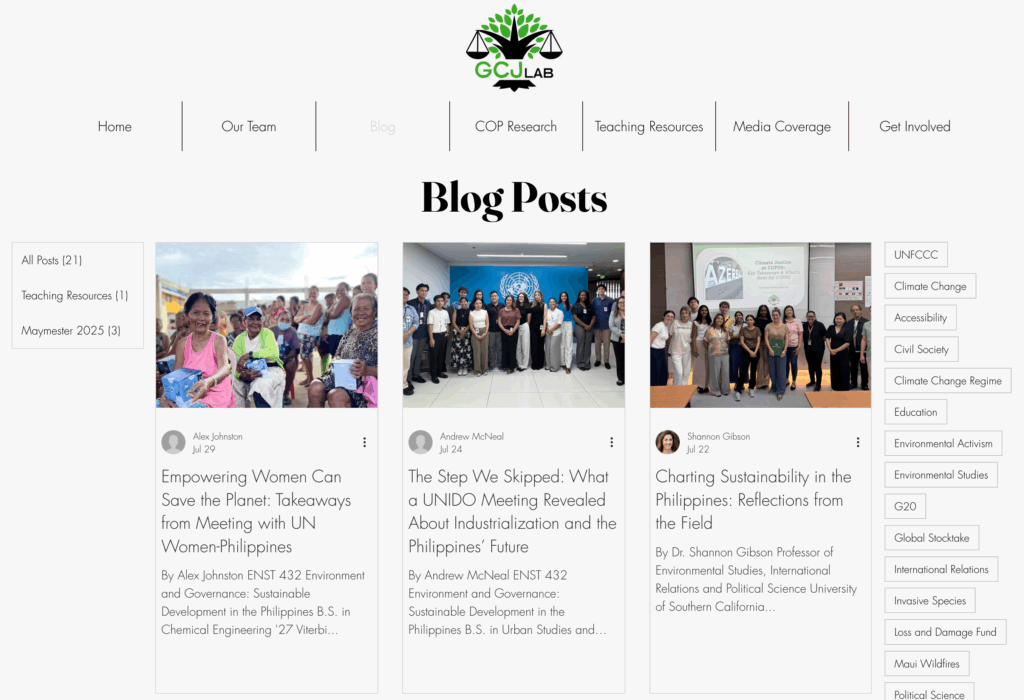
An unexpected source of learning for me came from reading blogs from students in Professor Gibson’s Maymester class focused on sustainable development in the Philippines. One of my internship tasks was to import and edit these blogs for publication on The Gibson Climate Justice Lab’s website. Reading through each students’ reflections, I gained many insights on climate justice and sustainability in practice, and I felt like I was taken along on the Maymester journey. One finding that struck me was that
“climate change is not gender-neutral,” and there are deep gender inequalities associated with environmental disasters.
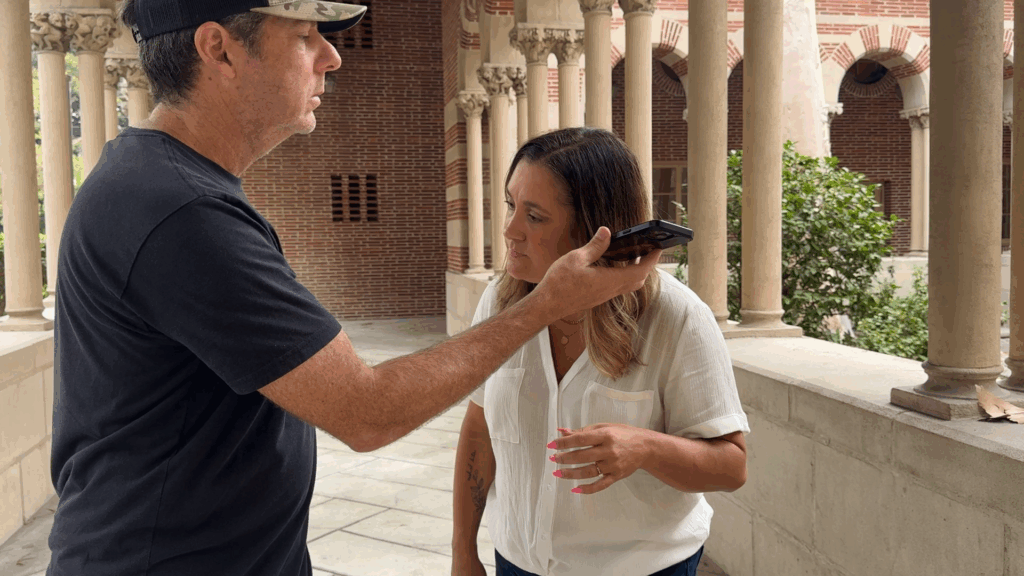
This internship exposed me to various facets of environmental communications work, such as social media, website editing, and video-making, and I am eternally grateful for the hands-on experience and skills I gained from this summer. As a remote intern, I also learned how to navigate time management, motivation, and staying on top of tasks while working independently. I got past communication and scheduling barriers, and it was a new experience to create a video almost entirely composed of clips I found online. With much-appreciated help, I was also able to incorporate a short interview of Professor Gibson into my video!
Building off of this experience, I now feel more confident in pursuing other environmental communications work, and it has opened my eyes to all the possibilities in the field. I hope to continue to bring awareness to environmental issues, inspire greater engagement with sustainability, and deepen my understanding of climate justice impacts. This fall, heading into Professor Gibson’s Public Policy for Sustainability course, I feel prepared and excited to learn about another side of environmental politics. At the same time, I’ll also be serving as a communication and outreach intern for a grassroots initiative through ENST 492, where I aim to apply and further develop my skills in environmental communications. I had an amazing experience this summer as a Wrigley Institute Environmental Communications Intern, thanks to inspiring leadership, a supportive cohort, and purpose-driven work. I encourage anyone with an interest in environmental storytelling or communication to explore this opportunity next summer and find your voice in the climate movement.
Watch Lilly Wang’s capstone video below.