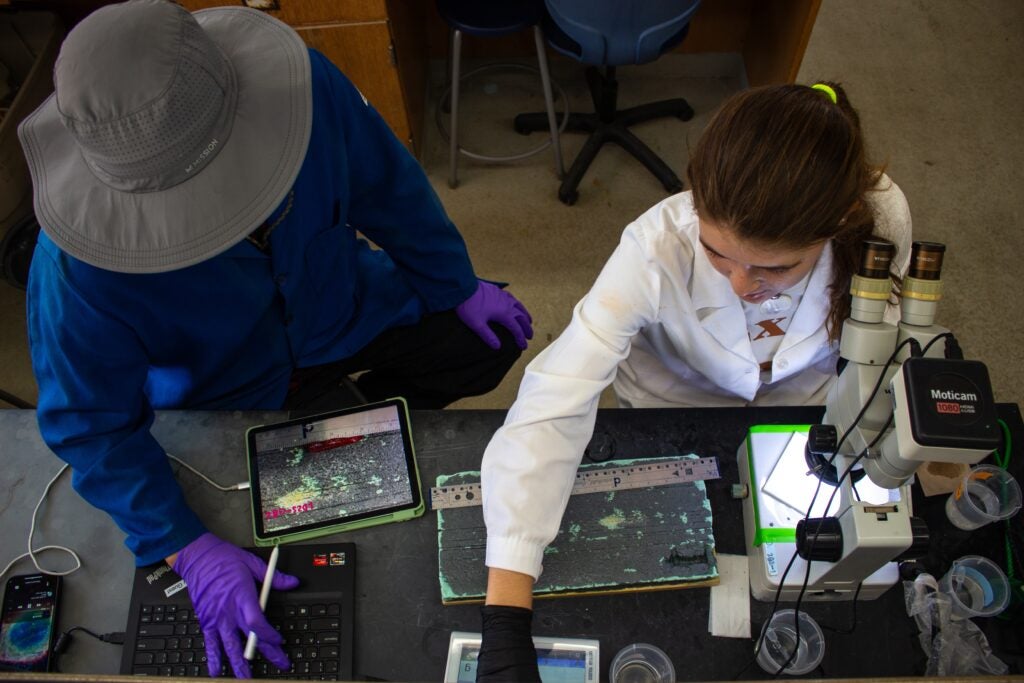
2025 Zinsmeyer Summer Research Program Intern Jesus Israel Venegas spent his summer working with Idahlo State University Professor Devaleena S. Pradhan, examining the behavior of bluebanded goby, a fish capable of bidirectional sex change (Anya Jiménez/USC Wrigley Institute).
Studying sex change and parental care in the blue-banded goby
My name is Jesus Israel Venegas, and I am a biological sciences major at the University of Southern California with an emphasis in ecology, evolution, and environment. This summer, I had the privilege of participating in the Zinsmeyer Summer Research Program, based at the Wrigley Marine Science Center on Catalina Island.
Under the mentorship of Dr. Devaleena S. Pradhan from Idaho State University and graduate student Abbie Symanietz, I spent ten weeks studying the parental behavior of the blue-banded goby (Lythrypnus dalli), a small reef fish capable of bidirectional sex change. I am deeply grateful to the USC Wrigley Institute for Environment and Sustainability, the National Science Foundation CAREER Award (#2145398), and the Zinsmeyer Fellowship for making this opportunity possible.
I have always been fascinated by animal ecology, particularly the ways in which species interact with each other and their environments. Going into this summer, I knew I wanted to pursue graduate school and eventually work in wildlife ecology and conservation. I felt this program would be an ideal way to strengthen my research skills, gain hands-on experience, and prepare myself for the rigor of a graduate program.
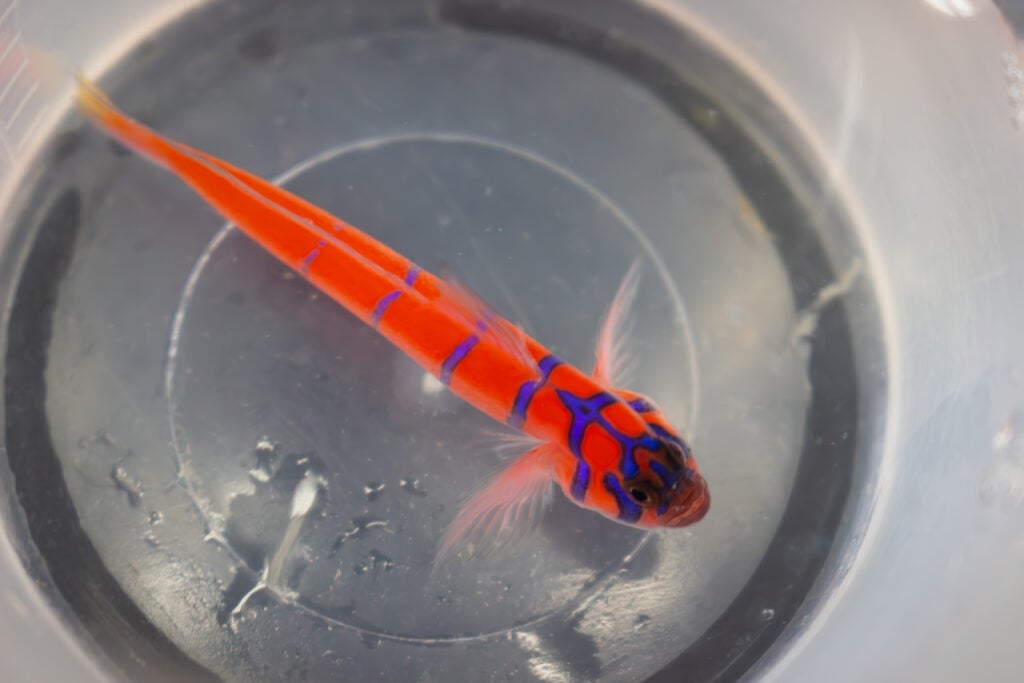
My project focused on comparing parental behaviors between newly sex-changed males and stable males, particularly in relation to the developmental stage of embryos in their nests. Lythrypnus dalli males are solely responsible for parental care, which includes guarding nests and fanning embryos. In social groups, if the dominant male is absent, the largest female undergoes sex change and assumes male reproductive and parenting duties. I wanted to investigate whether these “new males” showed differences in their parental care patterns compared to males that had been established in the role.
Over the course of the summer, I learned a wide range of research techniques. I conducted behavioral observations using ethograms, recording specific actions such as fanning, guarding, and social interactions. I also processed fish for morphological measurements, learning how to handle live specimens safely and efficiently. One of the most engaging parts of the project was photographing embryos daily to track their development, which allowed me to visually connect parental behavior to offspring growth. This meticulous, detail-oriented work taught me the importance of consistency and precision in research.
Living at the Wrigley Institute meant that my work was not confined to a single lab bench. I was surrounded by a diverse community of scientists and other fellow researchers, all working on different projects. The collaborative environment fostered daily conversations about science, experimental design, workshops, and career paths. I learned as much from my peers as I did from my own research, and I was constantly inspired by the dedication and creativity of those around me.
One of the most surprising aspects of my research was seeing how quickly newly transitioned males could adopt parental behaviors. In some cases, these individuals began caring for nests almost immediately after assuming their new role, while in others, their behavior was more tentative at first. Observing these variations in real time gave me a deeper appreciation for the complexity of animal behavior and the flexibility of social roles in nature.
I have always been drawn to asking questions about the natural world, and this summer showed me not only how fulfilling that process can be, but also how my contributions can fit into a broader scientific understanding.
This experience has reinforced my passion for research and confirmed my desire to pursue a long-term career in academia. I have always been drawn to asking questions about the natural world, and this summer showed me not only how fulfilling that process can be, but also how my contributions can fit into a broader scientific understanding. The skills I developed such as behavioral observation, data collection, morphological analysis, lab etiquette and embryo tracking, are all tools I will carry forward into my graduate studies and beyond. My time here has solidified my commitment to research, strengthened my preparation for graduate school, and deepened my appreciation for science. I am grateful for the mentorship, support, and friendships that made this summer both academically rewarding and personally unforgettable.