Original story by Greta Harrison
Plastic waste makes up 80 percent of all marine pollution, with more than 8 million metric tons of plastic entering our oceans each year. But what if something taken out of the ocean could help solve this problem?
USC Viterbi School of Engineering researchers have found a possible answer in seashells. Inspired by all the single-use plastic waste she saw created during the pandemic, Viterbi professor Eun Ji Chung decided to investigate biodegradable alternatives.
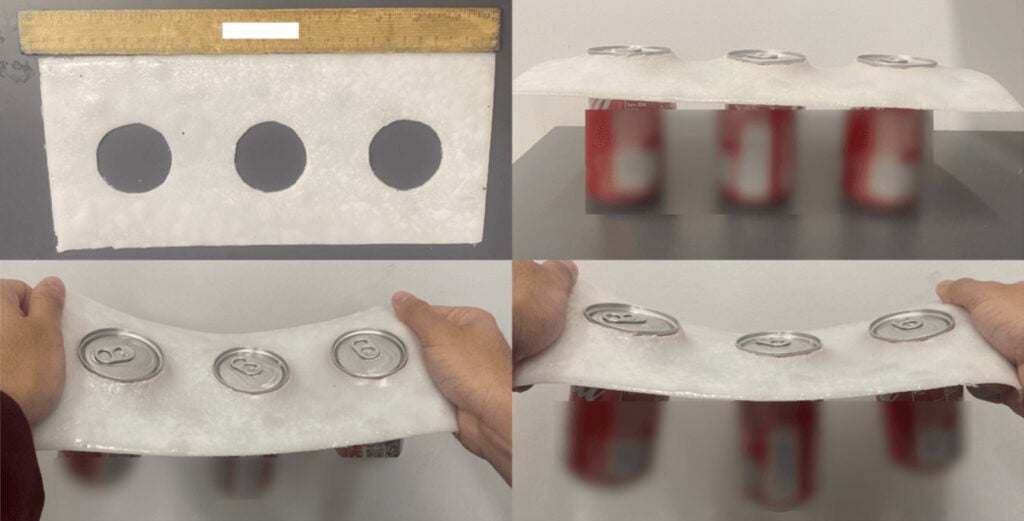
Now, she and her lab have developed a material they call POC-CC, made by mixing calcium carbonate from ground-up seashells with a citric acid-based polymer. Calcium carbonate is a mineral that causes seashells to harden. It’s also found in rocks, eggshells, and other naturally abundant materials. The polymer used by Chung’s lab is also made from a naturally abundant source–oranges–and is commonly used in biomedical applications, such as dissolvable stitches and devices that hold injured tendons in place while they heal.
Single-use plastic bags, beverage-can holders, and other plastic trash causes extensive harm to marine life. The materials can get tangled around animals’ necks, clog their digestive systems, or injure their limbs so that they can’t swim properly. And while conventional plastics do eventually break down in the ocean, the microplastics they create and the chemicals they release are also harmful to marine life.
POC-CC, however, has a pH similar to ocean water and doesn’t create microplastics or release harmful chemicals as it breaks down. In fact, Chung’s lab even grew a common type of marine algae alongside POC-CC as it broke down in ocean water for six months, and the algae was still thriving at the end of the experiment.
The research, funded by the Wrigley Institute’s USC Sea Grant, has promise for helping to solve one of the biggest pollution problems on our planet. Chung’s lab are already on their way to creating a second version of the material that will degrade even faster.
Read the original story on the USC Viterbi website >>
Read the academic paper in Springer Nature >>
Watch the FOX Weather story on Chung’s research >>