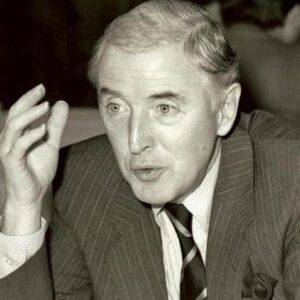
 Served as impactful School director and played key role in the establishment of CIS
By Center for International Studies
Aug. 20, 2025
We are saddened by the passing of Dr. Michael Graham Fry on July 28, 2025, in San Diego. He served as a professor in USC’s School of International Relations from 1981 to 2000, highlighted by his impactful role as the School’s director from 1981 to 1986. He is credited with successfully stewarding a generous gift from the Harris family toward the establishment of the Center for International Studies in 1986.
Born in Yorkshire, England, he earned his undergraduate degree from the University of London, followed by a PhD in diplomatic history from the London School of Economics.
Fry was a well-regarded diplomatic historian, focusing on international politics and security and the international relations of the Middle East. Among his works are a two-volume diplomatic history on British Prime Minister David Lloyd George and the Guide to International Relations and Diplomacy (2011).
After teaching history at Carleton University in Ottawa, Canada, he became dean of the Graduate School of International Studies at the University of Denver. He moved to USC in 1980 to become director of SIR.
While Fry was lauded as a gifted instructor at the graduate and undergraduate levels, his tenure as director marked a pivotal moment at SIR, moving the school away from its primary focus as a Cold War security program to a more expansive, interdisciplinary, and world-renowned school.
“Fry brought to USC a deep understanding of the importance of international relations as an interdisciplinary field of study,” writes Steve Lamy in a forthcoming history of SIR. “Unlike many American academics, he did not see international relations as a subfield of political science.”
Under Fry’s watch, SIR recruited high-caliber scholars with international reputations such as John Odell (global political economy), Thomas Biersteker (IR theory, development, and political economy), and Abraham Lowenthal (US foreign policy, Latin America). His commitment to an interdisciplinary approach was evident in a curriculum that included works by historians, economists, philosophers, geographers, scientists, and specialists in international law, notes Lamy in his history of SIR.
Fry’s administrative acumen extended to leveraging university resources to bolster his vision. For example, he oversaw rigorous reviews of the School at both the graduate and undergraduate levels, and SIR would regain a national reputation by the end of his period as its director. He revived interest among SIR alumni and strengthened the School’s master’s programs, including hundreds of MA degrees granted through USC partnerships with the US Air Force Education Office, the US Navy, and the Army. He revamped the undergraduate program, adding IR 210 as a required introductory theory and analysis course and distributed other offerings into fields such as security studies, political economy, foreign policy analysis and regional studies. He was also able to establish more competitive funding packages to recruit higher quality students to the PhD program.
Another great legacy of his leadership emerged when he rechanneled funds from a Harris family gift that had been briefly diverted from SIR to establish the Center for International Studies in 1986, with Biersteker (recruited from Yale by Fry) as its first director. Early on, the center was affiliated with USC’s Social Science Research Institute. After nearly 40 years, the center remains committed to the initial vision Fry helped establish – to promote basic and applied research and help educate the USC community and the general public concerning world affairs. From the start, the center sponsored a visiting scholar program, a weekly seminar series, special thematic workshops, and a publications program, while also providing much needed research support to SIR faculty and PhD students as well as undergraduate programs.
In a family tribute, Fry’s son captured yet another legacy to add to many of the USC accolades: “A true democratic socialist at heart, [Fry] believed in education as a force for good and dedicated his life to making the world a more thoughtful, equitable place. He leaves behind a legacy of scholarship, leadership, love and intellectual courage.”
This tribute drew from An Informal History of SIR, 1928–2018, a manuscript in progress by SIR emeritus professor Steve Lamy, and an obituary by the Fry family posted online.