Undergraduate Earth Sciences
Study the Earth.
Shape the Future.
Shape the Future.
The Department of Earth Sciences offers three undergraduate majors and four minors. Our programs combine fieldwork, research and interdisciplinary study to prepare students to understand—and help shape—the changing Earth.

Check Out Our Newest Major
Environmental Systems Science B.S.
Explore an interdisciplinary program focused on understanding Earth’s changing environmental systems and developing solutions for a more resilient future.
Advising and Declaring a Program
Current students interested in joining the department should contact Director of Undergraduate Studies Prof. Bottjer or visit the department office (ZHS 117) to learn more. Contact Dornsife Undergraduate Advising to declare a major or minor and register for classes.
Plan Your Courses
Review the current schedule of Earth Sciences courses and all undergraduate courses. Contact Prof. Feakins with any queries or interest in future semester offerings.
Compare Our Earth Sciences Degrees
The comparison below focuses on the B.A. in Earth Sciences and B.S. in Geological Sciences. Both emphasize experiential learning through capstone courses and field training in locations such as Catalina Island, Greece, Spain, Alaska and South America. The Environmental Systems Science B.S. follows a distinct interdisciplinary curriculum described on its dedicated program page.

Learning in the field: Earth Sciences students gain experience in remarkable environments around the world.

Research experience: Students develop analytical and laboratory skills through hands-on research.
B.A. and B.S. Degree Comparison
Use this comparison as a general planning overview. Consult the linked program requirements and an academic advisor for complete and current information.
Bachelor of Arts
B.A. in Earth Sciences
Required in Both Degrees
Introduction to GEOL
Any GEOL 100- or 200-level course. A GESM taught by a GEOL professor may be substituted.
Any GEOL 100- or 200-level course. A GESM taught by a GEOL professor may be substituted.
Minerals and Earth Systems
GEOL 315L, offered in the fall.
GEOL 315L, offered in the fall.
A flexible degree for students interested in geoscience and related careers in business, law, medicine or public policy. The program works well with a second major or complementary minor.
Chemistry
CHEM 105aLg, General Chemistry
CHEM 105aLg, General Chemistry
Mathematics
MATH 118gx, Fundamental Principles of Calculus, or MATH 125g, Calculus I
May be waived based on precalculus or AP Calculus AB preparation.
MATH 118gx, Fundamental Principles of Calculus, or MATH 125g, Calculus I
May be waived based on precalculus or AP Calculus AB preparation.
Additional science
One additional semester selected from BISC 120Lg, CHEM 105bL or PHYS 135ab.
One additional semester selected from BISC 120Lg, CHEM 105bL or PHYS 135ab.
Upper-division GEOL electives
28 units of electives. Typically, three options are offered each semester.
28 units of electives. Typically, three options are offered each semester.
Bachelor of Science
B.S. in Geological Sciences
Required in Both Degrees
Introduction to GEOL
Any GEOL 100- or 200-level course. A GESM taught by a GEOL professor may be substituted.
Any GEOL 100- or 200-level course. A GESM taught by a GEOL professor may be substituted.
Minerals and Earth Systems
GEOL 315L, offered in the fall.
GEOL 315L, offered in the fall.
A technically focused degree preparing students for geoscience industries, government agencies, graduate study and other careers requiring advanced scientific preparation.
Technical preparation
Includes additional science, mathematics, laboratory and research coursework. See the current B.S. requirements for the complete course list.
Includes additional science, mathematics, laboratory and research coursework. See the current B.S. requirements for the complete course list.
Upper-division GEOL electives
Electives selected from the range of specialized GEOL courses offered.
Electives selected from the range of specialized GEOL courses offered.
Fieldwork or research
Field geology or directed research in a laboratory.
Field geology or directed research in a laboratory.
Senior thesis
Completion of the GEOL 494 Senior Thesis.
Completion of the GEOL 494 Senior Thesis.
Expand Your Studies
Explore Our Minors
Four interdisciplinary minors allow students to explore connections among Earth systems, biological sciences, natural hazards, climate change and public policy.
Check Out Our Newest Minor
Paleontology
Explore the evolution, diversity and extinction of life through a curriculum combining biology, geology and the history of life on Earth.
Geobiology
For students interested in interdisciplinary study at the intersection of Earth and biological sciences, including topics such as life in extreme environments and the search for life on other planets ("astrobiology").
Geohazards
For students who want to broaden their understanding of natural hazards, global change and environmental problems. Accessible to science and non-science majors.
Climate Change, Stewardship and Resiliency
For students seeking a scientific grounding in climate issues, as a complement to specializing in areas such as international relations, public policy, economics, business, management or politics. Accessible to science and non-science majors.
Interdisciplinary Opportunities
The department works closely with the Dornsife Environmental Studies program, providing science-focused coursework and supporting double-major and major/minor combinations for students seeking a stronger scientific foundation in their study of the natural environment.
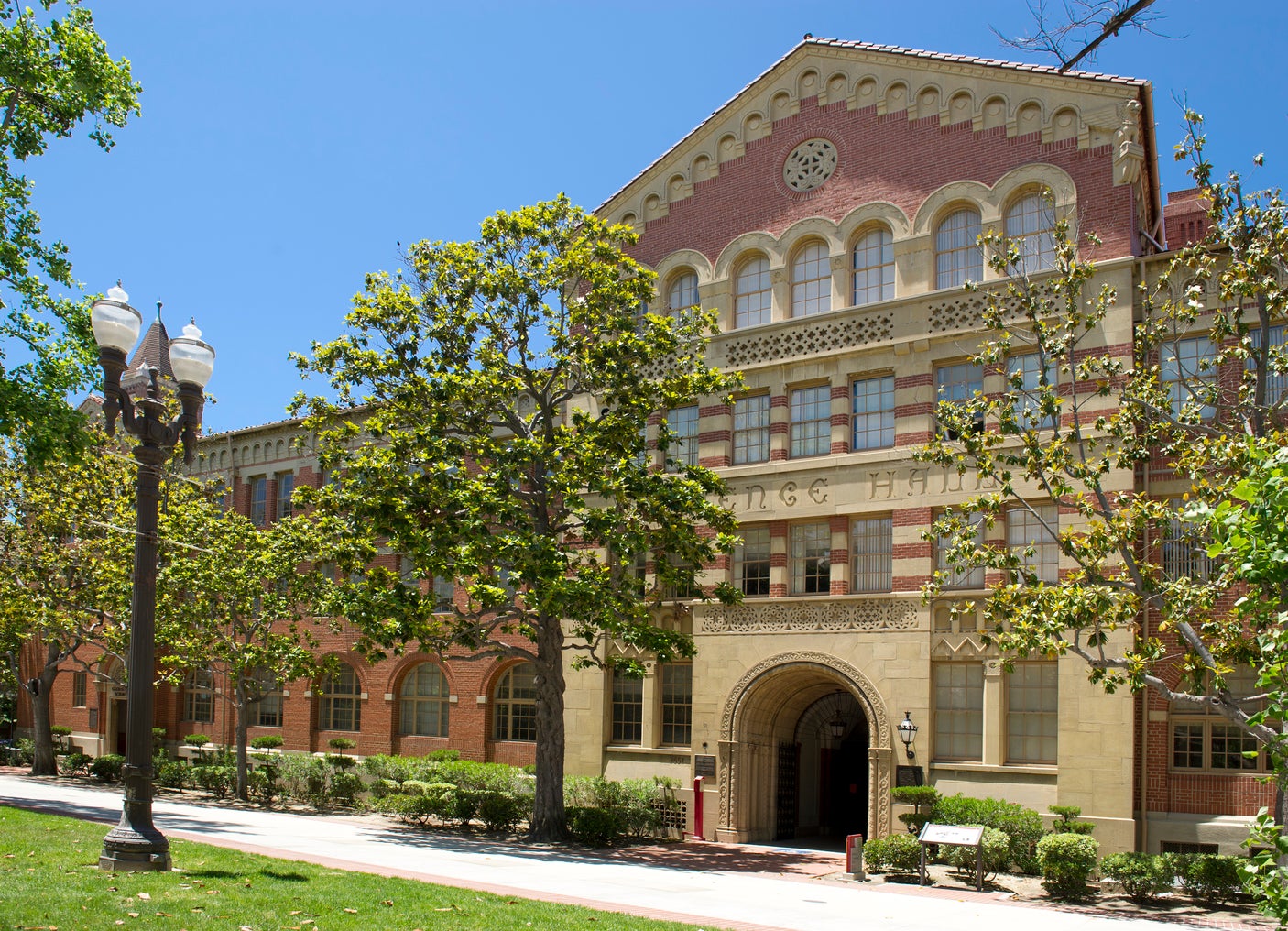
Zumberge Hall of Science, home of the Department of Earth Sciences.