8:30 a.m. – 9:30 a.m.
Registration & Breakfast
9:30 a.m. - 11:00 a.m.
Welcome
Ange-Marie Hancock, Associate Professor, Political Science and Co-Director, USC Center for the Study of Immigrant Integration
Invocation
Rev. Dr. Cecil “Chip” Murray, John R. Tansey Chair of Christian Ethics, School of Religion and Senior Fellow, USC Center for Religion and Civic Culture
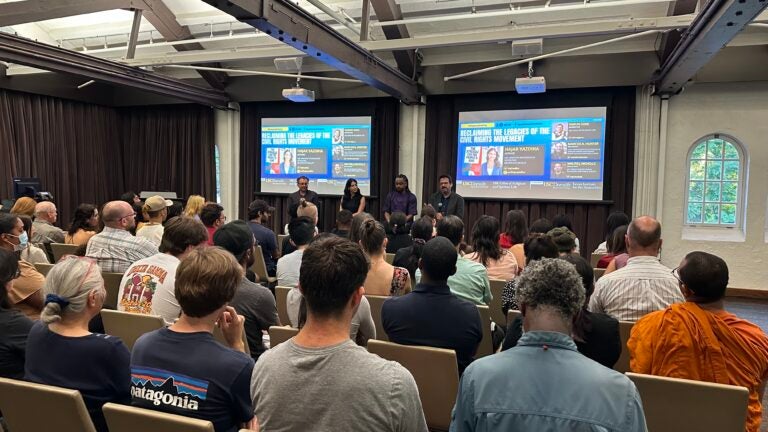
Opening Plenary Panel
Starting of Something New: Organizing after 1992
Twenty years ago, the media portrayed the unrest as a Black-white or Black-Korean conflict missing the pervasive economic distress that was one of the main drivers. Post-riot media focused on the reactions of major political actors and missed the everyday efforts of grassroots organizers and ordinary residents who took it upon themselves to take on the work of building a better Los Angeles. In this session, leaders who took on new or transformed approaches to economic, social, and political disparities will share their perspectives on why the city exploded on April 29, 1992, how it impacted their work, and what we can learn from the past two decades of struggles for justice and equity.
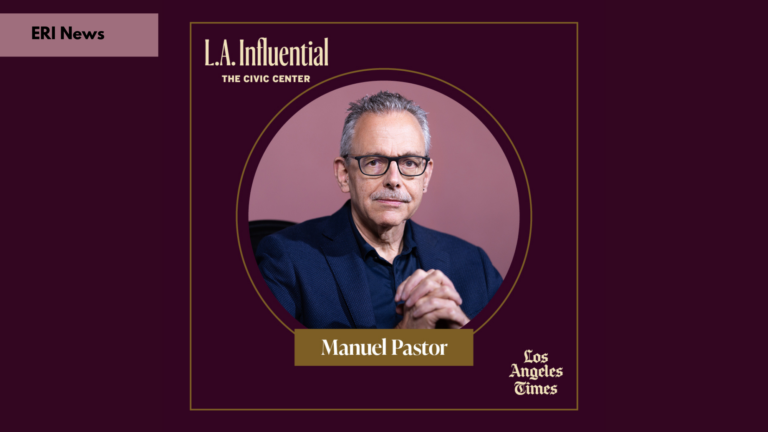
Moderator: Manuel Pastor, Professor, American Studies and Ethnicity, and Director, USC Program for Environmental and Regional Equity
Panelists:
- Maria Elena Durazo, Los Angeles County Federation of Labor, AFL-CIO
- Eric Mann, Labor/Community Strategy Center
- Anthony Thigpenn, Strategic Concepts in Organizing & Policy Education
- Danny Park, formerly with Koreatown Immigrant Workers Alliance
- Harold Meyerson, The American Prospect
[Back to top]
11:00 a.m. – 11:15 a.m.
Break
11:15 a.m. – 12:15 p.m.
Concurrent Panels | Building Movements: Lessons from Two Decades of Organizing
Panel #1 | From Criminalization to Empowerment: A Growing Youth Justice Movement and Building a Cradle-to-Career Pipeline
The frustration and rage that erupted on April 1992 had long been simmering, fed by poor education conditions, a lack of employment opportunities, and police abuse among other things. As a result, many youth participated in the unrest and that, along with ongoing imprisonment, gang violence, and Props 209 (1996) and 21 (2000), has led organizations to prioritize youth involvement and new strategies to improve conditions. This panel will explore early responses to the violence, the criminalization of Black and Brown youth, and current efforts to build a youth-led movement for change.
Moderator: Melvin Oliver, University of California, Santa Barbara
Panelists:
- Connie Rice, Advancment Project
- Melina Abdullah, California State University, Los Angeles
- Maria Brenes, Inner City Struggle
- Manuel Criollo, Labor/Community Strategy Center
[Back to top]
Panel #2 | From Disinvestment to Reinvestment: What Post-Unrest Urban Development Strategies Can Teach Us Today
Growing economic disparity in Los Angeles’ inner city due to a decades-long pattern of disinvestment, corporate restructuring, and government deregulation made economic development an imperative in the wake of the civil unrest. Shocked by the unrest, the city’s political, business, and philanthropic leaders realized that old models had to be reinvented and tried new approaches. This panel will discuss the successes and failures of early efforts to bring investment to high-poverty neighborhoods, the tension between top-down redevelopment and bottom-up efforts from the community, and lessons for today’s equitable urban development strategies.
Moderator: Regina Freer, Occidental College
Panelists:
- Denise Fairchild, Emerald Cities Collaborative
- Alexandra Suh, Koreatown Immigrant Workers Alliance
- Paulina Gonzalez, Strategic Actions for a Just Economy
- Madeline Janis, Los Angeles Alliance for a New Economy
[Back to top]
Panel #3 | From Prop 209 to Prop 8: Lessons from the Electoral Battleground
Over the past twenty years, more and more organizations are entering the electoral arena as a critical strategy to social change. Elections matter because it is when we take stands on issues and elect our representatives. But elections can also be leveraged to build on-going power so that we can play offense rather than defense and keep champions on the inside accountable from the outside. This session will highlight key electoral events, different strategies for building electoral power, and lessons on navigating the inside-outside game.
Moderator: Jaime Regalado, California State University, Los Angeles
Panelists:
- Larry Frank, Office of the Los Angeles City Mayor
- Karla Zombro, California Calls
- Yongho Kim, Korean Resource Center
[Back to top]
Panel #4 | Research for Change: Strategic Partnerships, Popular Education, and Participatory Research
In the ongoing struggle for social justice, participatory research and popular education have become important strategies for involving residents in the struggles and in defining the solutions for change. Panelists will share their experiences in how different tools of engagement can open doors into the region’s public square for marginalized communities.
Moderator: Laura Pulido, USC and University of California, Santa Barbara
Panelists:
- Gilda Haas, Antioch University
- Saba Waheed, DataCenter
- Robert Garcia, The City Project
[Back to top]
Panel #5 | Finding the Uncommon Common Ground: Organizing across Race, Place, and Faith
Out of the civil unrest, new forms of civic engagement developed: neighborhood councils in 1999, an increase in faith-based engagement, and new social movement organizing. This session features panelists from different efforts to engage multiple racial, ethnic, and immigrant identities from the ground-up. Panelists will share their experiences and insights into the successes and challenges in organizing across difference and what it takes to build a common agenda.
Moderator: Michele Prichard, Liberty Hill Foundation
Panelist:
- Carlos Vaquerano, Salvadoran American Leadership & Educational Fund
- BongHwan Kim, Los Angeles City Department of Neighborhood Empowerment
- Gloria Walton, Strategic Concepts in Organizing and Policy Education
- Richard Flory, USC Center for Religion and Civic Culture
[Back to top]
12:15 p.m. – 12:30 p.m.
Pick Up Boxed Lunch
12:30 p.m. – 1:30 p.m.
Lunch Keynote | Making Art, Making Change, A Conversation with Members of Ozomatli
Movements have always moved to the rhythm of music. A band birthed from an LA protest that is now the U.S. State Department Cultural Ambassadors and carries international appeal, Ozomatli will explore what music has meant for social resistance, for Los Angeles, and for building a new vision of community.
Moderator: Josh Kun, USC Annenberg School for Communication & Journalism
Panelists: Members of Ozomatli
1:30 p.m. – 1:45 p.m.
Break
1:45 p.m. – 3:00 p.m.
Strategy Workshops | Sustaining this Movement Moment: Strategies for Today and for the Future
During these five concurrent sessions, we will explore strategies that today’s organizers are exploring and testing. Panelists will share their perspectives on the organizing challenges and opportunities for the next twenty years.
Workshop #1 | Showing Up and Signing Up: Integrating Media and Organizing
Facebook, Twitter, print? What are effective forms for communicating with a mass audience in this technological era? Organizations are exploring ways to reach a broader segment of society (beyond door-to-door organizing or phone banking) to move them to act on a progressive agenda. This workshop will explore how to use new and legacy media, communications strategies, and technology to push our work forward and make the movement visible to all.
Moderator: Arely Zimmerman, USC Program for Environmental and Regional Equity
Panelists:
- Erna Smith, USC Annenberg School for Communication & Journalism
- Jung Hee Choi, Community Coalition
- Nancy Meza, DreamTeam L.A.
- Ian Inaba, Citizens Engagment Lab
[Back to top]
Workshop #2 | Sustaining Organizations: Scaling with Soul
With two decades of experience behind them, organizations are looking towards the next twenty. For some, executive transitions are bringing up a new set of questions around leadership development, generational divides, and retaining vision in the face of new issues. For others, scaling up means figuring out how to diversify funding, how to stay rooted locally and have reach nationally, and how to create strong partnerships with other movement builders. In this session, panelists will have a conversation about what it will take to build powerful, movement-building organizations that can be sustained for the next twenty years.
Moderator: Ann Bastian, New World Foundation
Panelists:
- Rabbi Jonathan Klein, Clergy and Laity United for Economic Justice, Los Angeles
- Cindy Chavez, Working Partnerships
- Marcos Vargas, Central Coast Alliance United for A Sustainable Economy
- Burt Lauderdale, Kentuckians For The Commonwealth
[Back to top]
Workshop #3 | Building Powerful Alliances: Balancing Depth, Density, and Size
In a diverse world where injustice comes in many forms, the struggle for a more equitable Los Angeles requires forming alliances in order to reach the specificity and breadth necessary to affect change. This means connecting across place (Pacoima to the Ports), race (Black to Brown), issues (EJ to Education), and sectors (labor to legal) while maintaining the depth, density and size to make an impact. Panelists in this session will address the components that make for a strong alliance, managing organizational relationships, and the major alliances in which Angelenos are engaged.
Moderator: Chris Benner, University of California, Davis
Panelists:
- Kokayi Kwa Jitahidi, Los Angeles Alliance for a New Economy
- Eileen Ma, API Equality-La
- Lola Smallwood Cuevas, UCLA Labor Center, Black Worker Center
- Chris Newman, National Day Laborer Organizing
[Back to top]
Workshop #4 | Measuring Movement Building: Defining Metrics that Matter
Movements are something special – they go beyond an organization to become sustained groupings with shared values, a common narrative, a broad and deep base, and a long-term commitment to change. Typical metrics, however, focus on individuals not communities, on organizations not movements, on institutions not intersections. This workshop will look at ways that movement builders, funders, and others are seeking a new framework and key milestones to gauge movement building.
Moderator: Martha Matsuoka, Occidental College
Panelists:
- Jennifer Ito, USC Program for Environmental and Regional Equity
- Aparna Shah, Mobilize the Immigrant Vote
- Arif Mamdani, Seasons Fund for Social Transformation
- Juan De Lara, USC American Studies and Ethnicity
[Back to top]
Workshop #5: Skilling Up: Engaging Communities in Campaigns
Strategic research and policy analysis are essential to successful organizing efforts and campaigns. This workshop will explore innovative strategies and tools for equipping grassroots organizations and residents with the information and analysis necessary to engage directly in public policy decision-making that affects their neighborhoods and their lives.
Moderator: Veronica Terriquez, USC Dana and David Dornsife College of Letters, Arts and Sciences
Panelists:
- David Robinson, Strategic Actions for a Just Economy
- John Kim, Advancement Project
- Bill Gallegos, Communities for a Better Environment
- Justin McBride, CLEAN Carwash Campaign
[Back to top]
3:00 p.m. – 3:15 p.m.
Break
3:15 p.m. – 4:30 p.m.
Comments from U.S. Congressmember Karen Bass
Introduction by Torie Osborn, California Calls
Closing Plenary | Scaling-up: The Future of Movements in Los Angeles and the U.S.
Strong social movements are more important than ever. Changing demographics, ensuing economic disparity, and drastic cuts to government are just some of the issues facing cities and regions across the nation. How can Los Angeles both learn from and be a model for the rest of the country? What movements should we be connecting with over the next twenty years? What are the opportunities and challenges that will we face? A new generation of leaders shares their vision for a strong social justice movement and discusses what effective strategies might look like over the next twenty years.
Moderator: Manuel Pastor
Panelists:
[Back to top]
Gospel Performance by Psalms
4:30 p.m.
Reception