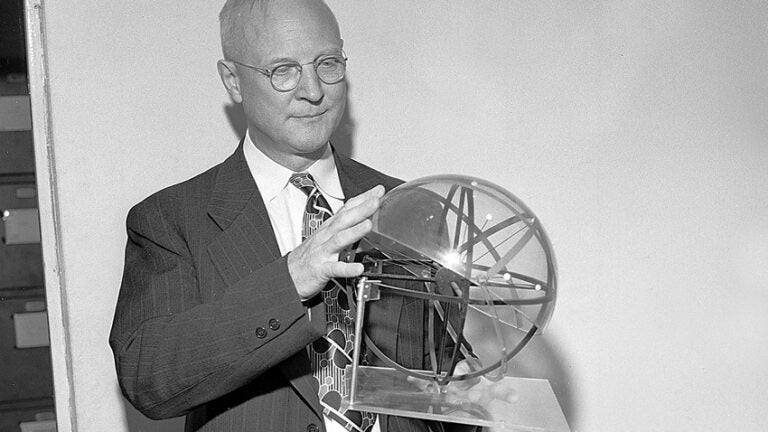
As evidenced by leap years, it may seem like humans have an odd way of measuring time, says USC Dornsife professor Vahe Peroomian. Sometimes, timekeepers even have to add extra seconds to clocks.
News Stories
USC Dornsife researchers will evaluate a new classroom program that’s teaching debate, deliberation and civil discussion skills to middle and high school students.
I’ve taught in prisons for 15 years – here’s what schools need to know as government funding expands
Very few prisons offer credit-bearing college programs for inmates. That’s about to change.
Saud Siddiqui ’11 helped develop the innovative educational software SketchyMedical, which landed him a spot on the Forbes 30 under 30 list. [5¾ min read]
A USC Dornsife study finds that together, genetics and years of education can influence whether or not someone becomes obese. [2 1/2 min read]
Genoeconomist Daniel Benjamin of USC Dornsife says that a combination of roughly 1,000 genetic variants across the genome can predict the length of a person’s formal education to a degree comparable with the usual demographic predictors.
Daphna Oyserman and Oliver Fisher take a look at what motivates and demotivates students in “The Conversation.” They found that how a person reacts to challenges – and even ease – can impact their academic success.
Promising results from a pilot study led by Anna Saavedra of the Center for Economic and Social Research (CESR) and supported by the George Lucas Educational Foundation could herald a shift in traditional approaches to education.
The genetic variants found by scientists account for a small fraction of the differences across individuals in education.
J.P. Guilford’s “Structure of Intellect” theory proposes a three-dimensional model of intelligence, with added emphasis on skills cultivated through a liberal arts education. Developed decades ago, the theory could help guide education policy today.