Science and Technology
An evolutionary adaptation that allows one ocean bacteria to thrive could prove to be its Achilles Heel as oceans change, new study reveals.

An evolutionary adaptation that allows one ocean bacteria to thrive could prove to be its Achilles Heel as oceans change, new study reveals.
Longtime USC Dornsife chemistry professor Arieh Warshel intertwines personal stories from his life with major milestones in Israeli history and his scientific journey to the Nobel Prize. [2¾ min read]
Findings from a new study could point the way to new treatments for blood diseases including cancers such as leukemia and lymphoma. [3 min read]
Ring in the New Year with these USC Dornsife scholar-recommended reads that promise a little self-transformation. [4½ min read]
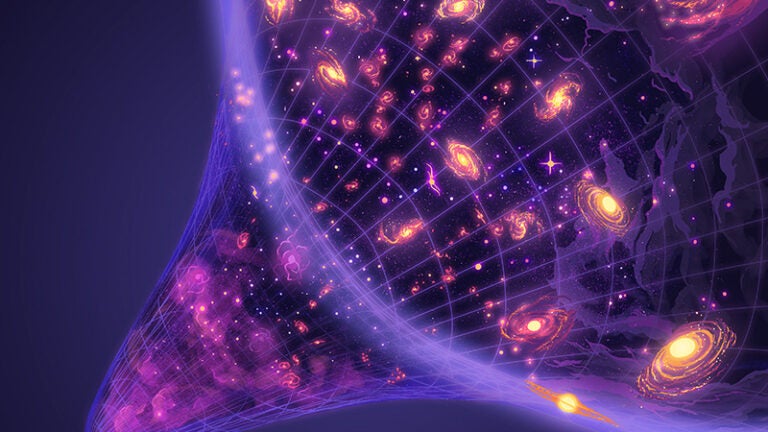
From the origins of the Big Bang to the composition of dark energy, dark matter and black holes, USC Dornsife cosmologists Vera Gluscevic and Elena Pierpaoli are searching for answers to the mysteries of the universe. [12¼ min read]
We have been fascinated by the wonders of the universe and have endeavored to understand our place within it since our earliest ancestors first gazed up in awe at the night sky. So, how did ancient civilizations make sense of the cosmos — and what did they get right? [12½ min read]
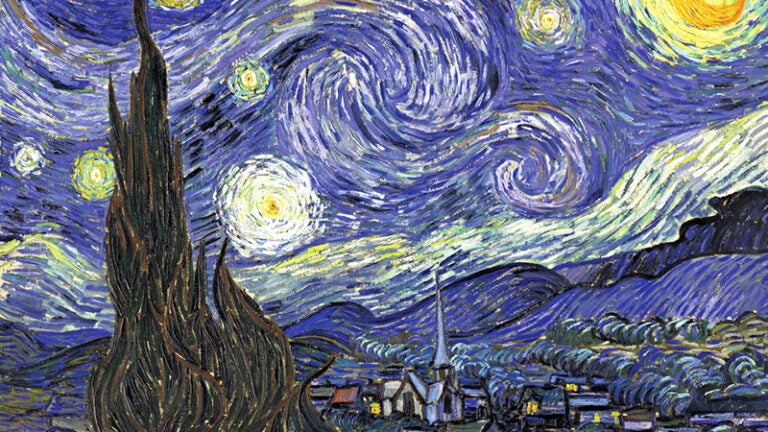
Our sense of wonder at the cosmos, and our desire to try to make sense of our place within it, have inspired generations of artists, writers, designers, musicians and filmmakers. [10¼ min read]
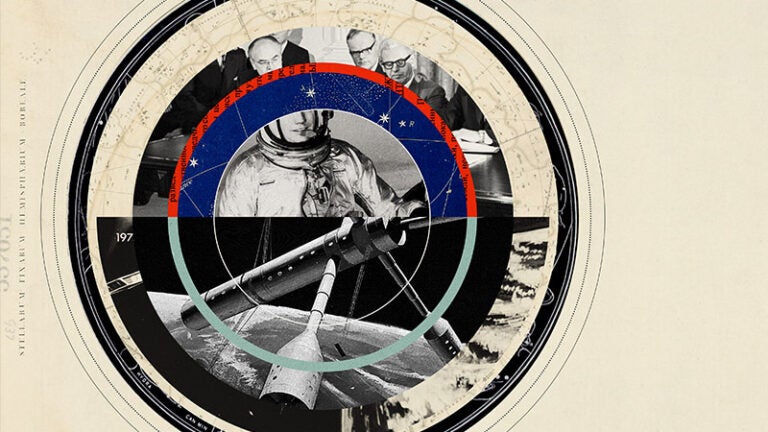
With many countries, companies and individuals intensifying their space exploration programs, questions about rights, ownership and the feasibility of manned space missions are coming to the fore of public debate. [9¼ min read]
For many scientists, it’s no longer a question of “if” but “when” we encounter alien life. So, what will happen when humans finally do come face-to-face with E.T. and how will we communicate? [8½ min read]
Alumni Laurie Barge ’09 and Scott Perl ’19 co-lead a laboratory at the Jet Propulsion Laboratory in Pasadena. There, they search for the origins of life on Earth to better understand how life might develop elsewhere in the universe. [5½ min read]