Part 3: At Home Lab Kits
By Jessica Parr, Associate Professor (Teaching) of Chemistry – April 9, 2021
Part 3 of a four-part blog series.
When the pandemic required us to swiftly move all classes to an online format, many of us were able to adapt our lecture and discussion sections reasonably well, but the hands-on activities were more challenging to modify. With six weeks remaining in the semester there was a good chunk of physical labs that students needed to perform. Over spring break the lab directors of our department – along with some dedicated TAs – recorded videos and took pictures of the experiments that students would have performed. We cobbled together what we could. As it became increasingly clear that instruction would be fully online for an extended period of time, lab instructors across the university began exploring options that would help students replicate the laboratory experience in a virtual environment. In a four part series I will talk about the alternatives that we considered. Third verse: what if we shipped the lab to the students?
There are several companies that prepare and ship lab kits to students homes. They have been around for years, to accommodate students participating in distance learning. The kits include equipment and chemicals needed to complete the laboratories, as well as detailed instructions for each of the experiments. The kits can be customized. Faculty select the experiments that they want students to do at home and the company sends it where it needs to go. Some of the companies even have an online lab notebook and question bank that students access to record their data and answer questions about the labs. These kits are convenient and have a reasonable cost.
Some faculty chose to build their own kits with equipment purchased by their departments and sent them directly to their students. Professor Jack Fienberg in the Physics department mailed kits to hundreds of students in the Fall of 2020. His efforts were highlighted in the USC news article: https://news.usc.edu/trojan-family/college-physics-experiments-at-home-covid-19-usc/ Professor Chi Mak in the Chemistry department chose to prepare kits and sent them to his students in the majors general chemistry class in the Spring of 2021. This shows incredible dedication. The students should be thrilled to get a chance to experience a little bit of class at home.
I received a commercial kit from Carolina Labs to try at home. The experiment that I was sent was a qualitative preparation of acetylsalicylic acid (aspirin). The kit included everything that I needed, even the necessary personal protective equipment:


There was a very stylish pair of plastic goggles, a plastic apron, and several pairs of nitrile gloves. The needed chemicals were included in small quantities, but enough that if the experiment is messed up you can try again. There were disposable pipettes, a small spoon, glass stir rod, and a plastic well plate. The only thing that I needed to provide was some water for cleaning the stir rod. The last thing in the kit was a booklet that included the instructions to complete the experiment, and data tables to record observations.
I recently performed the experiment and recorded myself doing so. If interested, you can watch the video to see what the students would be doing at home (see embedded video at the end of this blog post). In all it took me about an hour and a half to complete the experiment with good results. The provided instructions were clear enough that students who have little to no laboratory experience should be comfortable completing the experiment at their kitchen table.
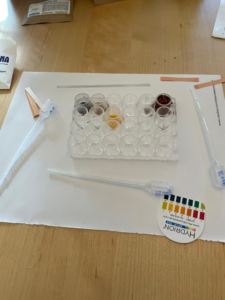
The booklet included instructions on how to clean up the work space and dispose of leftover material. In the quantities provided, everything could be safely thrown out in the trash or dumped down the sink with water running. It was fun and something that students would enjoy doing at home for some hands-on science experience.
Ultimately, we decided not to send kits, or have commercial kits sent to all of our general chemistry students. There were questions about shipping overseas and providing our international students the same instructional experience as our students studying in the US. There were also questions about safety and liability if students were injured completing the experiments at home. I did take some time to design some experiments that students could complete in their kitchens with household materials and things easily purchased at the drugstore, which I will discuss in my final post about the at home lab experience.
DO NOT TRY THIS AT HOME WITHOUT APPROPRIATE INSTRUCTION AND TRAINING. The video is edited to remove most of the names of the chemicals to prevent untrained copy attempts.