Collective Concept Mapping to Explore Complex Issues
By Shannon Gibson, Associate Professor (Teaching), Department of Political Science and International Relations – July 27, 2020
Something we are able to cultivate in physical classrooms, but is often lacking in the online teaching environment, is class camaraderie. I have found that short and content-relevant ice breakers were very useful in getting my students to know each other quickly and efficiently, while also incorporating work tied to our course learning objectives.
First, why the need for ice breakers? In my experience they are beneficial:
- As an early low stakes participation exercise. Creating an actual assignment and having it count for points sets the stage for the type of class you plan to run and the level of participation you expect in a course.
- In helping them to feel comfortable with one another. When there is a higher level of comfort, students seem more likely to keep their cameras on and to communicate verbally (as opposed to only in the Zoom chat function.)
- For future group work. They are more likely to make groups themselves or feel at ease with collective work when they know each other’s names, backgrounds and level of commitment to the class.
- As an assignment that can be revisited at the end of the semester to bring the class full circle. They can aid in last day reflection, showing them how you worked through the course learning objectives, and demonstrating how their viewpoints or knowledge base has changed from Day 1 to today.
There are a wide variety of resources available on creating in-class and online icebreakers, but I wanted to share one that I think would be especially useful in the social sciences or humanities — collective concept mapping.
Concept maps are a graphical tool or diagram that depicts various relationships (correlation, causation, etc.) between phenomena or concepts. There are many types of concept maps. For mine, I chose a “spider map” where you put a particular phenomena in the “center” of your map and then allow students to add and categorize influencing concepts around that central concept. I also utilized Creately, which is a free online concept mapping tool (among many other services), that worked perfectly for this assignment.

I created this assignment to reinforce the structure and learning objectives of my specific class, but much of this may be modified. First, this was part of my “flipped classroom” approach. Therefore, they were required to watch a video prior to our live session. Second, it was low stakes, meaning even if they didn’t watch that video, they could still participate. But in this process, it was made clear to them that in the future they need to watch or read what is assigned before our live sessions. Third, I asked them to introduce themselves as part of this collective assignment and to submit only one assignment per group. Fourth, I tied this to our course learning objectives and finally, it counted for participation points.
Their task? To create a concept map detailing what factors or forces led to the current COVID-19 Pandemic and that they try to group those factors/forces into categories. Here are two of the groups submissions:

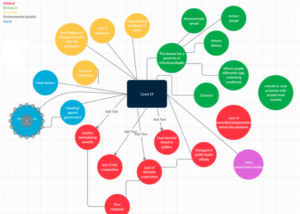

When we came back to the class, I asked the groups to share their images one at a time and we engaged in a lively discussion about how groups differed in their assessments and what influenced those different viewpoints. My plan for the end of the class is to bring these back out, put them in their original groups and ask them how they would modify their maps now. I look forward to the conversations we’ll have and hopefully to reminding them ust how much they’ve learned about the complexity of this issue over the last six weeks.