Cracking the student participation code in online courses
By Shannon Gibson, Associate Professor (Teaching), Department of Political Science and International Relations – July 16, 2020
One of the biggest complaints I hear from fellow faculty is the lack of student interaction and engagement in our new online format. Specifically, many lament the lack of students who turn their cameras on. I spent a good portion of early summer thinking about how I might get the students in my summer IR 339 class (International Relations Approaches to Global Public Health: Special COVID-19 Edition) to engage at a high level. This class is highly participatory and utilizes a good degree of active learning and group work, so the students “being there” is crucial to its success.
While we must be inclusive and understanding of the many reasons students cannot or may not want to use their web cameras, I think I may have cracked the code on how to encourage camera use among students…because sure enough on day one of my class, I arrived in Zoom to find 26 real live faces ready to start class with me.
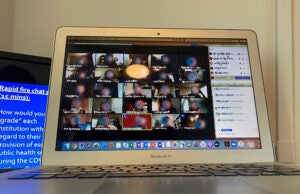
Please note, I realize my topics might lend themselves a bit more to open discussion and engagement, but I encourage you to think outside the box on how these ideas can be modified to fit your specific course.
1. Create a comprehensive Web Etiquette document and share it a week before class starts. Take the time to spell out all the expectations and then confirm their receipt of the document. For my class, I instructed students to sign the bottom of my form for participation points. This lets them know what you expect in the very beginning. If they start with cameras on, they’re likely to stay that way. Changing behavior later is generally more difficult. I also invited them to come to class about 10 minutes early just so we could chat and get to know each other. That seemed to put them at ease and perhaps created an environment that was more conducive to having their cameras on.
2. Set the bar high to start. For my class, I explain that this is a hybrid synchronous and asynchronous class. While there are always make-up options for those in different time zones or who have to miss synchronous class from time to time, they still have to engage with me, each other and their class discussion board. Additionally, I let them know that Zoom is no different than our regular classroom and that participation is graded.
|
Sample text from my Web Etiquette document General Rule of Thumb: Treat Blackboard and Zoom as you would any other interaction with me in a physical classroom or in office hours. The online format does not lessen my expectations of what constitutes meaningful engagement and participation, appropriate communication/presentation and dedication to this class. Remember, participation and engagement (synchronous and asynchronous) accounts for 10% of your grade.
|
3. Explain why their attendance and presence is important. Oftentimes students feel like attendance is an arbitrary part of their grade. I find that by explaining the pedagogical value behind their presence and engagement, they come to understand why it’s important and are more likely to buy into the process. I also emphasize that them having their cameras on helps me to better serve and teach them. When they see it as a benefit, rather than a requirement, it tends to go over better.
| Sample text from my Web Etiquette document
Attendance
Use of Web Cameras
|
4. Commend and acknowledge them for their participation. Positive reinforcement works. Try to say hello as they pop into the classroom, ask how their week is going, chat about news that relates to your course and so on to encourage the conversational feel we often get in our live classes. Also, actually reward and track participation. Again, in getting away from that feeling that “participation is arbitrary” having a participation rubric [SEE MY PREVIOUS POST ON PARTICIPATION], reinforces the fact that this is serious and worth something to their grade.
As we move into week 3 of this summer class, I can attest that students are still using their cameras and indeed makes the online teaching endeavor much more enjoyable.
If you have any questions or suggestions for topics, please email me at smgibson@usc.edu.