Tips on working with guest speakers on Zoom
By Andrew Chater, Adjunct Professor of the Practice of English – June 19, 2020
I’ve spent the past month teaching an online version of a USC Maymester, which in the pre-Covid age I’ve taught annually on location in New Orleans. The challenge was to retain some of the immersive flavor of the class – so I invited some of my New Orleans contacts to join us.
We shared our Zoom classroom with a chef, Scot Craig, who cooked us a crawfish etouffee; we heard New Orleans jazz standards played by Louis and Lars, two Preservation Hall legends; we went on a virtual tour of an Antebellum sugar plantation, courtesy of Demond ‘Ali’ Johnson, one of the Whitney Plantation’s inspired team of historical interpreters; we were serenaded in Cajun French by a friend of mine, Joel Breaux, who was born and bred in the bayou.
These guest sessions proved, not surprisingly, the highlight of the class. They brought the flavor of the Big Easy into our lockdown lives. But inviting guests into the on line teaching space takes preparation. So here are my thoughts on managing the process – recruitment, reimbursement, and the logistics of working with guest speakers on Zoom …

I had a clear sense of the kind of guests I wanted. I didn’t just want proxy lecturers. Their role was to add immersive depth to the learning experience. I wanted them to conjure the sensations and feelings that are integral to the culture of New Orleans. Music, clearly, would be part of that, and ditto food. But also, there was an emotional impact I hoped to deliver that could only come from locals. My guests brought a range of cultural experience to the mix – African American, Cajun, Creole. They shared with my students not just their passions and their skills, but their life experiences and outlook.
I sourced most of the guests from personal contacts made on previous trips. Some I found through local institutions – Preservation Hall, the jazz venue, and the Whitney Plantation, a museum/ interpretive center with an impressive education department. A couple of guests I found by word of mouth, asking local contacts for advice. (“Do you know of a Creole chef who’s not too busy, and likes people, who might be prepared to cook us a signature dish on Zoom, whilst fielding questions about the culture of gastronomy in New Orleans … ?”).
About five or six weeks in advance of the class, I contacted my prospective guests and pitched the idea – that they should join my students, on Zoom, for an hour, on a specified time and date some weeks into the future. (The long lead-in time helps – people are more likely to commit to something that doesn’t feel imminent).
They were intrigued and flattered to be asked, but nervous, too, especially those of them unused to speaking in public. I wooed them, describing the pleasure my students would feel in their company – which I knew to be true. I balanced a concrete request – that they should cook a signature dish/ play some jazz – with the promise of good conversation; not a lecture, but rather an informal chat about their experiences and their passions. I stressed the pleasant informality of the online space.
When they agreed (at least in theory) I followed up with an email, expressing my pleasure, confirming everything, and nailing the day and time – and I wrote them into the syllabus.
Pre-Class Logistics
I reconnected with my guests about ten days before class, to confirm the specifics and to share how much my students were looking forward to meeting them – a marvelously devious form of emotional blackmail, which ensured that no one backed out.
Then we discussed logistics: reiterating the time, clarifying PST/ Central Time etc. Confirming that they have Zoom and knew how to use it (everyone, it seems, does). Establishing whether they’ll be using a laptop (best option), or an iPad or a smartphone (worst option).
If they need to do more than sit at a desk, we discussed the practicalities. If playing the piano – how would they position the laptop so we might see both their face and the keys? If cooking – how will we be able to see the whole cooking space? (In the end, our Creole chef had his partner walk with him, offering a great shot on the screen as Scot moved around the kitchen).
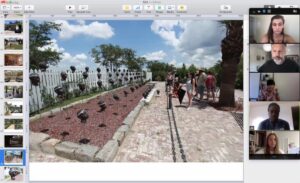
For some of my guests, there was more specific planning required. For instance, how to replicate a tour of the Whitney Plantation? I’d taken a tour with Ali in previous years, and his power of historical interpretation had impressed me deeply – but how would he fare divorced from the site itself, the physical location that gave his tour such meaning? My solution was to prepare a Keynote presentation, compiled of the many photographs I’d taken at the Whitney on my various visits. During the class, I would ‘share screen’ on Zoom, moving between Ali and the Keynote, illustrating Ali’s talk, and prompting the trajectory of the ‘virtual tour’. It worked brilliantly. But my point is that all this took preparation and discussion, liaising with Ali to create the best class for his particular circumstances.
Managing the Online Experience
A day before the session, I sent each guest their Zoom login details.
My morning classes were subdivided with a half hour break – so it made sense for me to use the second half of each session as the guest sessions. Before the break, I discussed with my students what lay ahead – introducing the agenda, and prompting thoughts for discussion and conversation. I then timed the guests to ‘log on’ five minutes before the end of the break, giving me a few minutes to say hello, and to check picture and audio quality before the class resumed.
During each hour-long guest session, I was there to mediate and moderate, steering the trajectory of the learning experience. But the more the students asked questions, the better the whole; their participation encouraged the guests to open up. As I’ve explained, none of my guests were there to lecture; they were there to spend an hour with us, in companionship and conversation. We took what they offered us – music, passion, insights, wisdom – and fed it back with laughter and ease.
We had technical glitches, of course. Two musicians on separate screens is a no-no – Zoom will try to mute out one or the other. But all glitches can be overcome. Louis and Lars, our two jazz musicians, played in turn, passing the theme back and forth between them. It wasn’t perfect – but it was joyful nonetheless.
Honorariums and Reimbursements
I offered an honorarium in some cases, but not in others. Professional jazz musicians out of work during the lockdown? – yes, of course. But my Cajun friend Joel – an architect by trade – thought the idea of joining my class sounded fun , and so it proved. He riffed on bayou culture and played his fiddle and accordion. He didn’t ask for payment, nor expect it. For those for whom payment seemed appropriate, I offered $150. For Scot, the chef, a busy professional used to doing a certain amount of local TV, I offered $200.
To pay an honorarium, I asked for full names, addresses, and telephone numbers in my confirmation email. I passed these details to my departmental administrative manager (thanks, Flora!), who sent the prospective guest a W-9, and inputted them into the USC system as a supplier. Officially, for an honorarium to be approved, the speaker needs to be mentioned by name in the syllabus – so I issued a revised version of my syllabus just before class began, by which point most, if not all, of my guests were confirmed.
For the Whitley Plantation, we paid the institution rather than the individual. Ask for an invoice, and submit the invoice to your administrative manager. But be aware of a potential confusion here. An institution can invoice for a service – a virtual tour, for instance. But if they field representatives to talk to an online class, USC might define that as an honorarium. I found this a strange distinction; best to seek advice.
Clearly, all the above depends on having a budget to spend, and budgets must be negotiated in advance. My New Orleans class is defined as a ‘special session’, and budgeted accordingly; but for most classes there should exist some kind of budget for honorariums. Ask, and it shall be given to you – touch wood.
So, yes – including guests in the Zoom classroom takes thought and preparation and a degree of administrative hassle. But it is richly rewarding. My only regret is that we didn’t get to taste Scot’s crawfish étouffée – it really did look delicious.