Ideas for using Blackboard tests for collecting and grading student work both in and out of the classroom
By Christa Bancroft – June 19, 2020
If you have created asynchronous material for your course that you would like to make sure that students complete, I would suggest using Blackboard tests.
Blackboard tests for asynchronous work:
My syllabus directions are as follows for asynchronous work and Blackboard quizzes to be taken after asynchronous work is complete at home:
| Lectures
All lectures will have an audio and written transcript section that should be read or listened to at home before coming to lecture that day. There will be quiz questions associated with the at-home portion of the lecture on Blackboard prior to coming to lecture. The remainder of the lecture slides will be presented in class. |
| Assignment Submission Policy
Answers to quiz questions for flipped lectures (asynchronous lecture content) should be submitted prior to the start of class at __ a.m. |
Suggestion for implementing Blackboard quizzes/tests on asynchronous work:
I use simple 1-pt. questions that test whether or not the students listened to or read the asynchronous assignment. I usually have 2-3 quiz questions that test for completion, not high-level comprehension. This motivates the students to do the work and ensures they are prepared for synchronous class time.
Here’s an example of a quiz question from my biochemistry class:

Blackboard tests for synchronous work:
My syllabus directions are as follows for synchronous work meant to be completed during class time:
| Assignment Submission Policy
Answers to group work assignments should be submitted before lecture section ends at _ a.m. Any technical difficulties or other issues that result in your not being able to submit on time should be brought up to the professor in class |
An idea for allowing pairs or small groups to work together on in-class assignments is to use the Zoom Break-out room function, where you can randomly or intentionally assign students to break-out rooms to work together on the assignment.
Though students can collaborate to solve the problems, have each student submit their answers to the questions individually on Blackboard for grading and credit.
Suggestion for Blackboard quizzes/tests on synchronous work:
–These assignments can incorporate more high-level comprehension because students are working together and have now learned all of the content for a particular lecture (asynchronously and synchronously). I usually assign more points for this work (5 pts. per class) and the questions are data analysis or comprehension and application of scientific passages. My questions are usually multiple choice for ease of grading in large classes, but you could collect free-response answers for smaller sections.
Example passage question:
Two students performed an assay to determine the concentration of lactase in a commercial preparation used to make milk consumable by those who are lactose intolerant. Lactase catalyzes the cleavage of lactose (β-D-galactopyranosyl-1→4-D-glucose) into β-D-galactose and D-glucose. A glutamate residue (Glu-1) in the active site donates a proton to an oxygen atom. Another glutamate on the opposite axial side (Glu-2) acts as a nucleophile to liberate D-glucose and generate an α-D-galactopyranosyl-modified enzyme intermediate. Then, Glu-1 deprotonates water, and the resulting hydroxide ion acts as a nucleophile to liberate β-D-galactose and regenerate the enzyme.
Rather than use lactose as a substrate, which is difficult to quantify spectroscopically, the students chose Compound 1, which produces β-D-galactose and yellow Compound 2 under the action of lactase (Reaction 1)
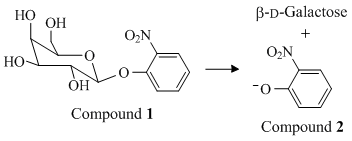
Reaction 1
The students prepared stock solutions of Compound 1 in four different concentrations in pH 7 buffer. A stock solution of the enzyme was prepared by diluting 0.100 mL of the commercial preparation to 25.0 mL in the buffer solution. Experiments were initiated by mixing 1.0 mL of each substrate solution with 1.0 mL of the enzyme solution. The initial rates Vo were measured for each trial. The students then plotted 1/Vo versus 1/[S] (Figure 1) to determine KM, Vmax, and [E]T for the four trials.


For details on how to create Blackboard tests for your class, please follow these instructions:
https://blackboardhelp.usc.edu/collecting-student-work/creating-assignments-text/
I hope this gives you some ideas for using Blackboard tests to collect students work both synchronously and asynchronously!