What will it take to end the Russia-Ukraine war? Two experts tell us
The Russia-Ukraine war is well into its third year, with no end in sight despite recent increases in pressure for peace from the Trump administration. We asked professors Robert English and Steve Swerdlow at the USC Dornsife College of Letters, Arts and Sciences — both international relations experts with personal experience in the now battle-scarred region — to explain why the war rages on, if there is a foreseeable end, and what we might expect in the aftermath.
Media professionals interested in speaking with Professor English or Professor Swerdlow should email Ileana Wachtel, director of media relations, at iwachtel@usc.edu or press_inquiries@dornsife.usc.edu.
As the war stands now, what’s at stake?
Swerdlow: The war threatens the rules-based international order (United Nations Charter) created in the aftermath of the Holocaust and World War II to prevent the usurping of territory by force and to prohibit the kinds of atrocities we see unfolding in Ukraine. The deportation of children, the occupation of 20% of Ukraine’s territory and the genocidal rhetoric from Putin, Kremlin officials and Russia’s state-controlled media are eviscerating the international human rights system that protects all of us.
Russia’s neighbors — Estonia, Poland, Lithuania, Moldova, Georgia, and Kazakhstan — as well as places further afield, like Taiwan, face growing danger. Normalizing aggression will create a world where we live in constant instability and more frequent conflict.
This is a fight between authoritarianism and democracy, and our democracy is as much on the line as Ukraine’s.
English: I do not agree that Russia’s invasion of Ukraine is a harbinger of future aggression against the West or a crusade to rebuild a Russian empire. And it is growing harder to convince Western publics that Russia is both mighty enough to threaten NATO countries and weak enough to collapse under one more set of sanctions or weapons delivery, as such contradictory messages continually issue from Brussels, London and Washington.
Rather, this war is mainly driven by Putin’s obsession with keeping Ukraine out of NATO. More broadly, Putin is demanding that the West should respect a kind of Monroe doctrine for Russia, meaning that the West acknowledge a Russian sphere of interest and stop seeking to bring Russia’s neighbors into the Western military alliance — similar to the U.S. demands in its own sphere of influence.
What human rights violations have been observed?
Swerdlow: The invasion of a sovereign state itself has been illegal since the United Nations was established in 1945. Russia’s invasion of Ukraine sparked the largest European land war since World War II. Their extrajudicial killings, torture, sexual and gender-based violence, wide-scale bombing of civilians and infrastructure, environmental devastation and mass deportation of Ukrainian children to Russia are at once war crimes, crimes against humanity and acts of genocide.
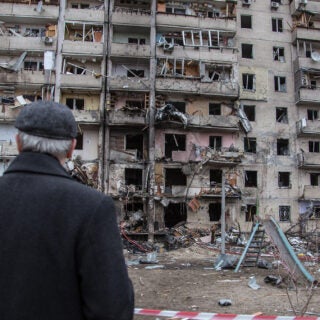
Within Russia, the invasion has fueled massive crackdowns — including a law that criminalizes all LGBT people and campaigns to disproportionately force non-ethnic Russians and other ethnic minorities to fight in Ukraine, often against their will — as well as the decimation of civil society and independent media organizations. It has also led to the largest population of political prisoners in Russia since Leonid Brezhnev was in power.
English: I have two observations: One, Russia has obviously been guilty of massive human rights violations in this war; and two, Ukraine has not been entirely innocent. We are not talking about Ukraine killing civilians and kidnapping children, of course, but rather about putting restrictions on Russian language and culture that heightened tensions even before Russia’s invasion in 2022. Even groups such as Human Rights Watch and The Council of Europe have criticized Ukraine for restricting minority or non-indigenous languages, providing grist for Putin’s propaganda mill. Russia has used the criticism to justify its invasion, claiming it’s protecting ethnic Russians from Ukrainian ultra-nationalists.
Ukraine’s policies toward non-Ukrainian languages have also exacerbated tensions with Poland and Hungary and are a key reason why much of the world does not see the war in the clear aggressor-and-victim terms that we do.
Should we should expect human rights violations to escalate?
Swerdlow: Russia has a history of committing atrocities in war since Putin’s rise to power beginning in the late ’90s. The Second Chechen War in Russia cemented Putin’s rule in the Kremlin and witnessed carpet-bombing of civilian areas, torture and extrajudicial killings of civilians, and a complete unwillingness to negotiate. Putin brought this same bellicose nature to the invasion of Georgia in 2008, the first invasion of Ukraine in 2014 and the 2015 bombing of Syria on behalf of the country’s dictator, Bashar al-Assad.
English: Historically it is absolutely true that human-rights violations skyrocket in war, and Russia’s brutality makes this war no exception. But the Russia-Ukraine war is partly bucking one trend: Since the 20th century, civilian victims have outnumbered military casualties during conflict, as they did in Bosnia, Chechnya, Iraq and Afghanistan. But in Ukraine, military casualties still greatly outnumber civilian ones.
What are the biggest barriers to peace?
English: Neither side is willing to end the war on terms that are acceptable to the other side. Ukraine will not agree to renounce NATO membership and still insists on reclaiming all its lost territories, including Crimea. Russia rejects both of those positions and insists on sweeping political changes in Kyiv. So, until the costs of continuing the fighting grow high enough that one or both changes these positions, the war will continue.
Swerdlow: Putin has turned this war into an existential fight for his own imperialist legacy, making it increasingly difficult for him to concede without appearing defeated. He has made clear that his intentions in this war are to subjugate Ukraine, deprive it of sovereignty, prevent it from having the right to join NATO. Even a temporary ceasefire is unlikely to satisfy the Kremlin’s revanchist desire to expand its imperial reach. The best outcome for both Russia and Ukraine is one that reaffirms the principles at the heart of our international system: territorial integrity, sovereignty, and democracy. That would require Russia’s withdrawal of forces from Ukraine’s internationally recognized territory and a commitment to avoid threatening future invasion.
What likely will happen in the aftermath of the war?
English: I suspect that a ceasefire will be concluded within six months and that this will harden the current line of contact into something like the division of North and South Korea. In other words, not an official peace agreement but a de facto one.
It could be that a post-Putin Russian leader will seek reconciliation with the West and restore some lost territories to Ukraine as the price of ending Russia’s pariah status, but that possibility currently seems remote. Unfortunately, while Russia will recover within a decade or so, Ukraine has been devastated and probably set back an entire generation or more. It has lost much of its industry and many resources, including millions of refugees abroad who may never return.
How would you advise each countries’ leader to arrive at a peace agreement?
Swerdlow: President Trump has recently changed course, seeming to recognize that Putin and the Kremlin have no desire to make peace and that the only way to end this war is to provide Ukraine with the military and political support they need. I believe the U.S. should join the effort to transfer frozen Russian sovereign assets to Ukraine and invest in civil society and human rights in Russia and Ukraine. That includes backing nongovernmental organizations’ ability to monitor abuses, providing support for political prisoners and developing independent media.
The work of Radio Free Europe and the Voice of America, the National Endowment for Democracy and the Bureau of Democracy, Human Rights, and Labor at the U.S. Department of State are vital to ensuring a lasting peace and supporting those that could work peacefully for a more democratic, stable Russia while also helping to strengthen Ukraine’s civil society.
English: Europe and the U.S. — basically, the NATO countries — have given Ukraine billions in military and economic aid. They have also imposed the most sweeping economic sanctions in history on Russia. None of it has sufficed. On the contrary, Russia is slowly advancing deeper into Ukraine.
Meanwhile, the political will to continue aiding Ukraine is weakening. Competing priorities from the Mideast to China are drawing attention elsewhere, and right-wing populist trends in many Western countries — including the U.S. — prioritize domestic interests and don’t see Russia as a major threat beyond Ukraine. So, it’s hard to see the West introducing any “game-changing” new measures toward ending the war.
I would advise both Putin and Zelenskyy to consider the long-term cost that their respective countries will pay for their stubbornness. Does Putin want to leave behind a pariah state dependent solely on petroleum exports, falling technologically and economically further behind with its best minds following an exodus of talent abroad? Russia financed much of this war on a credit card, so to speak, and when the bill comes due, it will mean long-term stagnation and declining living standards. Putin’s legacy will be one of shame, with his country one day even undertaking a sweeping “de-Putinization.”
For his part, does Zelenskyy want to leave behind a Ukraine that ends up completely hollowing out the rest of the country, in the hopes of recovering some war-torn eastern territories that were largely ethnically Russian even before the war? Ukraine’s population in 2022 was about 44 million. Now, with war deaths, collapsing birthrates and large portions of refugees abroad — most of whom will never return — conservative estimates put the population at 15 million by the end of this century. There is no Marshall Plan for Ukraine that can fix that, even if Ukraine’s backers could spare the trillions that it would require.
Our Scholar Experts
Robert English, associate professor of international relations, Slavic languages and literatures and environmental studies at USC Dornsife, has studied the history and politics of the USSR and Eastern Europe, with a particular emphasis on Russia, since he was a student at the University of California, Berkeley and Princeton University. He also draws on his earlier experience as a policy analyst for the U.S. Department of Defense and Committee for National Security. He frequently provides insight on the war for major media outlets such as CNN, the Los Angeles Times and Voice of America.

Steve Swerdlow, associate professor of the practice of political science and international relations at USC Dornsife, has studied both Russian and Ukrainian languages, history and law at UC Berkeley, Columbia University and Harvard. This includes studying, living and working in Russia and Ukraine as a human rights researcher, lawyer and scholar for significant periods over the past three decades. He has taught international human rights law as a visiting professor at Ukraine’s Kyiv School of Economics for the past two summers.
Media professionals interested in speaking with Professor Robert English or Professor Steve Swerdlow should email Ileana Wachtel, director of media relations, at iwachtel@usc.edu or press_inquiries@dornsife.usc.edu.
Inside Ukraine: The War Up Close and Personal

Invited by Ukraine’s Kyiv School of Economics to teach a course on international human rights law, Steve Swerdlow served as visiting professor in both 2024 and 2025. He also conducted research in several regions across Ukraine. Here, he recounts his experience in the war-torn country this past June.
This summer, I visited Ukraine for the second time since Russia’s full-scale invasion in 2022. I arrived in June during a period of intense bombings, spending nearly every night in a shelter. One night, crowded together with local Kyiv residents, their baby strollers and pets in tow, we listened to the sounds of approaching bombs and drones, trying to distinguish which ones had made it through the air defenses, as CNN and the BBC aired round-the-clock coverage of similar attacks in Iran and Israel. Three floors underground, I realized that somehow, despite Putin’s relentless attacks on Ukraine’s people, the war had faded from the global spotlight.
Also, on previous visits, I often heard unreserved gratitude for the West’s military and political support. But this summer, the mood had shifted. Many expressed confusion and disappointment that Washington seems willing to entertain the fiction that Putin desires anything other than total control over Ukraine’s statehood, civilians and very identity. Ukrainians rightfully view this as an existential struggle for survival and democracy. If Russia is not defeated decisively, they fear the war will be a precursor to future acts of aggression and occupation across Europe, threatening international law and democracies around the world, including the United States.
Still, what struck me most was Ukrainians’ resilience — especially that of the students I taught. After that exceptionally bloody night of bombing, which ultimately resulted in 28 civilian deaths, every single one of them showed up to class the next morning on time. That reminded me, once again, why I had come: to resist hopelessness and to support their fight for dignity and democracy.
But the trip also served as a reunion of sorts. I was fortunate to introduce my students to my friend and colleague, well-known Ukrainian journalist, human rights defender and former prisoner of war Maksym Butkevych, who was released eight months ago after more than two years in Russian captivity, surviving unspeakable torture and humiliation. He and I arranged a public talk at the school in which he and I shared our perspectives on the importance of supporting Ukraine’s struggle, and resolving to campaign to achieve the release of the thousands of Ukrainian soldiers and civilians still in captivity.