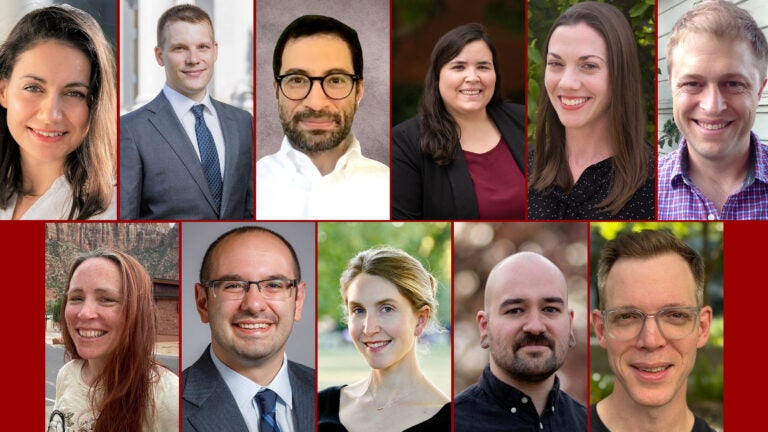
New faculty strengthen USC Dornsife’s social and natural sciences departments
Twelve new faculty members join the USC Dornsife College of Letters, Arts and Sciences this fall, including 10 in the social sciences and two in the natural sciences. Their research areas include how governments build infrastructure, how infants’ brains develop and how AI affects the labor force.
David Schönholzer | Assistant Professor of Economics
I study how societies build and organize the things we all depend on — schools, roads, public transit and public safety. My research combines economic theory with large spatial datasets and modern microeconometric tools, drawing on insights from public economics, political economy, development, urban studies, and economic history. I earned my Ph.D in economics from UC Berkeley in 2018 and am an affiliated researcher with the National Bureau of Economic Research, the Center for Economic Studies’ CESifo and the Center for Effective Global Action.
Whether I’m mapping 1,000 years of state borders or measuring the effect of new school buildings on student outcomes, my goal is to uncover how and why some governments serve their communities better than others. If you’re curious about why your neighborhood looks the way it does, or why some communities or countries thrive while others struggle, that’s exactly what I spend my time researching.
Michael Droste | Assistant Professor of Economics
I am a macroeconomist who is primarily interested in government policy and the macroeconomy, the entirety of an economic system. My research blends quasi-experimental statistical methods with structural macroeconomic models. In my dissertation, I studied how competition between firms in labor markets mediates the impact of government policy on inflation and output. I have also written about unconventional monetary policy, specifically studying how the Federal Reserve’s quantitative easing programs after the 2008 Great Recession impacted financial markets and the real economy. Some of my ongoing research studies the impact of state and local business taxes on investment and business activity. I received a PhD in economics from Harvard University in 2024 and a BA in economics and mathematics from Swarthmore College in 2014.
Milena Djourelova | Assistant Professor of Economics
I am an applied microeconomist specializing in political economy. My research examines how information and media influence public attitudes and political behavior, with applications to topics such as immigration and climate change. I am also interested in the political economy of clientelism — the exchange of goods and services for political support — and electoral institutions. I was born and raised in Sofia, Bulgaria, and received my PhD in economics from Universitat Pompeu Fabra in Barcelona, Spain.
Heather Kosakowski | Assistant Professor of Psychology
I had a nontraditional path through academia that included foster care, the Marine Corps, working at Starbucks, and being a single mother. I began my academic journey at a community college and gradually found my way to the field of developmental cognitive neuroscience. Being a new professor at USC Dornsife is an achievement I never would have dared to dream about as a child. Now I get the honor of sharing my passion for the infant brain and mind with my colleagues and students. In my research, I use functional magnetic resonance imaging (fMRI) to study how infants’ brains work while they process sounds, movies and their social environment.
Katharina Kircanski | Assistant Professor of Psychology
I study mood and anxiety disorders across childhood and adolescence. My research integrates brain imaging, lab-based and naturalistic methods, and quantitative tools to help unravel the complexities of how mood and anxiety symptoms develop and are maintained over time. I am particularly interested in the ways in which youth process both rewarding (positive) and threatening (negative) stimuli and experiences in their environments. Additionally, as a clinical scientist, I investigate ways to optimize treatments for anxiety and related disorders by harnessing insights grounded in cognitive and behavioral science.
Samuel Nastase | Assistant Professor of Psychology
The core questions driving my research are, “What is shared between individual brains?” and “How do we share our thoughts with one another?” — using language and other coordinated actions. My research combines naturalistic neuroimaging paradigms (Functional MRI, Electrocochleography) and deep learning models to better answer these questions in real-world contexts. In current work, we’re using large language models to better understand how we use language to transmit complex thoughts from one brain to another.
Valentina Gonzalez-Rostani | Assistant Professor of Political Science and International Relations
My research explores how technological change, like job automation and the incorporation of artificial intelligence in the workplace, impacts politics and society. I’m particularly interested in how these technologies influence people’s political attitudes and the rise of populist movements. I also focus on developing spatial-temporal modeling tools, which help understand patterns across time and locations, and natural language processing tools for analyzing political rhetoric. I’m currently part of the American Political Science Association Task Force on AI and Political Science, where we look at how AI affects the labor force and economic inequality, and its political consequences. Before coming to USC Dornsife, I was a postdoctoral researcher at Princeton University. I earned my Ph. in political science from the University of Pittsburgh and completed a master’s degree in public policy at Universidad Católica del Uruguay.
Eric Kramon | Associate Professor of Political Science and International Relations
My research examines challenges to both the quality and the survival of democracy, as well as programs and innovations aimed at deepening democracy and making it more responsive to ordinary people. Earlier in my career, I focused on newer democracies in Africa, conducting extensive fieldwork in Benin, Ghana, Kenya and Malawi. More recently, my work has expanded to countries in other regions, including Honduras and the United States. I am currently working on two projects. The first uses measurement models to create a new global dataset on public support for the judiciary and the rule of law. This dataset is helping to test theories about whether — and under what conditions — public support and mobilization can defend judicial independence and resist democratic backsliding. The second project uses field and survey experiments in Ghana and Honduras to investigate whether citizen deliberation and other democratic innovations can strengthen democratic governance.
Michael-David Mangini | Assistant Professor of Political Science and International Relations
I study how to differentiate between international trade flows that are potential vessels for coercive politics and those that are relatively safe. States that use commerce as a political bargaining chip must convince others that threats to interrupt market access will be followed through on. My work explains how this credibility constraint determines the scope, prevalence and effectiveness of economic coercion. In recent work, I am studying the evolution of trade dependence networks in the global economy. Previously, I received my PhD in political economy and government from Harvard and completed postdoctoral fellowships at Princeton and Yale.
Meredith McLaughlin | Assistant Professor of Anthropology
My research focuses on social policy, economic development and livelihoods. I explore how different societies approach redistribution through subsidies, social services and unconditional cash. I conduct research in India and the United States, using ethnographic methods to understand how social assistance is experienced in practice amid political and social change. I am passionate about using collaborative research approaches and comparative analysis to understand how people around the world strive towards economic well-being and imagine policy futures.
Peter Haine | Assistant Professor of Mathematics
I work in pure mathematics, with most of my research in homotopy theory (where we study spaces, but instead of worrying about exact measurements, we identify them if they can be continuously deformed into each other) and algebraic geometry, which studies spaces locally described by the solutions to systems of polynomial equations.
Being a pure mathematician means that I explore math for its own sake, driven by curiosity, patterns, and beauty. So I’m not trying to find real-world applications, but history is full of “happy accidents” in which pure math has found practical uses decades after its discovery. What draws me most to math is how creative it is, much like being a musician, novelist or artist. I grew up in the White Mountains of New Hampshire, where I developed a deep appreciation for nature and the outdoors. When I’m not doing math, I enjoy running, hiking, bouldering and spending time in nature.
Ahmed Elbanna | Professor of Earth Sciences
I obtained my bachelor’s degree in civil engineering from Cairo University. I received my PhD from Caltech and conducted postdoctoral research in physics at the University of California, Santa Barbara. My research focuses on mechanics of complex systems with applications to problems in geophysics, soft material, and engineering design. My contributions have been recognized with the National Science Foundation CAREER Award, the Journal of Applied Mechanics Paper Award, and the George Housner Fellowship, among others. I will assume the role of director of the Statewide California Earthquake Center in January 2026, leading its efforts to advance earthquake science and resilience in California and beyond.