
Special delivery of science kits lets students tackle experiments at their homes
When Elizabeth Zhou pulled the wires, alligator clips and other electrical parts from a package that showed up at her doorstep in Dallas, she felt a jolt of excitement tinged with apprehension.
The physics and computer science major had drawn countless diagrams of electrical circuits in her class notebook. But she had much less experience connecting wires, batteries and other gadgets in real life. After some fiddling and a few moments of frustration, she flipped a dial and a tiny lightbulb on the circuit glowed. Eureka!
Zhou also glowed — with pride at her newfound knowledge and abilities.
“Even if it’s a small circuit, it feels really gratifying to know that I made this circuit,” said Zhou, a senior at the USC Dornsife College of Letters, Arts and Sciences.
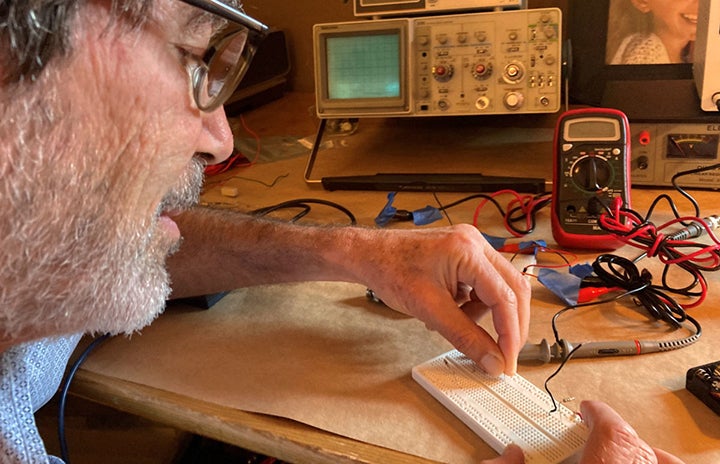
That hands-on experience is precisely why her instructor, Jack Feinberg, devised science experiments all summer. When the COVID-19 outbreak kept more than 1,000 USC undergraduates enrolled in physics labs away from campus, he organized kits full of equipment to be shipped to their homes this fall instead.
The longtime professor of physics and astronomy and electrical engineering at USC Dornsife knows that often the best way to learn is to do. And he wasn’t about to let a global pandemic keep his students from that thrill of discovery.
“I want to give them a taste of what it’s like to be a real scientist. There’s a certain joy in doing something yourself,” he said. “It’s the difference between watching a surf movie and being in the ocean. There really is no comparison.”
Shipping kits to more than 1,000 students
Before COVID-19 emerged, Feinberg had already agreed to gradually revamp USC Dornsife’s undergraduate physics lab courses over the course of several years. By early June, however, he realized most classes would be held online this fall and pushed his effort to create new experiments into overdrive.
After he secured approval — and funding — from leaders at USC Dornsife, Feinberg hunted for simple experiments that could be done at home. He adapted some from the existing undergrad lab manual, called colleagues for suggestions and found others online.
Some of the experiments proved too tricky, boring or impractical. Others needed expensive parts. But some worked out great, and he soon had a list of solid ideas.
Then he called Anton Skorucak.
A Trojan Family connection proves vital
Skorucak earned his master’s degree in physics at USC in 1999, studying under Feinberg. He went on to found xUmp (pronounced zump), an online science supply store.
When Feinberg asked him about putting together physics kits for USC students, Skorucak initially thought he meant for a class of 18 to 20 people.
“But then he sent an email saying, ‘By the way, I need these for at least 800 students,’” Skorucak said, so he called in every favor he could with his many overseas vendors.
“It was a little bit of twisting some people’s arms and a little bit of luck,” he said.
A container ship carrying many of the needed supplies cruised into the Port of Long Beach in mid-August. Skorucak assembled and shipped the kits in time for USC’s labs to start during the third week of the fall semester.
At last count, 1,053 shoebox-size parcels went out to students and teaching assistants across the country and beyond. Nearly 100 kits traveled abroad to places like China, Brazil, Vietnam, Costa Rica, Hong Kong, Canada and Singapore.
Remote learning has its benefits
Zhou enjoys the troubleshooting she has to do when plans go awry in one of her experiments. She is taking Feinberg’s advanced lab this semester and hopes to pursue a doctorate in physics.
After a friend told her about the kits Feinberg sent out spring semester, she was excited to try new experiments from home this fall.
“For those of us who want to continue to do hands-on work or applied physics, we’ll have to make that transition from theoretical proofs and diagrams we draw in our notebooks to actually implementing them and working with the materials,” she said. “It’s humbling to realize that even with basic circuits, I’m still building my intuition.”