Healing Heartwork Toolkit: Exploring Self
by Sondos Kholaki
April 9, 2021
Introduction to Healing Heartwork
In response to the emerging needs of AMCLI fellows, the USC Center for Religion and Civic Culture (CRCC) has crafted toolkits focused on deepening our understanding of Islamic modalities for healing and wellness. Released each Ramadan from 2021 to 2023, each Healing Heartwork toolkit presents three parts that can be applied toward self-care and community care.
Each year, the objective of the series is to:
- Educate fellows on the Islamic modalities indigenous to the faith that can be used as tools of self-care and community care.
- Provide fellows with the agency and opportunity to ground their well-being practice in the example of the Prophet Muhammad ﷺ and authentically reconnect to our rich and comprehensive spiritual tradition.
- Boost fellows’ mental health and resilience through healing heartwork and the creation of a community of practice and care,
Volume 1 of Healing Heartwork, Exploring the Self, focuses on cultivating afiya, or emotional well-being, through practices that create moments of sakina, or tranquility.
Volume 2 of Healing Heartwork, Exploring Loss, centers on janazah, or funeral rites, as a way to address experiences of grief during the global pandemic while creating opportunities to pause and reflect on the losses endured, drawing peace from spiritual practices focused on honoring the body, mind, heart and soul.
Volume 3 of Healing Heartwork, Exploring Joy, focuses on humor and comedy in Islam, alongside other modalities for cultivating joy and lightness of being, both in our everyday lives and in our work in the world.
Why Healing?
Islam, the religion that Allah perfected for all of creation (Quran, 5:3), remains a tradition of healing. In times of crisis, religion and spirituality offer invaluable coping strategies for our enhanced emotional well-being or afiyah. Emotional well-being includes the ability to express and manage thoughts and emotions, maintain a positive sense of self-worth, utilize practices for resilience, and sustain self-care and support networks in the midst of hardship.
Our beloved Prophet Muhammad ﷺ said: “It (Ramadan) is the month whose beginning is mercy; its middle, forgiveness; and its end, emancipation from the fire.” For each ten-day period of Ramadan, then, we will explore healing modalities around mercy/compassion, forgiveness, and safety toward the enhancement of our afiyah, individually and collectively, with God’s Grace and Guidance.
About Chaplain Sondos Kholaki
 Chaplain Sondos Kholaki serves as a hospital staff chaplain and a community chaplain in Southern California. She is a board-certified chaplain with the Association of Professional Chaplains (APC). Sondos earned a Master of Divinity degree in Islamic Chaplaincy from Bayan Islamic Graduate School/Claremont School of Theology and a Bachelor of Arts in English and Creative Writing from UCLA as a Regents Scholar. Sondos completed five units of Clinical Pastoral Education (CPE) residency where she served care seekers of all faiths and educated staff and volunteers on Muslim spiritual care. Sondos is the author of Musings of a Muslim Chaplain (January 2020) and the co-editor of Mantle of Mercy: Islamic Chaplaincy in North America (fall 2021). She also serves as Vice President of Healthcare for the Association of Muslim Chaplains (AMC). Sondos enjoys sipping a perfectly brewed cup of coffee, listening to Quran recitation by Turkish reciters, and singing her heart out at spiritual gatherings. She is married and has two children.
About AMCLI
The American Muslim Civic Leadership Institute (AMCLI) develops and trains American Muslim leaders who are committed to civic engagement. AMCLI strives to accompany these pioneering leaders as they realize their full potential and, in doing so, have a more effective and sustained impact on the issues affecting their communities and America at large.
The Healing Heartwork Toolkits are a collaboration between AMCLI and Chaplain Sondos Kholaki.
Exploring Self

Deepening our understanding of Islamic tools for healing, self-care, and community care
Download a PDF of Healing Heartwork Toolkit: Exploring Self
For a donation to AMCLI of more than $100, you will receive a printed gift set of three Healing Heartwork toolkits. Please click here to make a donation.
Ramadan is a time for reflection, spirituality, and nurturing a connection to the Divine, self, and community. After a difficult year, AMCLI hopes that this series will provide tangible tools that can increase the resilience and mental health of American Muslim civic leaders in the AMCLI network.
AMCLI partnered with Chaplain Sondos Kholaki, who developed this program based on her years of experience in supporting and accompanying individuals in crisis on their healing journey. Over the month of Ramadan, AMCLI Healing Heartwork with Ch. Sondos Kholaki released the series in three parts with each part focused on a relevant Ramadan theme.
- Part One: Mercy and Compassion, centered around cultivating personal afiyah (well-being) and mental health.
- Part Two: Forgiveness, which will explore ways to finding grounding, resilience, and redemption.
- Part Three: Safety, how can we create moments of sakina (tranquility)
Read on below, or click on the links in the menu to explore the content.
Part One: Mercy and Compassion
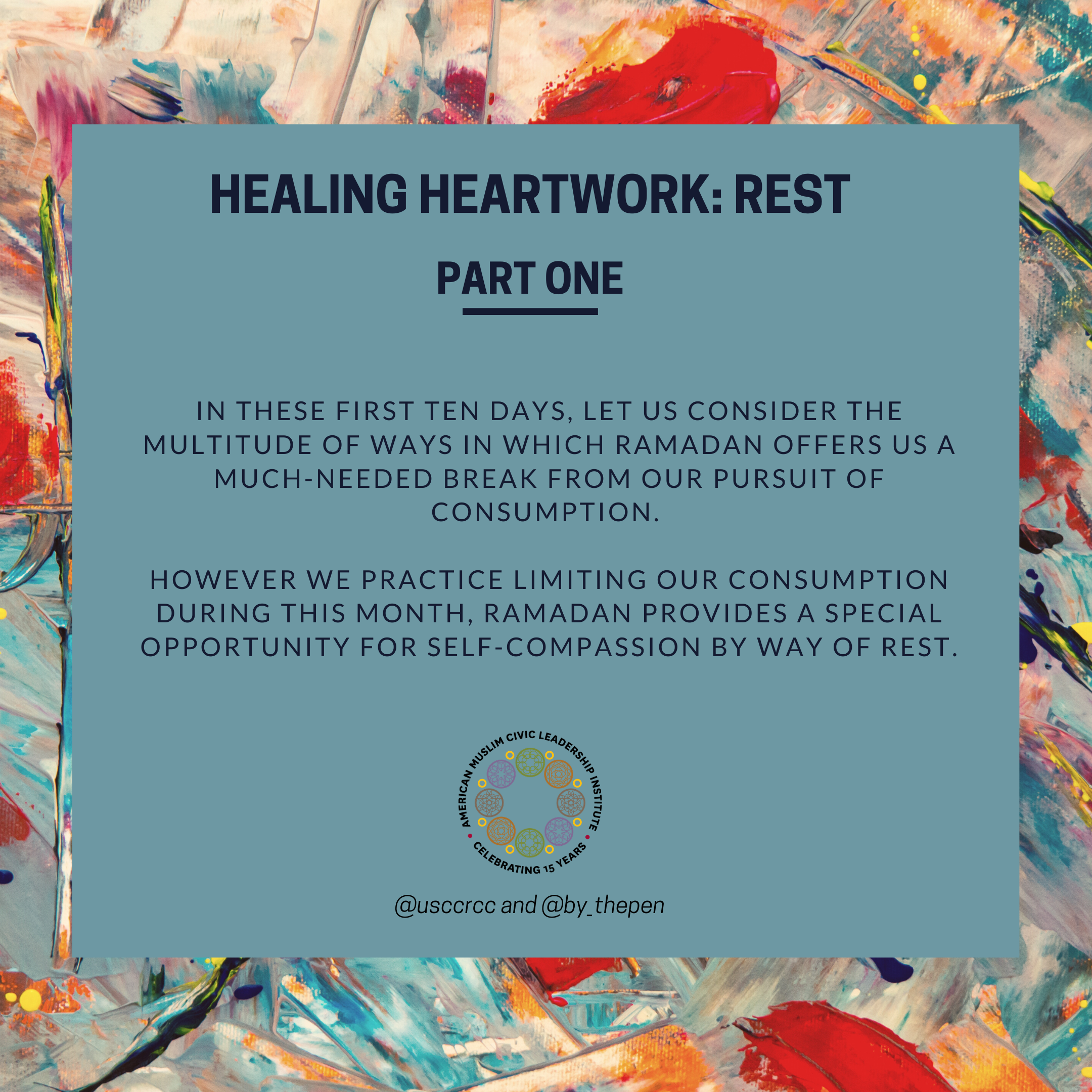
Rest: In these first ten days, let us consider the multitude of ways in which Ramadan offers us a much-needed break from our pursuit of consumption.
In the Qur’an, we understand that, as humans, we incline toward haste (21:37) — most days, life seems to manifest as an incessant stream of consecutive appointments with little time for pause. Through an intentional abstention from food and drink and from anything that distracts us from the remembrance and worship of God, Ramadan offers thirty days of conscious pattern-breaking, where we intentionally disrupt our hurried schedules to allow new meanings and spiritual understandings to emerge. Without the annual, welcomed disruption, we may settle deeper into our patterns, habits, and assumptions without creating the rest necessary to consider new ways of being and doing.
However we practice limiting our consumption during this month, Ramadan provides a special opportunity for self-compassion by way of rest. The hunger we experience during fasting serves as a slowing mechanism—without constant fuel from food and drink, we develop an acute awareness of the body wherein we may feel compelled to nap or recline. Rather than fight through our weariness — accumulated over the last eleven months of our daily grind — we may practice self-compassion and mercy by way of rest toward our precious physical form, gifted to us as a beautiful trust (amana) by God so tenderly and intentionally: “We have indeed created humankind in the best of molds” (Qur’an, 95:4). Our beloved Prophet Muhammad ﷺ cultivated healthy sleep habits that Muslims have practiced throughout the centuries, from sleeping soon after Isha prayer and waking with the arrival of Fajr prayer to taking an afternoon nap called a qaylulah after Duhr prayer. Practicing these prophetic sleep habits helps to maintain our energy and overall health, especially during Ramadan. Fasting invites this slowing down the process as we complete a task, take much-needed rest to recoup, and gently move again.
Reflection and retreat offer other forms of rest during Ramadan. While fasting, we may find that our fitra, or natural disposition, recoils from excess noise and mindless consumption and instead craves stillness. Our tradition encourages seclusion in nature, where our fitra and spirit may reconnect to the energy in the earth by sitting directly on the ground, or feel lulled into tranquility by the whispered dhikr of all the organisms, or recapture a primordial humility in the presence of a magnificent sunrise and sunset. This practice of retreat may manifest as simply sitting alone in our backyard or balcony with a string of prayer beads in our hand, or holding nothing at all. When we rest in the midst of the non-anxious energy of the natural world, our dysregulated systems sync to the regulation of Allah’s creation, which soothes us. We may find our capacity for mercy and compassion to all, following in the example of our beloved Prophet ﷺ, restored and replenished in rest and retreat.
Expression: “Tears are a mercy.” – Prophet Muhammad ﷺ
As we practice self-compassion by leaning into rest, we may also turn our attention toward our thoughts and emotions. Every emotion that surfaces plays an important role in alerting us that something is off, sort of like a God-given internal security system. If we distract from, rationalize away, suppress or ignore those inner signals, our bodies will absorb the emotional pain, which eventually manifests in some form of somatic disruption. When we can better understand ourselves–triggers, traumas, and wounds—so grows our understanding of and connection to others. God has ennobled humankind (17:70) with the incredibly unique capacity to both feel and be able to name the feeling (2:31). Whether during the death of his infant son, Ibrahim, or upon hearing especially moving verses of the Qur’an, our beloved Prophet ﷺ expressed his emotions openly and declared his tears as a tender mercy, thereby extending an invitation to all of us to emote as a healing practice.
When we are hit with a barrage of emotions, muraqaba (self-observation) invites us to pause, observe and name the thoughts and emotions surfacing, locate their source, and then engage in muhasaba (self-accountability) to assess our state.
Through this practice, we remain in a compassionate and curious evaluation of our thoughts and emotions. We may ask ourselves questions like, “What am I feeling (name the emotion), and what prompted the emotion? Why am I responding in this way, and is my response informed by my ego or from a sincere, grounded place? What remains raw or unhealed within me, still? Which voice emerged for me at that moment — my lower self or my higher self?”
Once discerned, we may choose to speak to a trusted friend or counselor about the thought and subsequent emotion, evaluate our need for pause and rest and practice engaging in dhikr (prayerful mantras) and duaa (supplication) — in essence, shifting our focus back to Allah and reminding our heart that we are not alone on our journey but that the Perfect Companion and Friend accompanies us throughout. In the Islamic tradition, this practice of muraqaba and muhasaba captures the real meaning of mindfulness and meditation. When we can begin to recognize our lower self dictating unhelpful thoughts and motives, only then can we begin the difficult and relentless work of refining our nafs, or ego, through dhikr remembrance, prayer, and repentance such that our every thought, word, and action begins to reflect the beauty and mercy of the Divine.

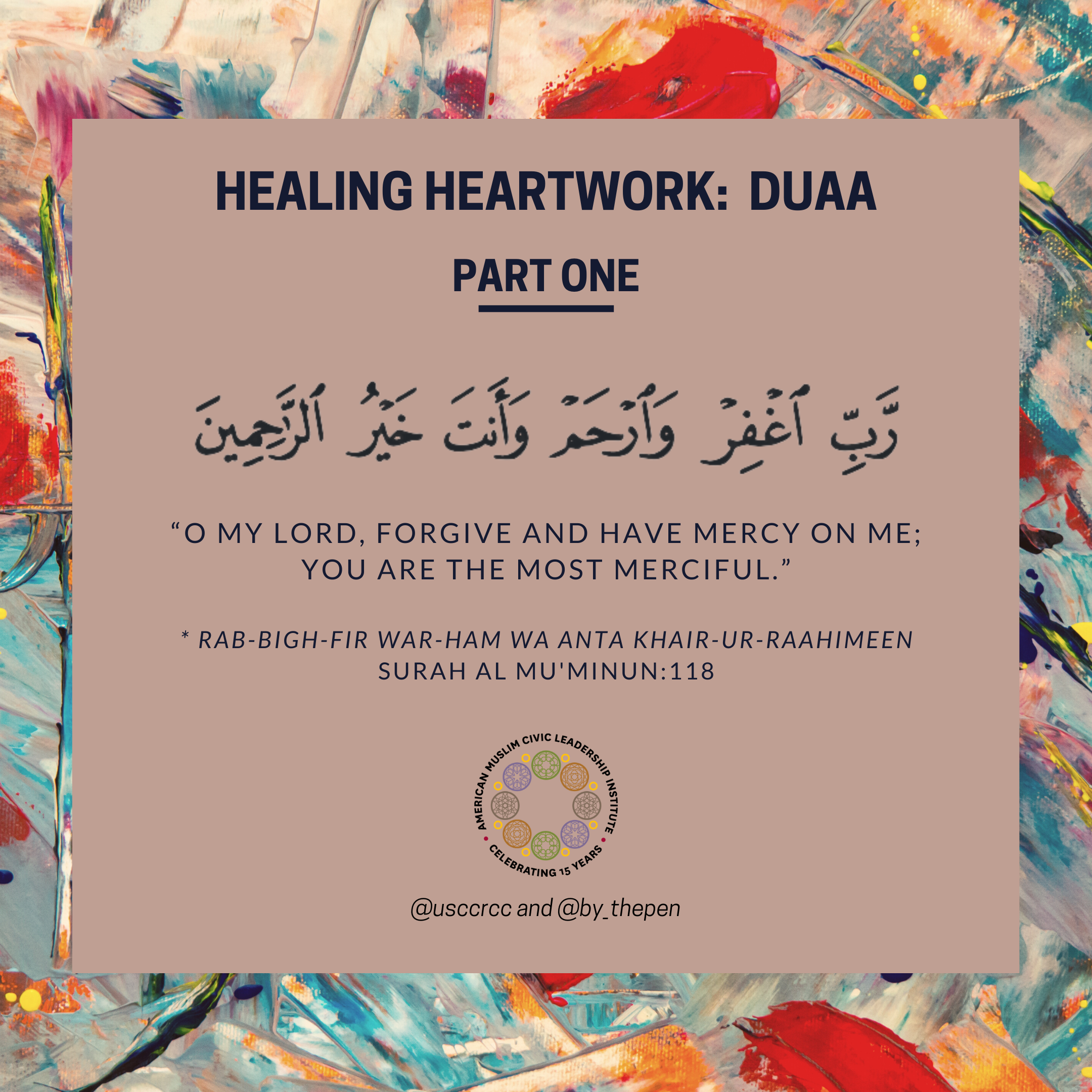
Suggested duaa for these first ten days:
“O my Lord, forgive and have mercy on me; You are the Most Merciful.”
* Rab-bigh-fir war-ham wa Anta Khair-ur-Raahimeen. (Surah Al Muminun:118)
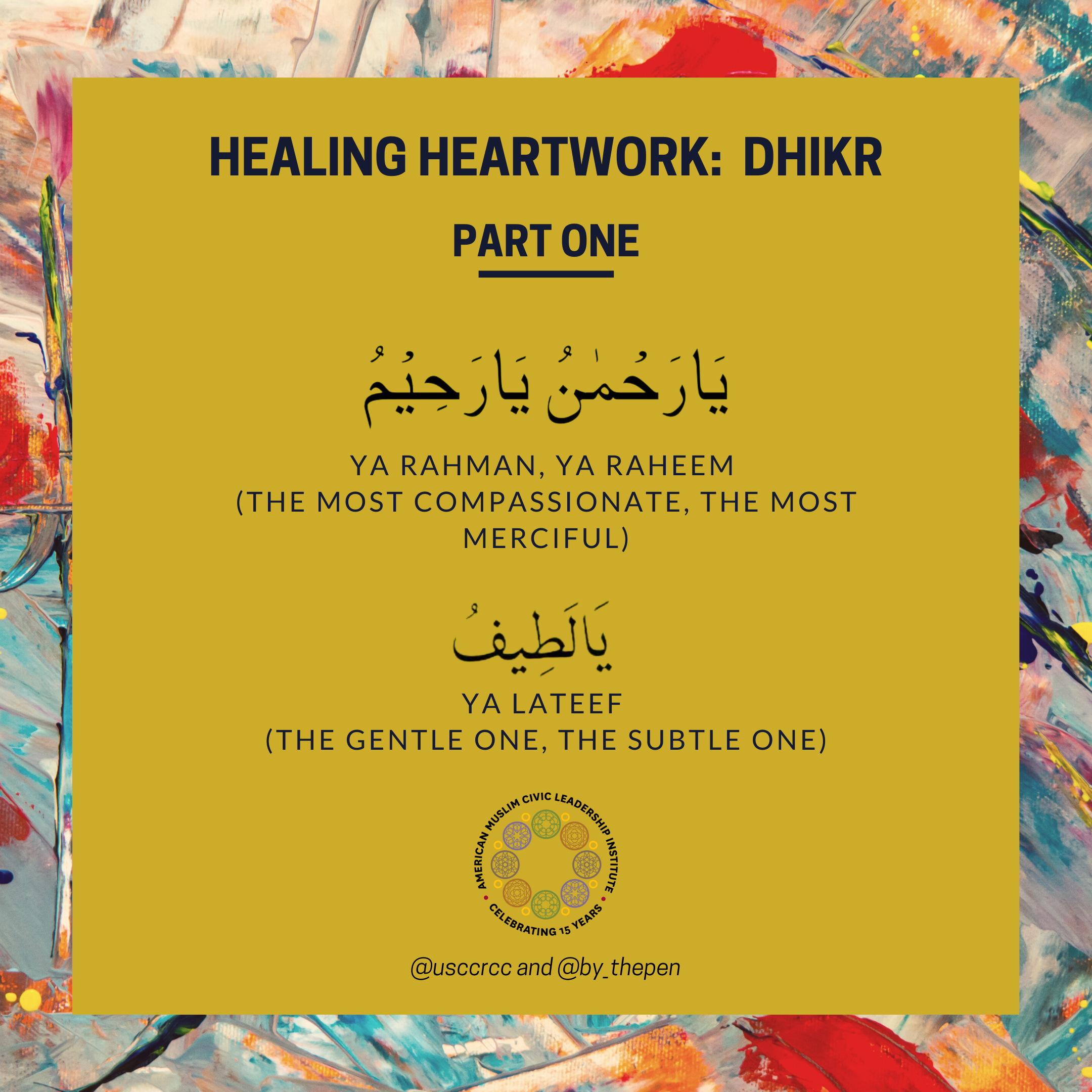
Suggested dhikr* for these first ten days:
Ya Rahman, Ya Raheem (The Most Compassionate, the Most Merciful)
Ya Lateef (The Gentle One, the Subtle One)
*Note on dhikr:
One may engage in dhikr using prayer beads to keep track, generally counting 33 or 99 beads. Additionally, our beloved Prophet ﷺ taught us how to use our fingers to keep track, notably through the use of tapping the thumb at certain points on our fingers, thereby emulating tapping therapy known as EFT, which creates balance in the body’s energy to control stress. Using either of these forms of dhikr, combined with the metaphysical power of the words and phrases taught to us by the beloved Prophet ﷺ, result in incredible stress relief and inner tranquility (13:28).
In Islam, healing is literally at our fingertips.
To download the full infographic for Part One: Mercy and Compassion, click below:
Part Two: Forgiveness
Growth Mindset: We build afiyah, or emotional well-being, through resilience cultivated by retaining a positive and hopeful outlook when faced with hardship.
In the Islamic tradition, hardship presents as a transient season of qabd, or state of contraction, to endure and learn from, and as a means by which we may turn to Allah and grow spiritually and emotionally. By recognizing our potential for spiritual and personal development in challenging times, as Muslims, we may position forgiveness — the theme of the second stage of Ramadan — within a growth mindset.
Ramadan occupies a different calendar month and subsequent number of fasting hours each year, suggesting a profoundly symbolic mirroring of life in its qabd (contraction) and bast (expansion) seasons. Without the seasons of qabd, we may lose our ability to fully appreciate the seasons of bast, or expansion and respite. Perhaps we appreciate the slower pace and rest that Ramadan brings precisely because the preceding eleven months proved so grueling. And perhaps we savor that first sip of water and bite of sweet date fruit at Maghreb, prayed just after sunset, precisely because we know intimately the feeling of deprivation; water and dates simply do not taste as delicious during any other time of year.
Spiritually speaking, some years, we may breeze through Ramadan and, other years, we may enter into and depart from the month in struggle. During some seasons, we may not feel the urgency of repentance and, during other seasons, the practice of repentance remains a desperate lifeline.
At the beginning of Ramadan, we may have reflected on how to use this precious time to grow in connection to Allah. Nearly two weeks later, how are we approaching this question? Maybe we planned modestly and achieved many of our goals but only for a brief time. Or, maybe we made lofty goals and fell short. Or, maybe we found the question itself so daunting, we never really formulated an answer.
Our mindset of spiritual growth occurs not in checking off boxes of “goals” but in our sustained, heightened sense of humility when acknowledging our shortcomings, flaws, and ceaseless inner heart-work.
Without our seasons of spiritual qabd, we may increasingly and arrogantly depend on our own selves and our perceived good deeds instead of on Allah and His Grace. Why would we turn to Allah for anything if we have our metaphysical and physical lives figured out?
As human beings, we will falter, fail, and make mistakes quite often. We stumble to remain humble. Our beloved Prophet Muhammad ﷺ said, “Indeed I ask Allah for forgiveness seventy times a day.” Even for the one promised Paradise, whose heart was tenderly cleansed of black spots by angels, he ﷺ sought forgiveness, always humbly refining himself in the presence of His Lord. Rather than embracing misplaced pride in any new spiritual achievements and deeming ourselves as “better than” others or in a position to “reform” others as a result, we may find that our sincere and unpresuming seeking — and not just the intended outcome — presents as the key to that connection to Allah after all. In our qabd, in our weariness and brokenness, it may be that we are the closest to Him that we will ever find ourselves.

Detox: Just as the act of dry, intermittent fasting serves as a cleanse of our physical form from inflammation, bad cholesterol, high blood sugar, and toxins, the act of tawbah (repentance) and practice of istighfar (seeking forgiveness from God) purify our spirit of metaphysical toxicity. As we empty our stomachs during the fasting day, we may engage in istighfar to empty our spirit of whatever grievances weigh us down.
For Muslims, hope — the antithesis of despair — remains incumbent upon believers: “Despair not of God’s Merciful Relief; truly, none despair of God’s Merciful Relief save those without faith” (Qur’an 12:87). The repetition of the wording here calls to mind another hope-inducing verse, “With hardship comes ease; indeed, with hardship comes ease” (94:5-6).
Our theology of healing offers us perspective: He who allows the trials and tests also sends us the resources we need to move through them.
We may look to the story of Adam and Hawa (as), both of whom erred and disobeyed their Lord. Upon realizing their mistake, Adam and Hawa (as) cried out, “Our Lord, we have wronged our souls: if You do not forgive us and have mercy, we shall be lost” (7:23). This statement of sincere regret and humility reaped an incredible reward whereby Allah taught Adam the words to say in repentance and subsequently forgave them (2:37). Allah may expect us to falter, but He does not set us up to fail. He will send us what we need to rectify our state; we merely need to turn to Him in humility. Retaining this good opinion of Allah and our relationship with Him enhances our positive coping skills and growth mindset.
The Prophet ﷺ emphatically reminded his companions that The Most Merciful, The Most Benevolent welcomes every believer who regrets his or her misdeeds and turns to Him with sincerity and in humility: “By Him in whose hand is my soul, if you did not sin, Allah would replace you with people who would sin and they would seek forgiveness from Allah and He would forgive them.”
A teacher once told her students that she asks Allah for forgiveness one thousand times a day to remind herself that if Allah can forgive her, what excuse would she have to not extend forgiveness to others? Sometimes, however, asking for forgiveness for our shortcomings from the Most Merciful, the Most Generous remains far easier than extending forgiveness toward others, particularly those who hurt us beyond comprehension. We may recall the story told to us by our beloved Prophet ﷺ of the man promised Jannah for his intentionality in forgiving those who wronged him every night before he slept.
Forgiving others is an intentional process, requires effort, and is often preceded and augmented by our own healing and heartwork. Whether we say the dhikr of forgiveness seventy times or one thousand times, we may imagine the black spots on our own heart disappearing, one by one, through this detox practice.
Our shortcomings and inadequacies, and our mistakes and failings offer us a valuable source of learning about ourselves as well as a means of developing compassion for others when they succumb to their lower self. Allah states clearly that all of us will experience hardship in one form or another (2:155); in other words, all of us have struggled, are struggling, and will struggle. Our hardships and failings create the cracks through which we may begin to see beyond our own egos, and when we work beyond the failings, we appreciate that much more the potential of Bani Adam (humankind) to refine oneself, bloom, and grow. Alhamdulillah for healing.

Suggested duaa for the second set of ten days:
“I ask forgiveness of my sins from Allah, my Lord and I turn towards Him.”
Astaghfirullah rabbi min kulli zambiyon wa atoobu ilaiyh

Suggested dhikr* for the second set of ten days:
“I seek forgiveness from Allah, the Almighty.”
Astaghfirullah al Atheem
*Consider the emptying function of this particular dhikr: as one empties and detoxes the physical body through fasting, we empty and detox the spiritual heart through istighfar.

To download the full infographic for Part Two: Mercy and Compassion, click below:

Part Three: Safety, Creating Moments of Sakina
Resilience is not about “powering through” on an empty tank; resilience is about how we replenish along the way.
The Arabic word sakinah, or comfort and serenity, connects to the word sakan, which translates to home, shelter, or refuge — a safe space we seek to return to day after day to rest. In these waning hours of the final ten days of Ramadan, and in anticipation of seeking the most blessed Night of Decree in these odd nights, let us consider two practices in which to cultivate moments wherein God may send sakinah to our heart, our spiritual sakan.
The practices of salah and dhikr may serve as our daily replenishment and refuge from this world’s myriad storms as well as augment our healing process. A fascinating connection exists between the clinically proven techniques for healing and our tradition’s main practices of salah and dhikr.
Trauma research identifies specific methods that facilitate healing such as exposure to melody and music, engaging in synchronization of a group in community, performing an act of repetitive somatic rhythm, and incorporating physical movement that links the mind and body.
In salah, we benefit from all of the above methods in this one main ritual, from the melodious Qur’anic recitation (encouraged to be recited beautifully), to the synchronized movement of jama’a prayer, to the mind-body(-spirit) connection of the mindful bowing and prostrating.
So too, dhikr incorporates all of the above with the additional benefits of patterned breathing (practice, for instance, the dhikr of “la illaha illa Allah” or simply, “Allah” with attention to your inhalation and exhalation) and somatic therapy of the consistent clicking of the smooth beads, one by one, or the therapeutic tapping of the thumb to specific points on the finger. It brings new meaning to the aya, “Truly it is in the remembrance of God that hearts find peace” (Qur’an 13:28).
In the Qur’an, we find yet another connection between salah, dhikr, and sakinah. Allah instructs the Prophet Muhammad ﷺ to pray, or invoke blessings, upon those with repentant hearts (9:103) because “salataka sakanun lahum,” or “your prayers are a comfort for them.”
Just as the Prophet’s ﷺ prayers serve as a comfort for us, sending salawat (prayers and praise upon him ﷺ) provides a healing therapy for anxiety — the Prophet ﷺ told a companion that making constant salawat as his dhikr will result in the removal of worries and forgiveness of sins.
Emptying: Multiple times in the day, at designated and purposeful pauses, the Most Merciful invites us into a space of safety and expanse.
If fasting functions in part to empty and lighten our physical form, salah exists to empty our spirit of its metaphysical burdens and weight.
We may even imagine any feelings of anxiousness pouring out of the top of our head as we tip our body forward in sujud (prostration), emptying the contents therein. When the quiet time for retreat and contemplation exists in limited quantities, salah offers us a consistent space to replenish through the union of body, mind, and spirit by engaging all three dimensions of our being.
Through the ritual of wudu, this theme of emptiness emerges even before we approach the prayer rug. In wudu, with every swipe of water, we purify our physical and spiritual forms of our past sins and shortcomings such that we step into salah emptied and ready to be refilled by The Most Compassionate.
From one prayer time to the next, we meet God with a new hal, or state, because God creates us anew, with fresh needs and experiences, at every moment. Moreover, consider the spatial emptiness that greets us in salah; when facing the qibla, we remain united with our prayerful community through this common direction, but alone, we pray into an expanse. In this emptiness, we discover humility, room to breathe, an openness for possibility, and a reminder of God’s Infinite Presence that surpasses time and space.

Grounding: The ritual of salah offers us an anchor wherein we may find literal and symbolic grounding, no matter the circumstances that surface throughout the day.
Coming into salah, we humbly slip off our shoes and hence connect to our spiritual ancestor, Prophet Musa (as), who was commanded by God to remove his sandals before stepping into sacred dialogue. Barefoot, we reconnect to the ground and its neutralizing electric charge, resulting in lower stress levels — among other health benefits — which explains why our Prophet Muhammad ﷺ encouraged us to walk barefoot from time to time.
In sujud, or prostration, we find ourselves most connected in both physical and metaphysical ways — as the seven points of our body (forehead, palms, knees, and toes) connect to the energy in the ground, our crumbled posture reminds us of our fragility and humility.
Choosing a favorite prayer rug (preferred for its texture, design, or fabric), scenting the rug with incense or essential oils, dedicating a corner to salah, and lighting a candle offer different methods of nurturing this feeling of tranquility. Rather than rush through this beautiful ritual, we may rethink our approach wherein we carve out time to recharge via this intimate conversation with the Most Compassionate, our Protector.
Once, I prepared to join one of my spiritual teachers for salah, but he hesitated and then gently advised that I proceed on my own, explaining, “Some people feel that I take too long in prayer, so I don’t want to burden you with my slow pace.” Knowing my limits, I thanked him and performed the salah by myself. Afterward, I watched my teacher with curiosity. Eyes closed, body relaxed and completely still, he lingered in and savored every movement, aligning his cognitive focus (khushu’) with intentional physical posture, as taught by our beloved Prophet ﷺ when instructing us to stretch into the ruku (bow) such that one could hypothetically balance a full cup of water on one’s back.
This mind-body connection embedded in the ritual of salah only recently emerges as a scientific and research-proven benefit encouraged on a daily basis for our well-being.
The benefits of this practice (salah) foster relaxation, lowered stress levels, restoration of balance, and improved immunity.
Ideally, one would train in this mind-body practice of salah such that one could summon the techniques and benefits therein throughout the day, even when away from the prayer rug. Over the centuries, our Muslim saints and sages have written thousands of musings about the physical and metaphysical benefits of this sole ritual.
Salah and dhikr are two of the most powerful practices that we, regrettably, severely undervalue.
May we continue to learn of the metaphysical and practical benefits of our rituals to embrace the prescription as medicinal and not burdensome. God, the Most Generous, sets us up to succeed by directing us toward what He knows we need.

Suggested duaa for the third set of ten days:
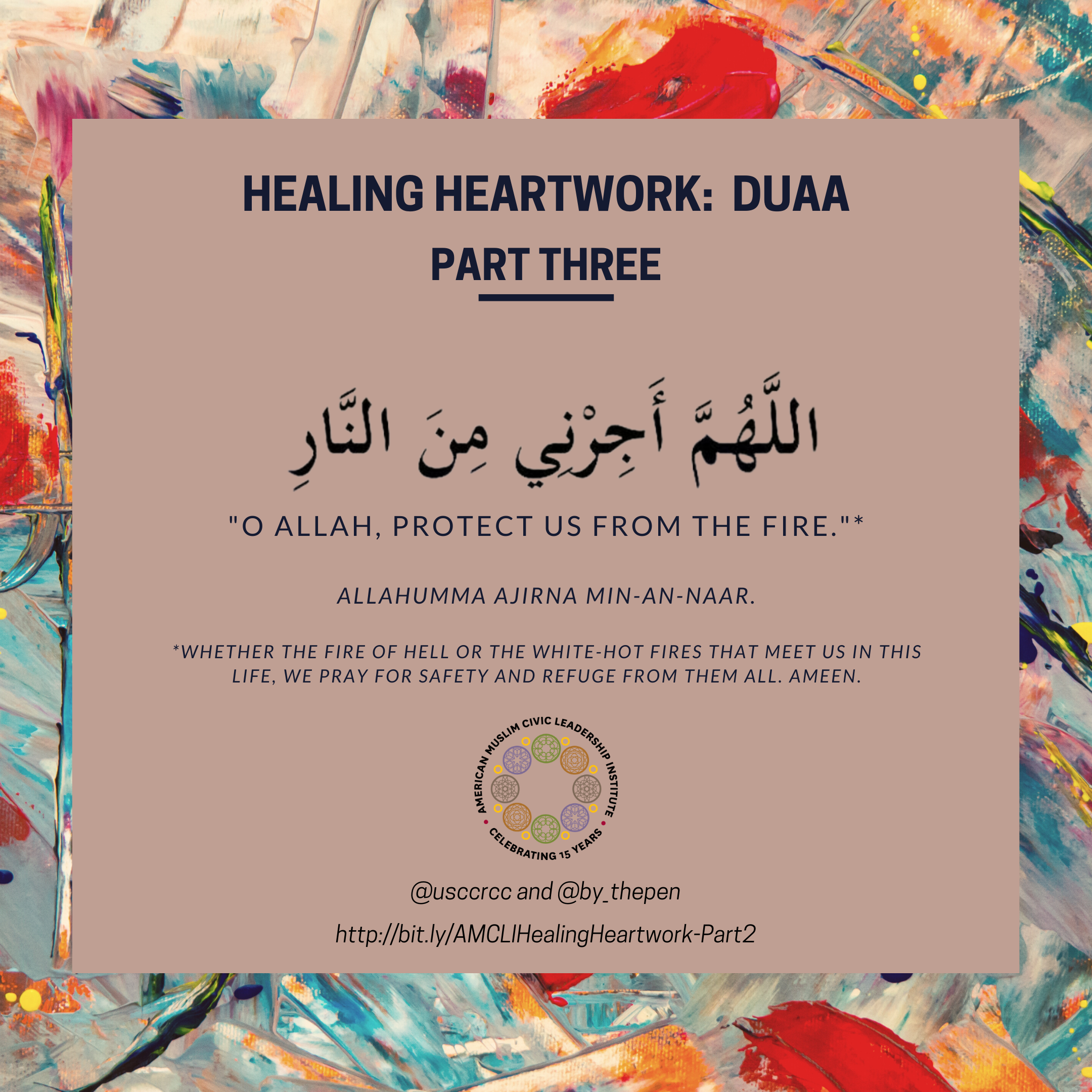
O Allah, protect us from the fire.*
Allahumma Ajirna min-an-naar.
*Whether the fire of Hell or the white-hot fires that meet us in this life, we pray for safety and refuge from them all. Ameen.
Suggested dhikr* for the third set of ten days:
O Allah, send your blessings upon our Noble Muhammad
Allahuma salli ‘ala Sayyidina Muhammad
*On the Day of Judgement, our beloved Prophet ﷺ will serve as our intercessor granting us safety and refuge — by Allah’s permission — from the Fire. It seems most befitting, then, to dedicate our dhikr in these last ten days to abundant praise of the beloved ﷺ.

To download the full infographic for Part Two: Mercy and Compassion, click below:

Download Healing Heartwork Toolkits
All three toolkits are available online and as PDFs.
For a donation to AMCLI of more than $100, you will receive a printed gift set of three Healing Heartwork toolkits. Please click here to make a donation.
Download a PDF of the toolkit on Exploring Loss
You can also explore the online toolkit for “Exploring Loss.”

Download a PDF of the toolkit on Exploring Joy
You can also explore the online toolkit for “Exploring Joy.”

Connect with CRCC
Building Knowledge, Strengthening Communities
Our mission is to advance the understanding of religion and society, and support faith and community leaders in becoming full partners in the work of positive social change.
Support Our Work
The USC Center for Religion and Civic Culture is independently funded by grants, contracts and gifts. We welcome your partnership and financial support.
Make a tax-deductible contribution to support our mission.
Contact Us
Center for Religion and Civic Culture
University of Southern California
Los Angeles, CA 90089-0520