For a full catalog of our videos, check out our Youtube Playlist. And don’t forget to subscribe!
The Power of Black Popular Culture: A Conversation with Aloe Blacc
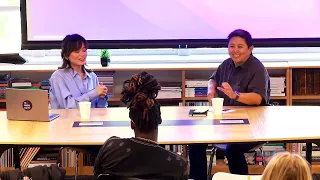
In an event hosted by the, USC Dornsife Black Studies Center, watch for an engaging conversation exploring the global influence of Black popular culture. Grammy-nominated singer, songwriter, and USC alumnus Aloe Blacc will be in conversation with Oneka LaBennett, Director of the Black Studies Center and Professor of American Studies & Ethnicity and Gender & Sexuality Studies, and Edwin Hill, Associate Professor of French & Italian and American Studies & Ethnicity at the USC Dornsife College of Letters, Arts and Sciences. Together, they explored how Black culture shapes global popular culture by examining influences across music, media, language, art, scholarship, and social movements around the world. The conversation highlighted the creative, intellectual, and cultural forces that continue to shape contemporary culture and public discourse.
Intergenerational Dialogues: “Showing our Work”
Our second Intergenerational Dialogues event, “Showing our Work”, features Sam Stiegler (University of Melbourne) and LJ Slovin (University of Victoria), co-authors of Embracing Queer and Trans Frameworks in Qualitative Educational Research: Showing Our Work (Routledge) will be in conversation with Kelso Becktol and Max Lubbers, Ph.D. graduate students who work in trans and queer studies in USC’s Department of American Studies and Ethnicity.
Intergenerational Dialogues: Dissatisfactions
Our first event of the Intergenerational Dialogue series featured Joshua Gavier Guzmán, the author of Dissatisfactions: Queer Chicano Style Politics (NYU Press, 2024), editor-in-chief of Aztlán: A Journal of Chicano Studies, and associate professor of gender studies at UCLA, in conversation with Ethan Trejo, a Ph.D. candidate in English at USC whose dissertation examines the political dimensions of Latinx drag aesthetics and performances. Both work in queer, Latinx studies, specifically queer of color critique and performance studies.
Book Talk: Engendering Blackness with Patrice Douglass
In this incisive new book, Patrice D. Douglass interrogates the relationship between sexual violence and modern racial slavery and finds it not only inseverable but also fundamental to the structural predicaments facing Blackness in the present. Douglass contends that the sexual violability of slaves is often misappropriated by frameworks on sexual violence that privilege its occurrences as a question of ethics, sexual agency, and feminine orders of gendering. Rather, this book foregrounds Blackness as engendered by sexual violence, which forcefully (re)produces Blackness, corporeally and conceptually, as a condition that lacks the capacity to ontologically distinguish its suffering from what it means to be human.
Patrice D. Douglass is an Assistant Professor of Gender and Women’s Studies at UC Berkeley. Her current book project, Race and Abortion Ethics: Antiblackness and the Opacity of Liberty, interrogates the (im)permissibility of abortion in US law and politics. Her research on Blackness, gender, afro-pessimism, reproductive justice, and Black philosophies appear in or forthcoming from Discourse: Journal for Theoretical Studies of Media and Culture, Political Theology, Journal of Legal Anthropology, Yale Journal of Law & Feminism, PRISM: Theory and Modern Chinese Literature, Souls, Journal of Visual Culture, Theory and Event, Zeitschrift für Anglistik und Amerikanistik: A Quarterly of Language, Literature and Culture (ZAA), and The Black Scholar. She holds a PhD and MA in Culture and Theory from the University of California, Irvine, a MA in Ethnic Studies from the University of California, Riverside, and a BA in Feminist Studies and Legal Studies from the University of California, Santa Cruz.
Citizen Reporting with Javier Cabral
A discussion on citizen journalism featuring Javier Cabral, the editor in chief of L.A. TACO. Javier was joined by Karen Tongson to explore the role of citizen reporting, which is taught in Javier’s Annenberg class and practiced at L.A. TACO. They discuss moving between food and culture coverage and political reporting, and ways those topics overlap.
Javier Cabral is a professional punk and editor-in-chief for the James Beard Award-winning L.A. TACO, an independently owned and operated media platform. Founded in 2006 from a simple desire to document the things they love about the city, L.A. TACO specializes in street-level news stories that often cover L.A.’s most marginalized communities with credibility and care, and also features profiles on L.A.’s underground culture and the everyday heroes that propel the city. Javier was also associate producer for the JBA-winning Las Crónicas del Taco and has co-authored two cookbooks. He previously served as a valiant restaurant scout for Jonathan Gold.

Podcasts and Audio Storytelling with Paola Mardo
Join USC alumni Paola Mardo (Proximity Media, Long Distance Radio) and Consortium director Karen Tongson as they discuss the elements of good audio storytelling and offer an insider’s take on the podcast industry. The two discuss entry points for scholars and students interested in podcasting.
Join Elaine Hsieh Chou in conversation with Dr. Dorinne Kondo, celebrating her recently published short story collection Where Are You Really From (Penguin Random House, 2025). Elaine Hsieh Chou is a Taiwanese American author and screenwriter from California. Her debut novel DISORIENTATION (Penguin Press / Picador) was a New York Times Editors’ Choice Book, NYPL Young Lions Finalist and Thurber Prize for American Humor Finalist. The novel was optioned by AppleTV+ with Elaine set to adapt.

Us: Empire and the Threat of Black Femininity with Dr. Amber Musser
Unlike Get Out, whose plot twists provided some of the film’s shock, the trailers for Us foreground the film’s conceit: a family comes home from a day at the beach to find murderous doubles in their home. While the film complicates this reveal, the sense of dread that the film activates—comes not from suspense but from its mobilization of the uncanny. Even before the doppelgangers are introduced, the film—especially upon repeat viewing—percolates with the sense that something is amiss. Bringing the unruly sensations of the uncanny to bear on Jordan Peele’s Us allows us to see how horror makes especially evident the United States as Imperial formation and the numerous ways that Black femininity is presented as threat.
Dr. Amber Jamilla Musser is a professor of English and Africana studies at the CUNY Graduate Center. She writes and researches at the intersections of race, sexuality, and aesthetics. In addition to writing art reviews for The Brooklyn Rail. She has published widely in queer studies, black feminism, psychoanalysis, and critical theory. She is the author of Sensational Flesh: Race, Power, and Masochism (NYU Press, 2014), Sensual Excess: Queer Femininity and Brown Jouissance (NYU Press, 2018), and Between Shadows and Noise: Sensation, Situatedness, and the Undisciplined (Duke University Press, 2024). Her collaborative projects include co-editing Keywords for Gender and Sexuality Studies (NYU Press, 2021) and co-hosting its accompanying podcast Feminist Keywords; special issues of Signs: A Journal of Feminist Theory on “Care and Its Complexities” and ASAP Journal on “Queer Form;” and the series Elements in Feminism and Critical Theory for Cambridge University Press.

Make Me Like It – Episode 3
In Make Me Like It, Dr. Collins explores diaspora food cultures beyond sentimentally and nostalgia, by taking an irreverent look at what happens when we actually dislike some of the food we grew up with. This week, Dr. Collins tries Rock Cakes, can she make herself like it?

Make Me Like It: Corned Beef
This week on Make Me Like It, Dr. Corrine Collins revisits the Corned Beef from her childhood. In Make Me Like It, Dr. Collins explores diaspora food cultures beyond sentimentally and nostalgia, by taking an irreverent look at what happens when we actually dislike some of the food we grew up with.


Anxious Masculinities: Lesbian Film and Lesbian Film Studies in 2024
Dr. Bradbury-Rance presents a public talk that probes the ways in which masculinity has shaped the terms of contemporary “lesbian” film and film studies. While mainstream film since the turn of the century has intensified its pursuit of femininity as the visible symbol of lesbian progress, gender nonconformity continues to function as a marker of inevitability and intrigue, contestation and disavowal. The reading and misreading of gendered codes of butch and trans masculinity has become a particularly fraught site of anxious correction. Situated against personal and intellectual trajectories of watching and writing about film, this talk explores masculinity through a double bind that underpins the seemingly endless anxieties over lesbian representability.
Dr. Clara Bradbury-Rance is a Senior Lecturer in Gender and Sexuality Studies at King’s College London. She is the author of Lesbian Cinema after Queer Theory, published by Edinburgh University Press and translated into Spanish by Osífragos (both 2019). Clara has published in the journals Camera Obscura, French Screen Studies, Feminist Media Studies, MAI: Feminism and Visual Culture, Feminist Pedagogy, Feminist Theory, New Review of Film and Television Studies, and Film Quarterly. She regularly writes film reviews for Sight and Sound magazine.

Celebrating Postmilennial Pop
Since 2013, The Postmillennial Pop series at NYU Press has served as an incubator for transdisciplinary scholarship that reimagines research on popular and public culture in the age of transnationalism, convergence, and globalization. Join presentations and a brief conversation between the series’ seven authors and editors: Ramzi Fawaz (University of Wisconsin), Liz Przybylski (UC Riverside), Taylor Black (Duke University), Bo Ruberg (UC Irvine), Iván A. Ramos (Brown University), Jennifer Stoever, (SUNY Binghamton), and Aaron Trammell (UC Irvine).

“Critical Conversations: On Cults” A Conversation between Guinevere Turner and Poulomi Saha
Critical Conversations: On Cults is a conversation between Dr. Poulomi Saha, an Associate Professor of English and co-Director of the Program in Critical Theory at UC Berkeley, and Guinevere Turner, a writer, director and actor who has first hand experience of growing up in Cults. They have an encompassing conversation about our fascination with cults, the dynamics of cults from the inside, and the presence of cults that permeate today.
Poulomi Saha is a scholar of Asian American literature, postcolonial studies, & queer and feminist theory, they are currently at work on a book about America’s long obsession with Indian spirituality and why so often those groups come to be called cults. Our current cultural investments in yoga and mindfulness actually have a history going all the way back to the early republic. A history limned by scandal, anxiety, and deep longing. Their first book, An Empire of Touch: Women’s Political Labor & The Fabrication of East Bengal (Columbia University Press, 2019) was awarded the Harry Levin Prize for outstanding first book by the American Comparative Literature Association in 2020 and the Helen Tartar First Book Award in 2017.
Guinevere Turner has been working in film and TV since her 1994 debut film Go Fish, which she wrote, produced and starred in. She teamed up with director Mary Harron to write the films American Psycho, The Notorious Bettie Page and the 2019 film Charlie Says. She was a writer and story editor on Showtime’s The L Word, and she played the recurring character Gabby Deveaux on that show. She has written and directed seven short films, two of which premiered at the Sundance Film Festival.
She can be seen in acting roles that include The Watermelon Woman, Chasing Amy, American Psycho and The L Word. Guinevere taught screenwriting at Sarah Lawrence College, Columbia University, University of Georgia, UCLA and NYU. She published an essay in The New Yorker in April of 2019, and expanded on that essay in her 2023 memoir When the World Didn’t End from Penguin Random House.

“Nobody Owns the Park” A Conversation with Greta La Fleur & Sarah Kessler
“Nobody Owns the Park” is a conversation between Greta La Fleur – the Consortium’s Fall 2023 scholar in residence, and Sarah Kessler, an Assistant Professor of English. Dr. La Fleur is an Associate Professor of American Studies and Women’s, Gender, and Sexuality Studies at Yale University. Their work has focused on early North American literary and cultural studies, the history of science, the history of race, and the history and historiography of sexuality, and queer & trans studies. Their first book, The Natural History of Sexuality in Early America, explores how eighteenth-century race sciences contributed to emerging sciences of sex in the colonial Atlantic World.
Dr. La Fleur is currently working on two projects. The first is a scholarly monograph tentatively entitled How Sex Became Good: The Feminist Movements and Facial Politics that Made Modern Sexuality tracks how cultural and legal responses to the problem of sexual violence shaped the politicization of sexuality in the modern world. The second is a co-authored book of essays on birding, authored by anthropologist Cal Brink.

Transforming Misogynoir: A Conversation with Professor Moya Bailey & A.E. Stevenson
“Transforming Misogynoir” was a pubic talk between Moya Bailey, Associate Professor of Communication at Northwestern and USC Consortium for Gender, Sexuality, Race and Public Culture and the Department of Gender & Sexuality Spring Public-Scholar-in-Residence, and A.E. Stevenson, Assistant Professor of Gender and Sexuality Studies. Professor Bailey is the founder of the Digital Apothecary and co-founder of the Black Feminist Health Science Studies Collective. Her work focuses on marginalized groups’ use of digital media to promote social justice, and she is interested in how race, gender, and sexuality are represented in media and medicine. She is the digital alchemist for the Octavia E. Butler Legacy Network and the Board President of Allied Media Projects, a Detroit-based movement media organization that supports an ever-growing network of activists and organizers. She is a co-author of #HashtagActivism: Networks of Race and Gender Justice (MIT Press, 2020) and is the author of Misogynoir Transformed: Black Women’s Digital Resistance (New York University Press, 2021).

A Conversation with Karina Longworth
Consortium director Karen Tongson’s conversation with Karina Longworth, a writer, film historian and podcaster, who is also the creator, producer and host of You Must Remember This, a podcast on the secret and forgotten history of 20th Century Hollywood. Longworth is the author of four books, most recently Seduction: Sex, Lies and Stardom in Howard Hughes’s Hollywood (Custom House, 2018).The two spoke about transposing archival and cultural studies research into audio series for general audiences, while exploring the links between archival labor, gender, and the different genres and formats through which research finds its expression. Sponsored by USC’s Consortium for Gender, Sexuality, Race, and Public Culture with the Levan Institute for the Humanities.

Gender & Sexuality Studies
University of Southern California
Mark Taper Hall of Humanities, 422
3501 Trousdale Parkway
Los Angeles, California 90089-4352
 |
 |
 |
 |

The Consortium for Gender, Sexuality, Race and Public Culture is generously funded by USC Dornsife and The Andrew W. Mellon Foundation.