CORE 101: Symbols and Conceptual Systems
CORE 101: Symbols and Conceptual Systems grapples with epistemology and competing theories of interpretation by examining the ways in which we share and transmit knowledge. This course asks students to consider not just what we know but how we know, and, in turn, to critically examine the various systems that shape their personal worldviews.
CORE 101, 103, and 104 may be taken in any order, in any semester. Students are encouraged to take courses when a particular iteration speaks to their interests.
Sample Course Descriptions

The American Gun
Professor David Treuer, Department of English
The gun has come to dominate our modern American lives. Who has one? Who should have one? What do we have to fear from them? Where might they suddenly appear? From police brutality to school shootings, guns have come to define, to symbolize, and to shape our country. This course will treat the gun as a symbol and look at the various systems that run through, meet, and cross in the phenomenon of “the American gun.” Using the shootings at Columbine High School in 1999 as our primary focus, we will analyze legal, cultural, religious, colonial, imperial, and psychological systems by way of readings such as the U.S. Constitution, Discipline and Punish, Civilization and Its Discontents, The Gun, and films such as Full Metal Jacket, Elephant, and Bowling for Columbine, among others.
Texts
- Michelle Alexander. The New Jim Crow: Mass Incarceration in the Age of Colorblindness.
- Eula Biss. On Immunity: An Inoculation.
- David Cullen. Columbine.
- Michel Foucault. Discipline and Punish: The Birth of the Prison.
- Sigmund Freud. Civilization and Its Discontents.
- Clifford Geertz. The Interpretation of Cultures.
- Malcolm Gladwell. “Thresholds of Violence.”
- Richard Hofstadter and Michael Wallace, eds. American Violence: A Documentary History.
- Cormac McCarthy. Blood Meridian.
- Claudia Rankine. Citizen.
- Matt Taibbi. The Divide: American Injustice in the Age of the Wealth Gap.
- Adam Winkler. Gunfight: The Battle Over the Right to Bear Arms in America.

Artifacts of Self Regard
Professor Roberto Díaz, Departments of Latin American & Iberian Cultures and Comparative Literature
More often than not, works belonging to various art forms—literature, painting, opera, film—tend to hide the fact that they are symbols or codes, and not reality itself. A novel, for instance, may tell a story whose characters, mere verbal constructs, fall in love as if they were creatures made of flesh, while a still life may depict a semblance of lemons without explicitly remarking on its true colors as just a mixture of pigments. Yet there are some works of art, including a few famous ones often regarded as masterpieces, which openly reveal or playfully flaunt their status as artifacts. Consider, for instance, Cervantes’ Don Quixote, whose characters are readers obsessed with reading, or Velázquez’s Las Meninas, where the artist represents himself as he paints under the shadow of numerous other paintings. Oddly enough, these Spanish seventeenth-century works, despite their disarming verbal or visual self-reflexivity, are frequently praised as paragons of realism, or as works that truly seem to capture aspects of reality.
Anchored on our reading of Don Quixote and viewing of Las Meninas, we will examine a series of works from various parts of the world that variously engage with reality even as they meditate, sometimes rather obliquely, on their condition as art. We will read short stories and essays by Borges, who wrote, quite disturbingly, “if the characters of a fictional work can be readers or spectators, we, its readers or spectators, can be fictitious as well.” Beyond literature and painting, we will also study an opera—Strauss’s Ariadne auf Naxos, whose plot deals with the staging of an opera—and three feature films: Resnais’s Hiroshima mon amour, whose female lead is an actress making a movie about peace; Bergman’s Persona, about an actress who has stopped talking; and Gutiérrez Alea’s Memories of Underdevelopment, a tale about filmmaking in the wake the Cuban Revolution. Finally, we will read an English novel, Woolf’s Orlando, the subject of which is reading and writing; and a French theoretical work, Barthes’ Empire of Signs, which views Japan not as a reality but as a system of symbols.
Texts
- Roland Barthes. Empire of Signs.
- Ingmar Bergman, dir. Persona.
- Jorge Luis Borges. A Personal Anthology.
- Miguel de Cervantes. Don Quixote.
- Tomás Gutiérrez Alea, et al. Memories of Underdevelopment and Inconsolable Memories.
- Alain Resnais, dir. Hiroshima mon amour.
- Richard Strauss. Ariadne auf Naxos.
- Virginia Woolf. Orlando.
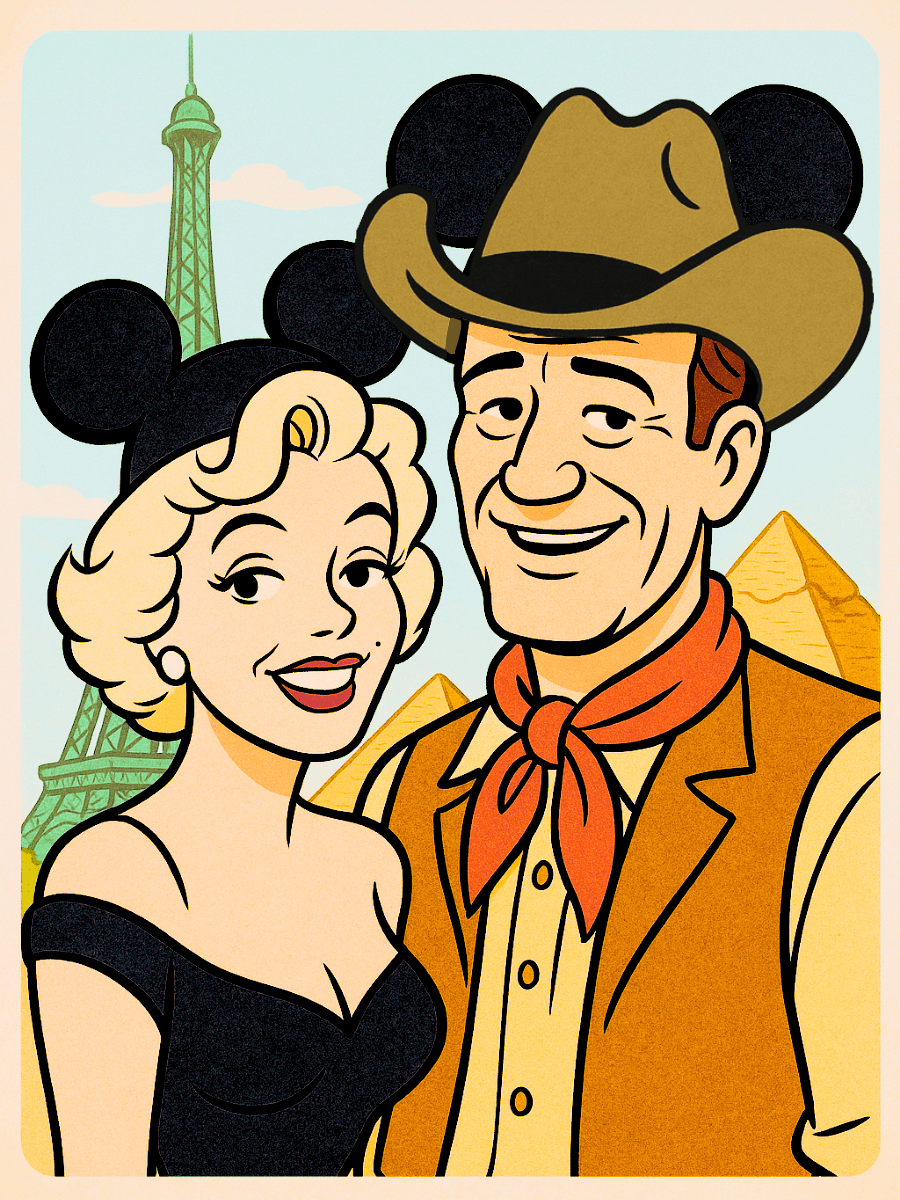
Icons
Professor Vanessa Schwartz, Department of Art History and Van Hunnick Department of History
Marilyn Monroe, the Eiffel Tower, the Pyramids, John Wayne, and Mickey Mouse. Few would dispute the notion that the mass visual media have transformed these people, places, and things into “icons.” Although these phenomena exist apart from their representation, their cultural significance and importance is attached to their status as pictorial representations that are widely disseminated. The term “icon” initially invoked an object worthy of religious devotion; that original meaning now denotes an uncritical and popular devotion.
This course poses the question “What becomes a legend most?” That question, made famous by the Blackglama fur ads, conflated “becoming” in the sense of being visually pleasing with “becoming” a legend, a modern process fueled by image-making. We will examine basic ways of thinking about visual symbols by learning about semiotics, symbolic and cultural anthropology, and what art historians have called iconology. This course will trace the interplay between specific icons and the visual culture that made them iconic.
Particular emphasis will be placed on technologies of representation such as photography and film and the vital role they have played in the culture of modern icons. If possible, there will be an optional class field trip to Disneyland.
Texts
- John Berger. Ways of Seeing.
- Julie Cohen and Betsy West, dirs. RBG.
- Arthur Danto. Andy Warhol.
- Ezra Edelman, dir. OJ Simpson: Made in America.
- Neal Gabler. Barbra Streisand: Redefining Beauty, Femininity, and Power.
- Jason Hill and Vanessa Schwartz, eds. Getting the Picture: The Visual Culture of the News.
- Martin Kemp. Christ to Coke: How Images Become Icons.
- Scott Lukas. Theme Park.
- Chris Rojek. Celebrity.
- Donald Sassoon. Becoming Mona Lisa.
- Susan Sontag. On Photography.

Law, Culture, and Identity
Professor Alison Renteln, Departments of Political Science & International Relations and Anthropology, Price School of Public Policy, and Gould School of Law
This interdisciplinary course examines the ways in which individuals and groups attempt to control symbolic representations of their identities through the law. As a fundamental question, we ask whether the law can offer any meaningful way of protecting identities. As various bodies of law provide mechanisms for safeguarding the images and symbols associated with identities, we consider topics from the fields of constitutional law, employment law, intellectual property law, and international human rights law.
Individuals have challenged the use of their images or those of their relatives through “right of publicity” lawsuits. They also seek to control the choice of their surnames in court; this has been an issue for women in many countries who are required, upon marriage, to take the names of their husbands. Criminal statutes on the growing problem of identity theft serve as yet another illustration of the problematic nature of attempting to regulate the use of individual identities through the law.
With respect to the maintenance of groups’ identities, we consider controversies over dress codes, English-only policies, foodways, Indian mascots, the cultural defense, and sacred sites. As part of our analysis of the role of law in influencing collective identities, we also take up laws designed to prevent or discourage the existence of extremist groups. These include anti-masking laws intended to outlaw Ku Klux Klan marches, anti-sect statutes designed to prohibit “cults” or “new era religions,” and hate speech regulations drafted to prevent the advocacy of race hatred.
Among the more important debates we analyze is inter-ethnic conflict in the international arena. The extent to which groups are willing to resort to violence to maintain literal and figurative borders is a topic of crucial importance in the modern world. We consider the extent to which individuals are willing to risk their lives to protect national or ethnic identities. In the final part of the course, we study relevant international legal instruments.
Readings for the course include theories of identity for individuals and groups, jurisprudential texts, analytic essays on various policy debates, and court cases.
Texts
- Frederik Barth, ed. Ethnic Groups and Boundaries: The Social Organization of Culture Difference.
- Michael F. Brown. Who Owns Native Culture?
- Erik H. Erikson. Identity and the Life Cycle.
- Amitai Etzioni and Jared Bloom, eds. We Are What We Celebrate: Understanding Holidays and Rituals.
- Mark Monmonier. From Squaw Tit to Whorehouse Meadow: How Maps Name, Claim, and Inflame.