
Healing Heartwork Toolkit: Exploring Joy
By Sondos Kholaki
March 20, 2023
Introduction to Healing Heartwork
In response to the emerging needs of AMCLI fellows, the USC Center for Religion and Civic Culture (CRCC) has crafted toolkits focused on deepening our understanding of Islamic modalities for healing and wellness. Released each Ramadan from 2021 to 2023, each Healing Heartwork toolkit presents three parts that can be applied toward self-care and community care.
Each year, the objective of the series is to:
- Educate fellows on the Islamic modalities indigenous to the faith that can be used as tools of self-care and community care.
- Provide fellows with the agency and opportunity to ground their well-being practice in the example of the Prophet Muhammad ﷺ and authentically reconnect to our rich and comprehensive spiritual tradition.
- Boost fellows’ mental health and resilience through healing heartwork and the creation of a community of practice and care,
Volume 1 of Healing Heartwork, Exploring the Self, focuses on cultivating afiya, or emotional well-being, through practices that create moments of sakina, or tranquility.
Volume 2 of Healing Heartwork, Exploring Loss, centers on janazah, or funeral rites, as a way to address experiences of grief during the global pandemic while creating opportunities to pause and reflect on the losses endured, drawing peace from spiritual practices focused on honoring the body, mind, heart and soul.
Volume 3 of Healing Heartwork, Exploring Joy, focuses on humor and comedy in Islam, alongside other modalities for cultivating joy and lightness of being, both in our everyday lives and in our work in the world.
Why Healing?
Islam, the religion that Allah perfected for all of creation (Quran, 5:3), remains a tradition of healing. In times of crisis, religion and spirituality offer invaluable coping strategies for our enhanced emotional well-being or afiyah. Emotional well-being includes the ability to express and manage thoughts and emotions, maintain a positive sense of self-worth, utilize practices for resilience, and sustain self-care and support networks in the midst of hardship.
Our beloved Prophet Muhammad ﷺ said: “It (Ramadan) is the month whose beginning is mercy; its middle, forgiveness; and its end, emancipation from the fire.” For each ten-day period of Ramadan, then, we will explore healing modalities around mercy/compassion, forgiveness, and safety toward the enhancement of our afiyah, individually and collectively, with God’s Grace and Guidance.
About Chaplain Sondos Kholaki
 Chaplain Sondos Kholaki serves as a hospital staff chaplain and a community chaplain in Southern California. She is a board-certified chaplain with the Association of Professional Chaplains (APC). Sondos earned a Master of Divinity degree in Islamic Chaplaincy from Bayan Islamic Graduate School/Claremont School of Theology and a Bachelor of Arts in English and Creative Writing from UCLA as a Regents Scholar. Sondos completed five units of Clinical Pastoral Education (CPE) residency where she served care seekers of all faiths and educated staff and volunteers on Muslim spiritual care. Sondos is the author of Musings of a Muslim Chaplain (January 2020) and the co-editor of Mantle of Mercy: Islamic Chaplaincy in North America (fall 2021). She also serves as Vice President of Healthcare for the Association of Muslim Chaplains (AMC). Sondos enjoys sipping a perfectly brewed cup of coffee, listening to Quran recitation by Turkish reciters, and singing her heart out at spiritual gatherings. She is married and has two children.
About AMCLI
The American Muslim Civic Leadership Institute (AMCLI) develops and trains American Muslim leaders who are committed to civic engagement. AMCLI strives to accompany these pioneering leaders as they realize their full potential and, in doing so, have a more effective and sustained impact on the issues affecting their communities and America at large.
The Healing Heartwork Toolkits are a collaboration between AMCLI and Chaplain Sondos Kholaki.
Exploring Joy

Deepening our understanding of Islamic tools for healing, self-care, and community care
Download a PDF of Healing Heartwork Toolkit: Exploring Joy
For a donation to AMCLI of more than $100, you will receive a printed gift set of three Healing Heartwork toolkits. Please click here to make a donation.
For the past three years, grief, pain and loss have dominated the pandemic narrative. We have a choice in how we respond to hardship, and Islam offers several healing modalities–from practiced patience to prayer–as explored in previous Healing Heartwork installments. The less often explored but equally healing response to challenging times from the Islamic tradition is humor – that is, taking difficulties less seriously and allowing ourselves to laugh at the unpredictability of life. So, in the words of Lorne Michaels, producer of Saturday Night Live, on the first show after 9/11: “Can we be funny [now]?”
Ramadan is a time for reflection, spirituality and nurturing our connections to the Divine, self and community. After many difficult years, AMCLI hopes that this series will continue to provide useful tools that can support the resilience and mental health of American Muslim civic leaders in the AMCLI network.
AMCLI has once again partnered with Chaplain Sondos Kholaki, who will lead the program based on her years of experience in supporting and accompanying individuals in crisis on their healing journeys. Over the month of Ramadan, CRCC will release the AMCLI Healing Heartwork series with Ch. Kholaki in three parts, with each part focusing on a relevant Ramadan theme. At the conclusion of the series, interested AMCLI fellows can sign up to receive a mailed copy of the toolkit, along with other useful tools to facilitate your incorporation pf Islamic Healing Heartwork into your journey and spiritual practices.
- Part One: Mercy: Haqq, Humor and Honoring God’s Divine Creation
- Part Two: Forgiveness: Comedic Relief, Belief and Creating Ease
- Part Three: Safety: Holistic Healing in Humor
This year, AMCLI is featuring author and illustrator Huda Fahmy with each part of the Healing Heartwork: Exploring Joy.
Part One: Mercy - Haqq, Humor and Honoring God’s Divine Creations
A patient with a permanent visual impairment once asked me, “Why did God give eyes to blind people?” She wondered aloud why God did not, for instance, leave the sockets empty, and she questioned the presence of the eyeballs when they lacked the primary function of seeing. As the chaplain, I held space for her exploration and offered a thought or two, but she did not settle on a satisfactory answer in that conversation. The next day, she met me with excitement, concluding, “Chaplain, I know why God gave eyes to the blind – because God has a sense of humor!”
In the patient’s question, she attempted to reconcile why God gives all of creation eyes but only some with the function of vision, and in her answer, she approached the inconclusive nature of it all while honoring a positive opinion of God.
A companion once asked the Prophet Muhammad ﷺ, “O Messenger of Allah, does the Lord laugh?” The Prophet replied, “Yes.” The companion said, “We will never be deprived of goodness by a Lord who laughs!” (Sunan Ibn Mājah 181).

A “Lord who laughs,” or God having a sense of humor, reveals the quality of humor that enables us to approach a person or situation with mercy, as Muslims believe God does. Both this patient and the companions of the Prophet Muhammad ﷺ felt comforted by their relationship with a Merciful God.
Humor has the potential to relieve or reinforce pain. In Islam, humor serves the purpose of healing, not harming. We learn from the Qur’an and the example of the Prophet Muhammad ﷺ how to achieve the former and avoid the latter.

We can realize the potential of humor as a healing modality while also upholding mercy for self and others by remaining mindful of our words. The classic rhyme of “sticks and stones” declares that words contain little harmful power. Those on the receiving end of mocking or ridiculing language, however, may hold a different opinion. The Qur’an captures this sentiment powerfully, stating, “O you who believe! Let not some men among you laugh at others: It may be that the latter are better than the former. Nor let some women laugh at others: It may be that the latter are better than the former. Nor defame nor be sarcastic to each other, nor call each other by offensive nicknames. Ill-seeming is a name connoting wickedness…And those who do not desist are indeed doing wrong” (49:11).
The Qur’an offers clear etiquette around humor that does not transgress the dignity of God and creation. Muslim theologian Imam Al-Ghazali lists certain conditions for merciful humor, such as one may not lie or exaggerate to garner laughs. In a hadith narration, the companions of the Prophet Muhammad ﷺ commented on how he joked with them, to which the Prophet ﷺ replied, “Yes, I do. But I only tell the truth” (al-Tirmidhī, n.d. 357).
In one illustrative instance, the Prophet Muhammad ﷺ jokingly referred to his companion, Anas ibn Malik, as “O you with the two ears!” (al-Tirmidhī, n.d. 3828), which both states a fact and elicits amusement. Al-Ghazali lists several more tenets of merciful humor, such as avoiding jokes that center racy or suggestive elements, jokes that contain unkindness, and jokes that scare the listener. Finally, Al-Ghazali teaches that humor always requires wisdom – some situations call for gravitas rather than levity, and one must know when to use one and not the other.
This quality of wisdom in humor surfaces in other ways. From court jesters to wise fools, comedians hold a long-standing reputation of speaking truth to power from behind the facade of entertainment. In the Islamic tradition, humor is used as a subtle yet potent teaching tool. Much of Sufi literature, for instance, draws upon humor and jokes to convey important lessons about spiritual development, such as the story of the chickpea in Jalal-Din Rumi’s poem.
After being immersed in boiling water, the raw chickpea pleads with the woman cooking to remove it from the pain of the heat. The woman lovingly declines, informing the chickpea that the hot water serves to cook the chickpea so that it can reach its delicious potential. This amusing story teaches that we as humans dislike and avoid discomfort and pain without realizing the alchemical transformation involved in the process of our spiritual actualization. Furthermore, the stories of Mulla Nasrudin and his Middle Eastern counterpart, Juha, feature the “holy fool” character who turns a humorous situation into instructive teaching, thus helping us find mercy in our ability to laugh at our human limitations. In one story, a man came across Nasrudin on his knees searching the ground for a lost key. The man joined Nasrudin in the search for a while before asking, “Where did you last see the key?” Nasrudin replied, “At my house.” Surprised, the man asked why then was Nasrudin searching outside. “The light is better here,” Nasrudin explained (The Exploits of the Incomparable Mulla Nasruddin, p. 9).
Humor, when delivered with wisdom, serves as a merciful healing modality, powerful enough to repair and strengthen our relationships with God, others and ourselves.

Learning Activities: Merciful Humor
Take a moment to read the story of “The Sick Man and His Deaf Visitor” written by Jalal-Din Rumi. As you read, consider how one is given allowance to feel levity as they learn. Ponder how we might also transmute our difficulties into fables, parables and allegories that convey truth with humor.

Part Two: Forgiveness: Comedic Relief, Belief and Creating Ease
A philosopher, having made an appointment to dispute with Mulla Nasrudin, dropped by and found him away from home. Infuriated, the philosopher picked up a piece of chalk and wrote “Stupid Oaf” on Nasrudin’s gate. As soon as he got home and saw this, Nasrudin rushed to the philosopher’s house. “I had forgotten,” Nasrudin said, “that you were to call. And I apologize for not having been at home. Of course, I remembered the appointment as soon as I saw that you had left your name on my door.”
– adapted excerpt from “The Exploits of the Incomparable Nasrudin”
There is considerable research that confirms the relationship between managing stress and one’s ability to take a humorous and positive perspective on challenging situations. In the vignette above, Nasrudin, the “wise fool” character in Muslim literature, opts to view the philosopher’s intended insult in a different light, one that allows Nasrudin to extend forgiveness toward the philosopher, continue a relationship with him, and even gain the moral upper hand. One study demonstrates a specific correlation between humor and forgiveness, positing that those who possess a sense of humor take a lighter perspective on difficult people and situations and tend to forgive more easily. Similarly, individuals who perceive themselves as happy also usually describe themselves as more forgiving. The converse also holds true – those who easily forgive report a higher level of happiness and inner peace.
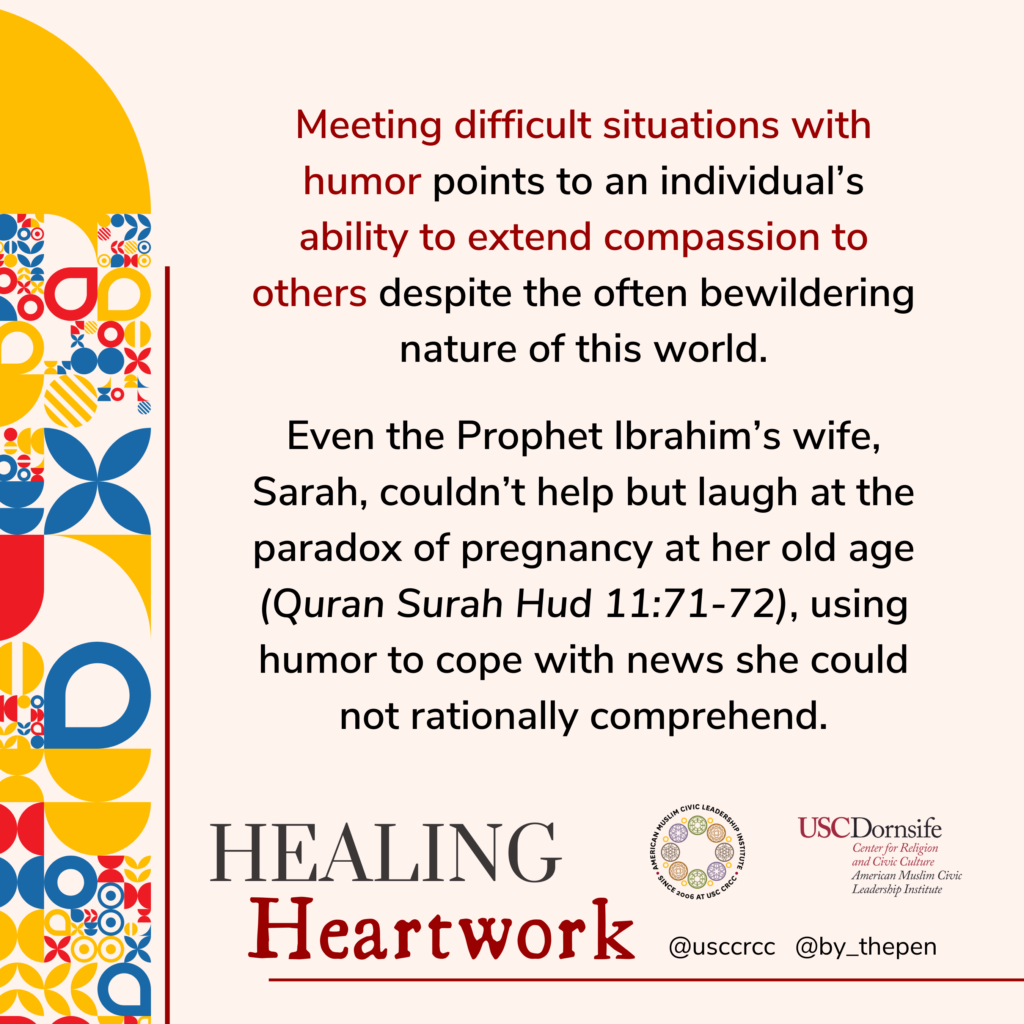
Meeting difficult situations with humor points to an individual’s ability to extend compassion to others despite the often bewildering nature of this world. Even the Prophet Ibrahim’s wife, Sarah, couldn’t help but laugh at the paradox of pregnancy at her old age (Quran 11:71-72), using humor to cope with news she could not rationally comprehend.
Applying humor when confronted with the heaviness of this world is best modeled in the example of the Prophet Muhammad ﷺ, who often used levity to facilitate his teaching.
One prophetic teaching states that the best of deeds includes, among other charitable actions, bringing happiness to a believer (al-Mu’jam al-Awsaṭ 5081) and, in another narration, that whoever relieves a Muslim of the burdens of the world, Allah will relieve him of a burden on the Day of Judgement (Jami` at-Tirmidhi 1930).
More explicitly, the Prophet taught that smiling at others can be understood as a form of charity (Jami` at-Tirmidhi 1956). When the Prophet ﷺ would speak, he would often smile, communicating approachability, care, and warmth.

Umar ibn al-Khattab reported: The Messenger of Allah, peace and blessings be upon him, was asked, “Which deeds are best?” The Prophet ﷺ said, “To bring happiness to a believer, to satisfy his hunger, to clothe his nakedness, or to fulfill his needs.”
Source: al-Mu’jam al-Awsaṭ 5081
Humor and Lightness of Being
The Prophet ﷺ and his companions frequently engaged one another in a light-hearted manner to encourage this forgiving approach to human interaction. The companion Mahmud bin Rabi relayed one such example of the Prophet ﷺ’s levity, sharing that, “When I was five years of age, the Prophet ﷺ came to our house, drank water from the well and, in a playful manner, squirted water with his mouth in my direction” (Sahih al-Bukhari, Kitab-ul-Ilm). Another companion named Nouyman ibn Amr carried a reputation for practical jokes. Once, Nouyman took an item from a traveling caravan to Medina without paying for it and gifted it to the Prophet Muhammad. When the merchant caught Nouyman and insisted on payment, Nouyman took the merchant to the Prophet ﷺ and said, “Oh Prophet of Allah! Pay him the price of that item.” The Prophet ﷺ, surprised, asked, “Did you not gift it to me?” Nouyman replied, “I had no money with me, but I really wanted you to have the item.” The Prophet ﷺ laughed and paid for the item.
Even in the midst of battle, the Prophet ﷺ and his companions used moments of levity to restore balance. The companion ‘Auf bin Malik shared a memory during the Battle of Tabuk when he visited the Prophet ﷺ, who was resting in a very small tent. After being invited inside, ‘Auf joked about the size of the tent by asking the Prophet ﷺ, “Should I bring my whole body in?” The Prophet ﷺ enjoyed the joke and, returning the banter, replied, “Yes, bring your whole body in the tent” (Sunan Abu Daud, Kitab-ul-Adab).
Comic Relief
A number of stories from the hadith literature capture the Prophet Muhammad ﷺ’s endearing sense of humor, which he particularly used to bring relief to those who were suffering. An elderly woman approached the Prophet ﷺ and, concerned about her salvation in her old age, pleaded with him to ask God to accept her into Heaven. The Prophet ﷺ replied to her teasingly that no old woman will enter Heaven, which prompted the elderly woman to burst into tears. The Prophet ﷺ then quoted a verse from the Qur’an that implied that women will return to their youthful bodies in Heaven, reassuring the elderly woman that she will not only enter into Heaven but also in her best form (Ash-Shama’il Al-Muhammadiyah 239).
In another story, a man came to the Prophet Muhammad ﷺ visibly awe-struck. To put him at ease, the Prophet used self-effacing humor, saying, “I am just a man whose mother ate dried meat.” And when meeting with a sorrowful youth whose bird just died, the Prophet ﷺ comforted him with a playful pun, rhyming the boy’s nickname “Abu Umayr” with the word for sparrow, “al-nughayr” (Sunan Abī Dāwūd 4969).
Creating Ease with Laughter
The Prophet Muhammad ﷺ also deployed humor in situations when those from his community behaved in less-than-optimal ways, meeting them with forgiveness rather than reproach. A man once approached the Prophet ﷺ in remorseful distress, confessing that he was intimate with his wife during the fasting hours of Ramadan. The Prophet ﷺ recommended several expiating actions, and the man declined each one. The Prophet ﷺ fell silent for a moment and, spotting a basket of dates, handed one to the man and recommended that the man give it away as an act of charity for expiation. The man then proclaimed that he should have the date himself as he was poorer than most. The Prophet Muhammad ﷺ responded to the man’s obstinance with humor and, grinning widely, told the man just to take the date to his family (al-Bukhaari, Fath, 1936).
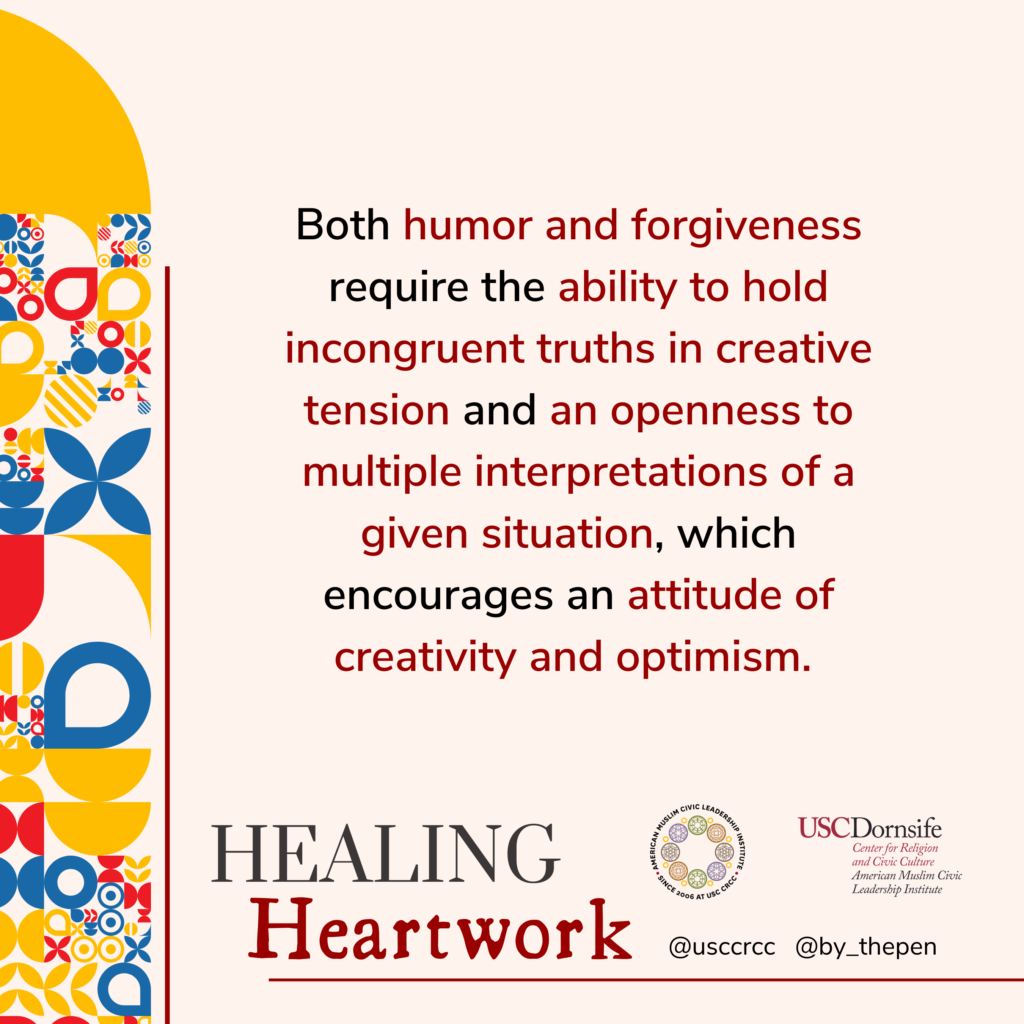
We learn, from the Prophet Muhammad ﷺ’s example, that levity, when tempered with wisdom and balance, may help bring ease to others and to ourselves. Both humor and forgiveness require the ability to hold incongruent truths in creative tension and an openness to multiple interpretations of a given situation, which encourages an attitude of creativity and optimism.
Learning Activities: Comedic Relief

Part Three: Safety: Holistic Healing in Humor
I regularly meet with a patient who cycles through the hospital often due to chronic illness. Though she faces many challenges in her life, she quickly releases her emotions through crying and also has a sharp sense of humor accompanied by an endearing laugh. With every new hospital admission – some more critical than others – she and I joke that “we need to stop meeting like this.” Neither of us ignores the glaring reality of her multiple near-death experiences nor the ongoing grief of her two teenage daughters. But, if only for a few moments, we like to swap jokes about the mundane aspects of life. This space of humor and relative lightness provides her with a sense of safety amid the formidable presence of her severe chronic illness.
As the old saying goes, in life, you can laugh, or you can cry. The Quran affirms both options as gifts from God: “It is He Who causes people to laugh and cry” (Quran Surah An-Najm 53:43); however, unlike the old saying, the Quran verse joins the two options as collaboratives rather than as alternatives. Laughter and crying serve a similar purpose, offering the body healing through the physical release of accumulated emotion. A good laugh stimulates the organs, releases endorphins, relaxes muscles, and relieves pain. Even a smile produces similar healing results, invoking a contagious response from others.

The Prophet Muhammad ﷺ references these benefits and more in his teaching: “Smiling in the face of your brother is charity.” Just like any act of charity, we receive far more than we think we give. Offer a genuine, warm smile to a fellow human being conveys safety and builds community.
Smiling and laughter do not merely enhance physical and mental wellness. In Islam, smiling and laughter are signs of spiritual wellness, too. Happiness and contentment are the highest states that the human soul can reach, described in the Quran as “the soul at peace – well-pleased (with God) and well-pleasing (to God)” (Quran Surah Al-Fajr 89:27-30). The Prophet Muhammad ﷺ explicates this notion in a description of the believer as one who finds contentment and happiness in everything – prosperity and adversity – because the believer sees good from God in all of it. A seeker who has reached this level of happiness, separate from the fluctuating external circumstances of this world, will always be laughing and rejoicing in whatever situation he or she finds themselves.
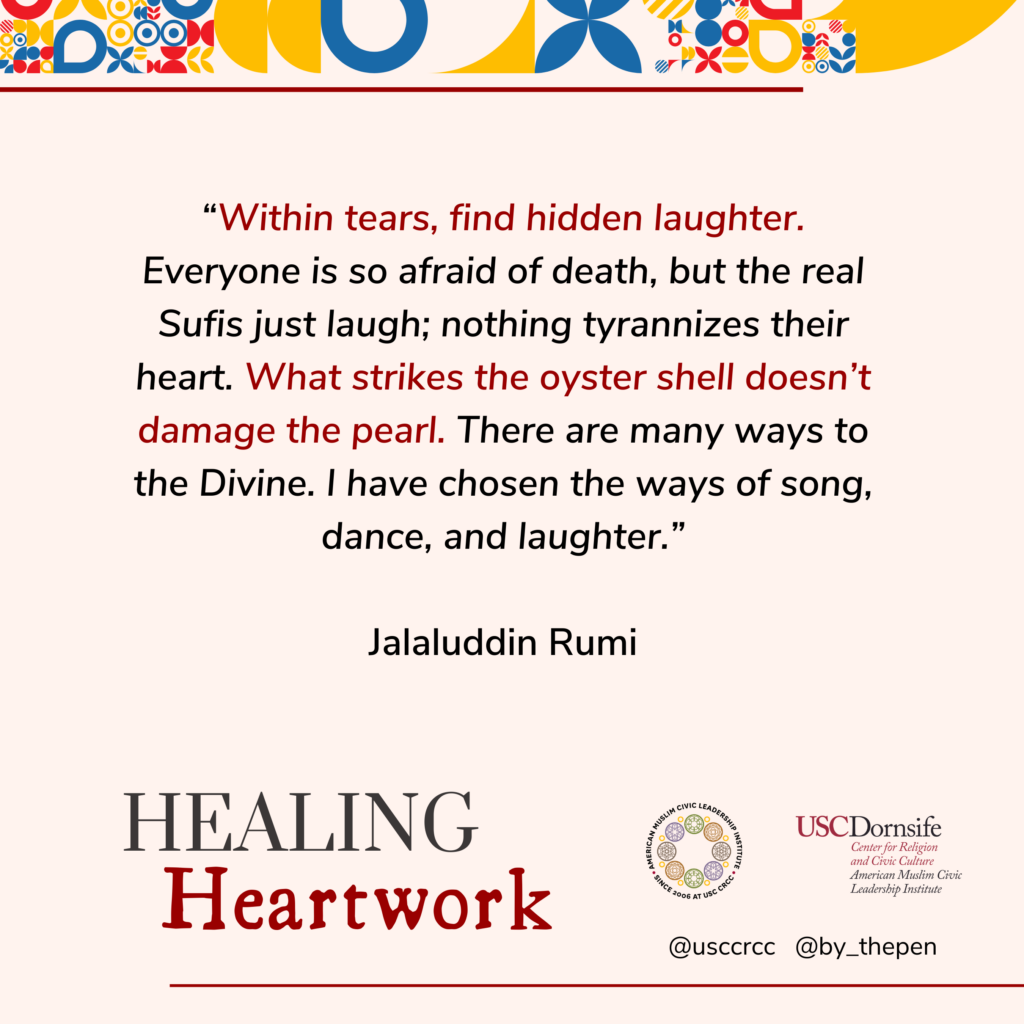
This equanimity in the face of adversity is the essence of safety, as Jalaluddin Rumi captures so beautifully: “Within tears, find hidden laughter. Everyone is so afraid of death, but the real Sufis just laugh; nothing tyrannizes their heart. What strikes the oyster shell doesn’t damage the pearl. There are many ways to the Divine. I have chosen the ways of song, dance, and laughter.”
To experience God in only one dimension deprives us of the whole picture. A soul at peace knows God in the fullness of what is possible in this life – in ease and in difficulty, in lightness and in darkness.
Finding happiness in all that comes our way in this life also translates to everlasting happiness in the next life. Abu al-Darda al-Ansari, a companion of the Prophet Muhammad ﷺ, said, “Verily, one who keeps his tongue moist with the remembrance of Allah, they will enter Paradise laughing” (Ḥilyat al-Awliyā’ 1/219). Muslim sages teach that the most sincere believer experiences jannatayn, or “Two Paradises”: the paradise of this life, which results from the inner peace of an intimate relationship with God, and the Paradise of the Afterlife. Paradise, as described in the Quran, is the absence of fear and grief (Quran Surah al-A’raf 7:49) or, in other words, a place of true emotional, physical, and mental safety. Paradise in this life thus shares a portion of this experience of safety through the believer’s spiritual immersion in the Presence of God.
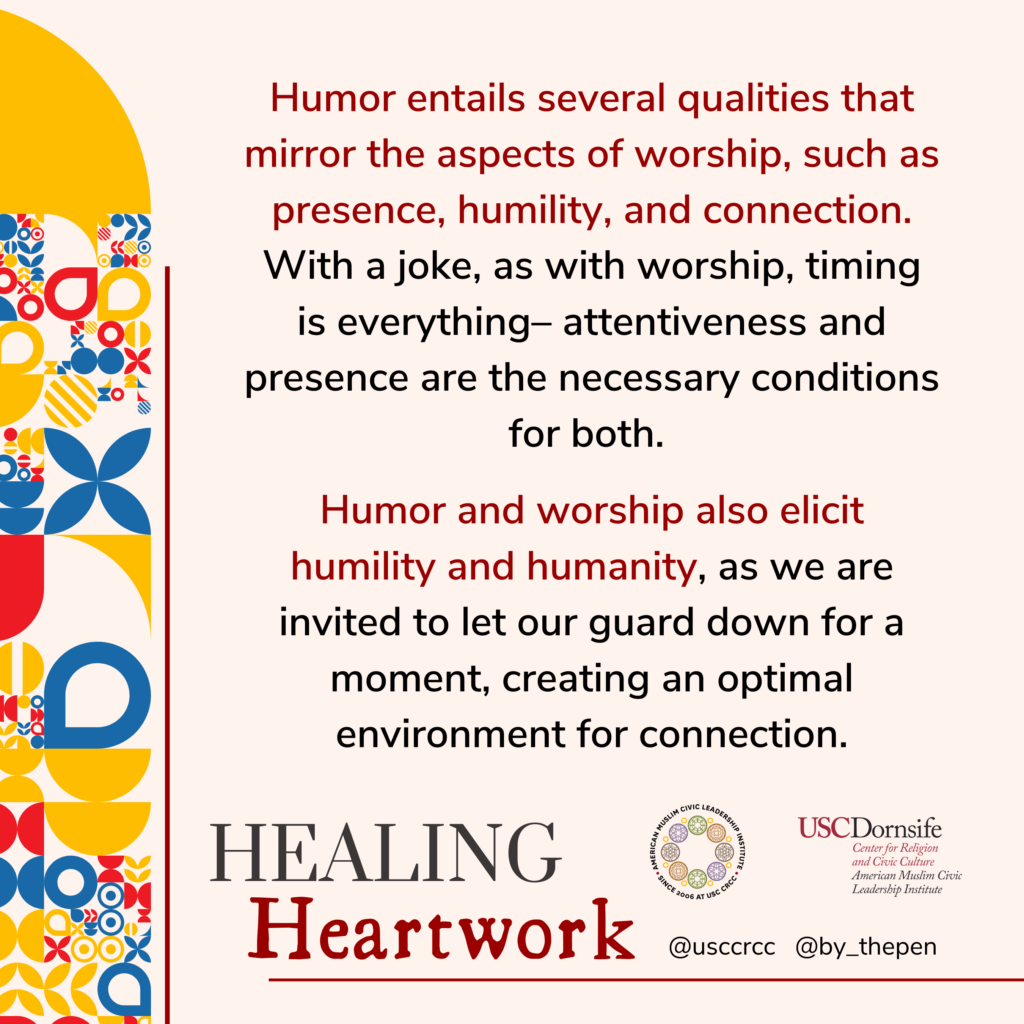
We humans often utilize practices such as worship and humor as ways to make the search for basic safety and survival richer and more holistic. Thus, in a practical sense, worship and humor are more similar than we think. Humor entails several qualities that mirror the aspects of worship, such as presence, humility, and connection. With a joke, as with worship, timing is everything– attentiveness and presence are the necessary conditions for both. Humor and worship also elicit humility and humanity, as we are invited to let our guard down for a moment, creating an optimal environment for connection.
When we see and hear our lived realities conveyed through comedy, we are able to laugh at the truths that jokes reveal about ourselves. For instance, in the Qur’an, when God asks Prophet Musa about the staff in his hand, Prophet Musa’s stumbling and rambling reply elicits a chuckle from the reader (Quran Surah TaHa 20:17). How many of us have found ourselves in a similar situation, responding to someone we deeply admire by putting our foot in our mouth? Whether through humor or in worship, we share a situation that others find themselves in too, and we feel a little less alone.
Humor needs at least two entities – the giver and the receiver – to function. Likewise, a community – whether between one person and another or between a person and God – also needs two entities to exist. Through humor, we cultivate a sense of safety that nourishes and strengthens the bond of community and fosters holistic healing and wellness.
Learning Activities: Holistic Humor

Download Healing Heartwork Toolkits
All three toolkits are available online and as PDFs.
For a donation to AMCLI of more than $100, you will receive a printed gift set of three Healing Heartwork toolkits. Please click here to make a donation.
Download a PDF of the toolkit on Exploring Self
You can also explore the online toolkit for “Exploring Self”

Download a PDF of the toolkit on Exploring Loss
You can also explore the online toolkit for “Exploring Loss.”

Connect with CRCC
Building Knowledge, Strengthening Communities
Our mission is to advance the understanding of religion and society, and support faith and community leaders in becoming full partners in the work of positive social change.
Support Our Work
The USC Center for Religion and Civic Culture is independently funded by grants, contracts and gifts. We welcome your partnership and financial support.
Make a tax-deductible contribution to support our mission.
Contact Us
Center for Religion and Civic Culture
University of Southern California
Los Angeles, CA 90089-0520