Maps & Data
The USC Center for Religion and Civic Culture has documented many different religious groups, including their social and demographic makeup, locations and stories, through its various research projects.
Together, these data sets tell the story of religion in Los Angeles and beyond at different times, while tracking religious, social and cultural change across discrete groups and time periods. They lay a historical groundwork for future research on religion in L.A.
Each resource provides the years in which the project data was collected. These data are available to scholars, journalists and community leaders through the different databases and maps listed below.
Religion and Place
How does “place” matter in the life and mission of religious groups?
How does geographic location influence how a religious organization understands itself and its mission?
How do leaders and members understand the role of the congregation in their local community?
All social activity, including religious activity, is emplaced. Social activity takes place in a particular geographic location that has specific forms and is infused with meaning through interaction of members (individuals and groups) of those communities
CRCC strives to understand how religious groups interact with their geographic location, including its relationships with community organizations, individuals and families; the physical environment; and social and economic conditions.
Understanding how religion and place influence each other provides insight on how a congregation’s activities and presence are lived out on a daily basis. For example, religious groups in quiet suburban communities often operate very differently from congregations in poor inner-city neighborhoods. The differences in “place” characteristics, such as their relative wealth or poverty, the presence or absence of crime, the quality and type of physical spaces — including built and natural spaces — and how people attach meaning to these areas, constrain and encourage different kinds of religious activities.
Read more about the significance of place in the study of religion, or explore some of our databases and maps:
“The specific ‘place; that provides the context through which we interact with the larger world is of key importance in developing our ongoing understanding of that world. Religion is no different in this regard.”
– Richard Flory

Databases
Please note: Each database below was collected for different projects at a specific point in time and have not been updated. Nonetheless, they can serve as a good starting point for your research or a comparison point for today.
This database of religious congregations in the five-county region that makes up Southern California, provides counts collected at three different points in time, 1997, 2009, and 2013.
It is available for researchers and community leaders who are interested in understanding religion in Southern California.
Email crcc@usc.edu to request access to the database.
The following listings include racial demographics and statistics on faith congregations for California counties as of 2010.

This resource includes faith-based organizations that were active from 2008-2010, in the five areas we have identified (charity, organizing, advocacy, community development and interfaith dialogue). While it is not an exhaustive list of all the faith-based organizations in Los Angeles, it is representative of the range of groups that are actively working in the public sphere. This dataset includes information about the goals and activities of each group, contact information and website links.

California Mosques
A mosque, or masjid, is the place of worship for Muslims. With the largest Muslim population, California is cited to have more mosques than any other state in the United States.
Explore a map of mosques, masjids or Islamic Centers in California. You can also link to a list of mosques and find out more about Islam in America.

California Megachurches
When researchers talk about “megachurches,” they are generally referring to any Protestant congregation with a sustained average weekly attendance of 2,000 persons or more in its worship services. There are nearly 1,600 megachurches in the United States, in addition to many more located throughout the world.
Explore a map of megachurches in California. You can also link to a list of megachurches and find out more about megachurches.

Maps of Congregations in Los Angeles
As a part of an effort to understand the relationship between religion and place, CRCC created maps of congregations in California, published in 2016. (Please note that maps have not been updated since then.)
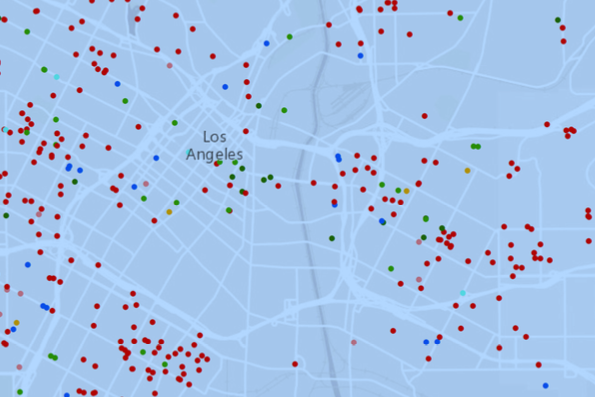
CRCC created neighborhood maps based on data collected on more 500 congregations across six different areas in Southern California. These maps show the concentration of religious groups and their diversity, both in terms of religious tradition (Protestant, Catholic, Jewish, Muslim, Buddhist and the like) and in the different people they serve.
Los Angeles is an area of rich religious vitality and diversity that can be observed in these maps.
Explore religious diversity and faith-based community services in Downtown Los Angeles and the Wilshire Corridor (2016).
Link will open the map on the Arcgis website in a new tab.

Explore religious diversity and faith-based community services in the Los Feliz neighborhood of Los Angeles (2016).
Link will open the map on the Arcgis website in a new tab.

Explore religious diversity and faith-based community services in the San Fernando Valley (2016).
Link will open the map on the Arcgis website in a new tab.

Explore religious diversity and faith-based community services in Long Beach, California (2016).
Link will open the map on the Arcgis website in a new tab.

Laundry Love is a nationwide network of more than 100 groups that offer free laundry to people in need, creating new communities at laundromats.
Learn more about Laundry Love and explore Laundry Love locations (2016) in this map.
Link will open the map on the Arcgis website in a new tab.

Engaged Spirituality Maps
As part of a research and journalism project on engaged spirituality, CRCC studied the lives and work of exemplary people committed to advancing human flourishing across the globe. Journalists and scholars profiled 104 people from 13 different religious traditions working on critical issues, such as poverty, peace-building, human rights and environmental justice.
Explore a map listing the Spiritual Exemplars featured in CRCC’s project. Click on each listing to find out more about a spiritual exemplar, including the exemplar’s area of work, gender, age, faith tradition and organization. You also will find a paragraph description that highlights these extraordinary individuals’ stories, their accomplishments and how their spirituality interacts with the work they do in the world.
Link will open the map on the Arcgis website in a new tab.

Environmental justice represents the third largest area of work in the spiritual exemplar sample making it a significant area of focus for leaders motivated by their religion to make positive change in the world.
Explore this story map that shows different areas of environmental work: ecologically-minded spirituality, climate-related disaster response, cultural preservation and environmental resilience.
Link will open the map on the Arcgis website in a new tab.

Connect with CRCC
Building Knowledge, Strengthening Communities
Our mission is to advance the understanding of religion and society, and support faith and community leaders in becoming full partners in the work of positive social change.
Support Our Work
The USC Center for Religion and Civic Culture is independently funded by grants, contracts and gifts. We welcome your partnership and financial support.
Make a tax-deductible contribution to support our mission.
Contact Us
Center for Religion and Civic Culture
University of Southern California
Los Angeles, CA 90089-0520