About AMCLI
AMCLI's Vision
The American Muslim Civic Leadership Initiative (AMCLI) at the USC Center for Religion and Civic Culture develops and trains American Muslim leaders who are committed to civic engagement.
AMCLI strives to accompany these pioneering leaders as they realize their full potential, and in doing so, have a more effective and sustained impact on the issues affecting their communities, and America at large. Our nation is stronger when all citizens participate in shaping our democracy.
AMCLI fellows are at the forefront of creating a greater presence of Muslims in the public square. They are actively reshaping what it means to be a “Muslim leader,” moving away from self-appointed spokespersons to leaders accountable to their communities. We believe that these leaders, when properly invested in, nurtured, and supported will be able to transform their organizations into highly innovative and effective partners in social change for the betterment of all Americans.
AMCLI hosts leadership retreats, virtual programs and a deeply connected network made up of the hundreds of American Muslim leaders who have been through its programing.
Building a Dynamic National Network of American Muslim Leadership (2016 Convening)
The Need for AMCLI
American Muslim leaders work to address social issues that impact their own communities and a much broader cross-section of Americans. They advocate for the protection of civil liberties; the need for fair housing, healthcare for all and immigration reform; racial and economic justice; and more. These leaders have demonstrated that partnerships enrich Muslim communities and add essential voices to the American democratic process.
AMCLI believes that American Muslim civic leaders—when fully invested in, nurtured and supported—will transform their organizations into highly innovative and effective partners in social change for the betterment of all Americans.
Muslim civic leaders of a new generation are leading, despite a challenging environment and lack of tools necessary for effective leadership.
American Muslim leaders face struggles on several fronts. Leaders cope with the demands from their constituencies and simultaneously negotiate complex relationships in the broader civic landscape. Many feel overwhelmed in the face of islamophobia and scrutiny in the public spotlight.
Many young Muslim civic leaders lack mentors and a reliable support systems to sustain their efforts. Prior to AMCLI’s inception in 2006, leadership training programs and a cohesive network among American Muslim civic leaders did not exist. The creation of new organizations and programs is a testament to the continued demand for leadership training.
These developments highlight the importance of investing in a generation of Muslim leaders who possess a unique ability to navigate secular and non-secular worlds, build partnerships and consensus within the Muslim community (across different ethnicities, schools of thought and socio-economic strata), and work with non-Muslim organizations to address social and economic policies that effect all Americans.
AMCLI's Values
AMCLI works to…
- Unlock potential
- Use the power of faith to inspire and sustain great leadership.
- Help leaders to move past discomfort into new levels of leadership.
AMCLI believes that…
- Relationships have inherent value.
- People learn and connect through stories.
- Social change requires disciplined leaders.
- There are many ways to lead and to make change.
- Organizations and leaders cannot solve problems on their own.
AMCLI works with leaders who…
- Know themselves.
- Are connected to a community and reflect its diversity.
- Are lifelong learners.
- Treat time as precious.
- Make space for others.
- Recognize that failures are inevitable in any endeavor.
- Are able to engage in healthy conflict.
- Understand how to succeed in the face of uncertainty.
- Set healthy boundaries.
- Develop other leaders.
- Know where they are going and articulate their vision.
- Do not wait for permission to create change.
- Realize that graciousness is at the core of good leadership.
- Seek and develop creative partnerships based on shared vision, even when they may not always be in complete alignment with their partners.
AMCLI's Origins
The idea for the American Muslim Civic Leadership Initiative emerged in the mid-2000s from a conversation among four women. Edina Lekovic, then-communications director at the Muslim Public Affairs Council (MPAC), arrived late for a dinner date with Sumaya Abubaker, who would become AMCLI’s program manager, and AMCLI’s future co-founders Brie Loskota and Nadia Roumani. Brie was then-managing director of the USC Center for Religion and Civic Culture (CRCC) and Nadia was working as a research associate at CRCC.
Edina describes that fateful meeting as “AMCLI’s patient zero moment.” She decided to let her guard down and share what her friends were already hearing from countless other young Muslim leaders: She felt isolated, burned out, overwhelmed and exhausted. They all agreed that the culture of Muslim American leadership did not need to be that way—a new strategy for cultivating leaders was possible.
In her role as a research associate at CRCC, Nadia was leading a series of projects focused on American Muslim young adults and Muslim organizations engaged in domestic and foreign policy issues. Her research identified two dominant trends:
- Muslim organizations lack capacity and are overburdened and, thus, unable to engage effectively in partnerships on regional/national policy issues, and
- Emerging Muslim leaders feel that they lack sufficient mentors, resources, and training to lead effectively.
In the summer of 2006, Nadia worked with colleagues Brie and Edina to convene a three-day meeting of 22 civic leaders from across the country at the Rockefeller Brothers Fund’s Pocantico Conference Center in New York. (View the list of attendees below.) The women and men around the table had been carefully selected through a nomination process and represented the ethnic, social and geographical diversity of the Muslim communities of America.
As the participants shared ideas, stories, disappointments and triumphs, they developed a deeper sense of common purpose and cultivated a shared belief that their civic work, if strategically nurtured, could lead to a vibrant and civically engaged Muslim community in America. At this meeting, the group discussed shared challenges and prioritized the most pressing need: to develop a national leadership program to invest in an emerging generation of leaders, provide them with learning tools and help them connect with their peers across the country.
To develop this concept further, a steering committee emerged:
- Muneer Aliuddin, a community activist
- Gibran Bouayad, an interfaith leader
- Tannaz Haddadi, a mediator
- Dalia Hashad, a human rights attorney
- Edina Lekovic, a communications professional
- Brie Loskota, a religion researcher
- Nadia Roumani, a non-profit and philanthropic consultant
- Khadijah Fatinah Sharif-Drinkard, a corporate attorney
Between 2006 and the program launch in 2008, Nadia, Brie, and a team at USC studied several well-established training programs that sought to increase civic engagement among faith-based and ethnic communities around the country. The team identified the following needs of Muslim civic leaders:
- Leadership and non-profit management skills;
- A better grounding in the tenets of social justice in an Islamic framework;
- A formal network of American Muslim civic leaders that can exchange ideas and best practices;
- Case studies of American Muslim civic leaders to be shared with the broader American Muslim community;
- A deeper understanding of policy issues and potential organizational partners at the local, regional and national levels;
- Access to resources and assistance in developing relationships with foundations that are interested in engaging with the Muslim community; and
- Skills to assess and address the needs and sensitivities of an increasingly ethnically and religiously diverse American public.
AMCLI found a home at the USC Center for Religion and Civic Culture, and created a partnership with Georgetown University’s Bin Talal Center for Christian-Muslim Understanding. With grant support from the Ford Foundation, the program launched in 2008 with the first AMCLI cohort of 20 fellows from across the United States. Several funders also supported this effort in its first year, including the Carnegie Corporation of New York, the Ford Foundation and One Nation for All.
Since 2008, AMCLI has offered its training programs in different formats—national, regional, virtual and hybrid. These goals remain at the heart of its work:
- Identifying leadership needs, human capital gaps, organizational best practices and theological resources on civic engagement in Islam;
- Equipping leaders with practical skills in communication, community mobilization, leadership, policy analysis, advocacy and organizational management;
- Connecting to a network of civic leaders (Muslim and non- Muslim) across the country and facilitating a forum for constructive intra-Muslim dialogue;
- Guiding the development of projects, partnerships and resources; and
- Sustaining the learning with ongoing opportunities for fellows to interact with each other.
Feelings of isolation and burnout continue for many young American Muslim leaders, but AMCLI is now an established program that is reshaping the landscape of civic activism and building communities of trust and cooperation among American Muslim leaders. AMCLI supports a new generation of leaders who are able to fully engage co-religionists and fellow citizens in the work of building better communities for all.
List of Attendees at First Retreat
The following individuals attended the “Muslim-American Leaders Retreat: Young Adults Defining the Future” retreat, July 28-30, 2006 in Pocantico Hills, New York.
- Su’ad Abdul-Khabeer
- Firas Ahmad
- Muneer Aliuddin
- Mehrdad Azemun
- Gibran Bouayad
- Babak Darvish
- Mohammed Elbiary
- Tannaz Haddadi
- Dalia Hashad
- Jim Jouney
- Farhana Khera
- Edina Lekovic
- Brie Loskota
- Aliya Mawani
- Rami Nashashibi
- Mohammad Ali Naquvi
- Saafir Rabb
- Nadia Roumani
- Fateen Seifullah
- Khadijah Fatinah Sharif-Drinkard
- Shirin Sinnar
- Ahmed Younis
AMCLI Through the Years
AMCLI founders Nadia Roumani and Brie Loskota share the story of how AMCLI began and reflect on lessons learned from 15 years of running a leadership program and network of American Muslim civic leaders.

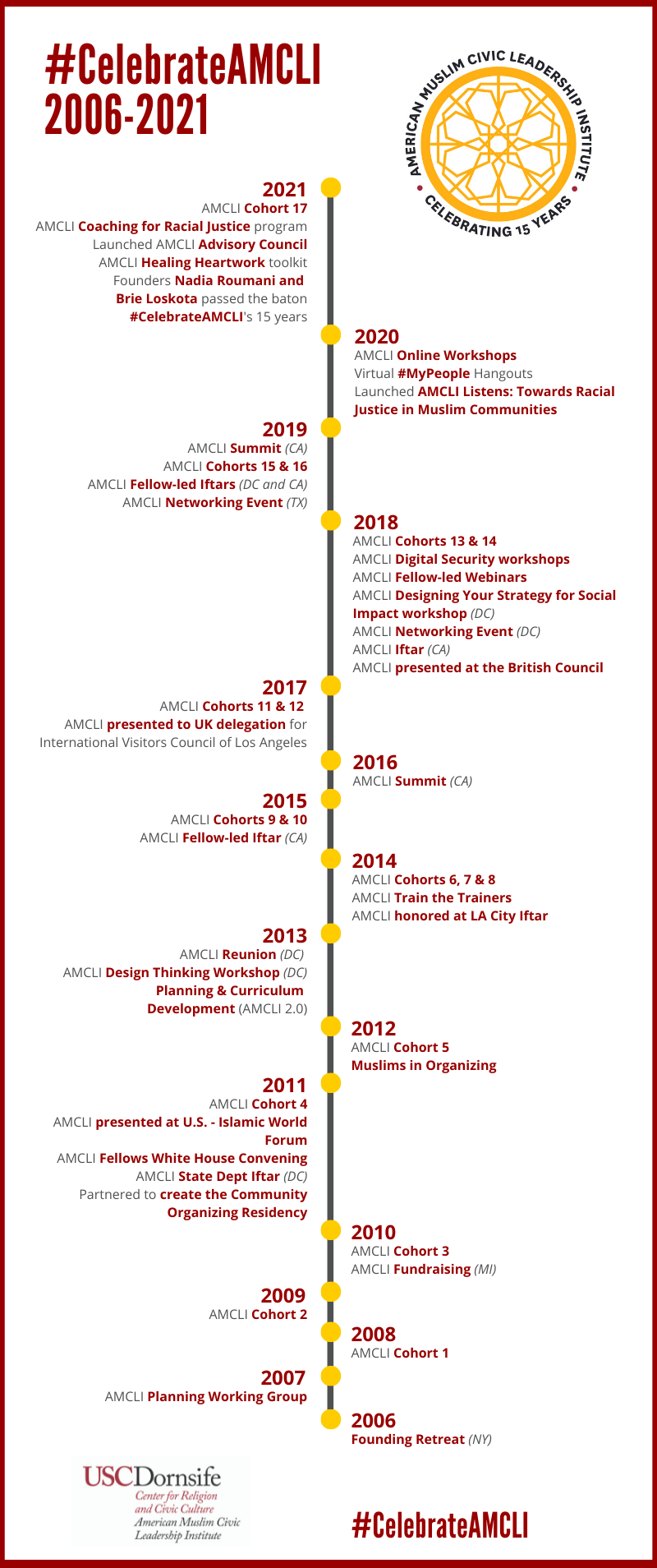
Timeline
AMCLI created this timeline to celebrate the 15th year since its founding retreat, where the idea a leadership program for American Muslims emerged. Since then, AMCLI hosted a series of online trainings over the pandemic and multiple additional cohorts.
Testimonials
In honor of AMCLI’s first 15 years, CRCC released 15 (+1 extra!) video testimonials. Hear from AMCLI fellows about how the program has made a difference in their lives.

Having a cohort of Muslim civic leaders across the country to bounce ideas off of, get advice from on professional obstacles, share lessons learned, and to collaborate with on national campaigns will ultimately benefit us all. Together, we have so much to offer the world and I now feel reinvigorated about our community’s latent potential.

This program has led to the creation of a network of young, vibrant leaders who have already so enriched my life and my work, and who without a doubt will be a source of guidance for the Muslim community for generations to come.

AMCLI is a great program that brings a diverse group of Muslim Americans to learn from and grow with each other.

AMCLI is an empowering, transformational and phenomenal experience. It has solidified my personal sense of service and purpose. It redefined my view of our community, our future and our potential.

My experience in AMCLI was truly eye-opening for my career and personal enrichment. AMCLI training has helped me apply more effective leadership skills to my work as a spiritual and social leader in the Muslim community.

Connect with CRCC
Building Knowledge, Strengthening Communities
Our mission is to advance the understanding of religion and society, and support faith and community leaders in becoming full partners in the work of positive social change.
Support Our Work
The USC Center for Religion and Civic Culture is independently funded by grants, contracts and gifts. We welcome your partnership and financial support.
Make a tax-deductible contribution to support our mission.
Contact Us
Center for Religion and Civic Culture
University of Southern California
Los Angeles, CA 90089-0520