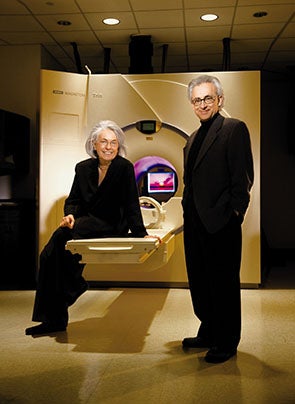
Artists and philosophers have sought to explain human nature since antiquity. Today, new insights from general biology and from the brain sciences bring us closer to that goal as we uncover the foundations for a large array of mental processes — from feelings, consciousness, language, and decision-making, to the invention expressed in the arts, sciences and technology. Antonio and Hanna Damasio founded the Brain and Creativity Institute (BCI) to capitalize on such advances.
The BCI research program is organized around thematic centers and laboratories as noted below. The respective leaders are noted in brackets.
- The Center for Consciousness Studies, which investigates the neurobiological basis for human consciousness. It includes studies on the comparison of natural and artificial intelligences (A and H Damasio);
- The Center for Music, Brain and Society, which focuses on the mechanisms underlying music processing and their relation to brain development (Assal Habibi and Hanna Damasio);
- The Addiction and Self Control Laboratory, dedicated to the individual and social aspects of the addictions (John Monterosso);
- The Center for the Neuroscience of Embodied Cognition explores the neuroscience of Human/Artificial Intelligence interactions; the fact that metaphors are embodied; and the relationships of the gut microbiome to brain function (Lisa Aziz-Zadeh in collaboration with Srini Narayanan of Google DeepMind);
- The Center for Brain and Society, which addresses the neurobiology related to ethics and the law, as well as the biological processes related to economical and political systems (Jonas Kaplan and Antonio Damasio);
- The Center for Psychedelic Science is dedicated to understanding how psychedelic compounds and contemplative practices transform the mind and reshape the brain, both as therapeutic tools and as windows into the nature of human consciousness (Rael Cahn, Jonas Kaplan and Assal Habibi).
- The BCI Center for Education (CANDLE): A science-informed center devoted to innovative teaching practices and the transformation of adolescent education (MH Immordino-Yang).
Results from the Institute’s ongoing research are relevant to elucidating the human condition but also have applications in (a) the diagnosis and treatment of neurological and psychiatric disorders; (b) the study of child development; and (c) the vast field of education. For example:
- Conditions such as pain, depression and addiction drastically reduce individual well-being but can be helped as we identify novel strategies to control these problems ranging from social interventions to new medications;
- Early results from an ongoing BCI study undertaken in collaboration with the Los Angeles Philharmonic and the GRoW @ Annenberg Foundation show the remarkable neural and cognitive benefits of early musical education on the minds and brains of children ages 5-12;
- Artificial Intelligence and robotics challenge the conventional boundaries of the definition of humanity. As we compare the designs of living systems and of intelligent artifacts we have an opportunity to address the moral questions posed by those advances.
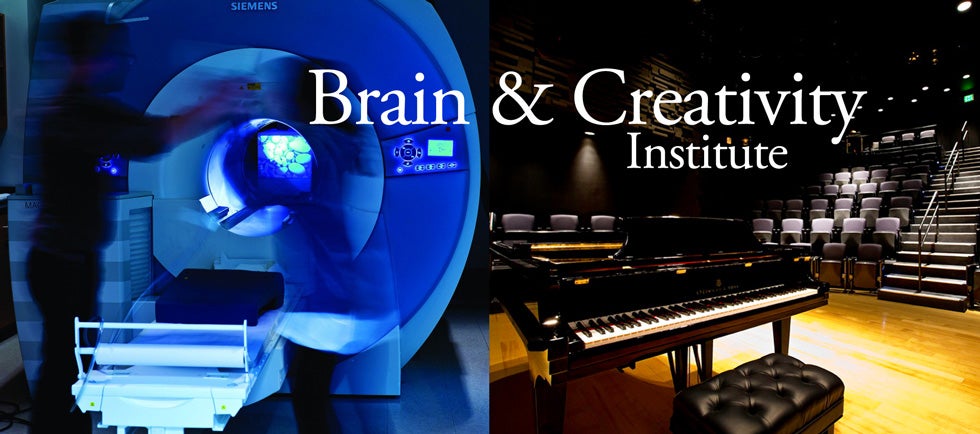
As envisioned by the founders, the design of the BCI reflects its mission. The faculty offices and research spaces sit next to the modern laboratories of the Dornsife Neuroimaging Center (DNI) which are directed by Hanna Damasio and are dedicated to the scientific investigation of mind and brain, and to one of the oldest instruments used to explore the human mind: a classical auditorium (the Joyce J. Cammilleri Hall) devoted to music and theater performances, literary readings, scientific presentations, and also provides a unique setting for music-related research.