CORE 112: Writing Seminar II
CORE 112: Writing Seminar II asks students to place contemporary texts in conversation with larger critical concepts or lenses. In particular, students learn to: use the arguments of others to create their own original interpretations of primary texts; conduct effective searches for timely and appropriate scholarly secondary sources; evaluate the sources they find in light of disciplinary conventions and their own argument; write effectively in multiple scholarly genres, including oral presentation; present their original scholarship in an academic community; and draw connections between their course texts/themes and the world outside the classroom.
Students are required to take CORE 111: Writing Seminar I in their entering fall term and strongly encouraged to take CORE 112: Writing Seminar II the following spring. This year-long arc of writing instruction helps students maintain momentum between semesters and emerge from their first year at USC with the tools needed to succeed in future academic and professional writing. Both CORE 111 and CORE 112 are augmented with bi-weekly, one-on-one tutorials that provide students with individualized coaching and the opportunity to address their specific strengths and weaknesses, track their growth as writers, and develop their personal voices.
Sample Course Descriptions

Awestruck and Dreadfully Aware: Encountering the Sublime
Dr. Krishna Narayanamurti, Thematic Option Honors Program
Have you ever stared at a dark gray ocean or a vast mountain range and felt a rush of delight and terror? You may have experienced “the sublime.” An aesthetic category stronger (and stranger) than “beauty,” the sublime points to the grace and power, inconceivable in form or scope, behind a captivating object. Traditionally associated with nature—and more recently, technology—this feeling can come from anywhere. Yet, it rarely occurs. You can’t see or prove it through reason alone. You must sense it, when intuition overwhelms your perception. For scholar Stephen Zepke, the sublime “exiles you from yourself” and leaves you “painfully suspended between cosmic awareness and crushing madness.” Writing on the philosophy of art, Zepke joins the mystics, poets, novelists, and painters who have tried for centuries to capture the sublime on paper or on canvas.
In this course, we will study texts that attempt, successfully or not, to represent sublime experience. We’ll observe the ways scientific wonder transforms into spiritual reverence in Mary Austin and Annie Dillard’s nature essays and Terrence Malick’s arthouse filmmaking, as they immerse us in rainstorms, solar eclipses, or the formation of the Earth. We’ll consider why and how the graphic novel Gods’ Man draws a dreadful awe onto urban and wilderness settings alike. In Zong! and The Swimmers, experimental texts that blend poetry or fiction with history, we’ll bear witness to the generational trauma and collective consciousness that work through “unseeable” and “unspeakable” social forces and power structures to shape the past and present. The films Oppenheimer and The Matrix will problematize the human amazement at technological feats like the atomic bomb and artificial intelligence that threaten our survival and our humanity itself. And through 1960s psychedelic rock and avant-garde orchestral music, we’ll sway to the siren songs of dismay and transcendence. To support our close reading and writing, we’ll consult scholarly research in aesthetic philosophy, ecocriticism, and affect theory. Recent work in neuroscience and psychology will help us ask what measurable effects aesthetic experiences like the sublime produce in the brain and body. Be forewarned: in this class, “cosmic awareness and crushing madness” are possible but not guaranteed.
Texts
- Mary Austin. The Land of Little Rain (selections).
- Annie Dillard. “Total Eclipse.”
- Terrence Malick, dir. The Tree of Life.
- Christopher Nolan, dir. Oppenheimer.
- M. NourbeSe Philip. Zong!
- Julie Otsuka. The Swimmers.
- Lana and Lilly Wachowski, dirs. The Matrix.
- Lynd Ward. Gods’ Man: A Novel in Woodcuts.
- Music selections from The Doors, Krzysztof Penderecki, and others.
The Knowledge of Good and Evil
Professor Amy K. Cannon, Thematic Option Honors Program
Let me tell you the story of right-hand–left-hand, the tale of Good and Evil?
—Spike Lee, Do the Right Thing
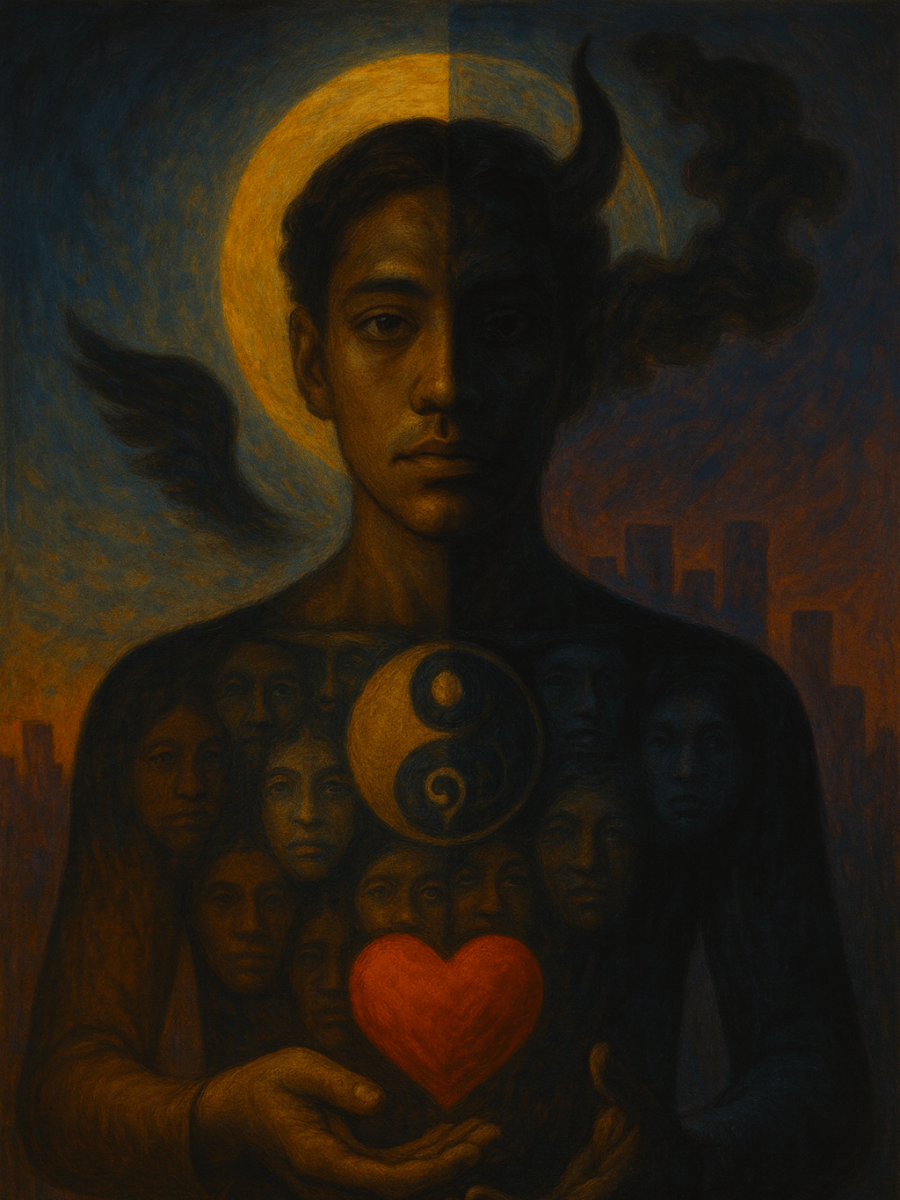
In the stories we tell, what kind of people get to be heroes? Are they always strong and self-sacrificing? With archetypes likes Jesus and Superman, whom do we fail to see as heroic? If the good are always superhuman or divine, can the rest of us ever rise above murky mediocrity? Does anyone really think they’re the villain? And how can we account for the very human impulses at the root of even our worst offenses?
Why is it that crafting a compellingly good character is so challenging? Why do heroes often come across as a little one-dimensional—even boring? And why are we so intrigued by depictions of evil? In this course, we’ll encounter foundational texts about the capacity for good and evil within us all and consider narratives that complicate an easy understanding of morality.
In Dr. Jekyll and Mr. Hyde, we’ll look at evolutionary, economic, and psychoanalytic approaches to good and evil and examine the inner conflict that underlies moral choice. Octavia Butler will ask whether empathy can or should be extended even to those who view us as less than human in Kindred. We’ll move from the black and white world of the very first Superman comics to the radical difference perspective can make in Gene Luen Yang’s Boxers & Saints. With protagonists as disparate as an impervious space alien, a pizza deliveryman, and an illiterate peasant child, we’ll consider how race, gender, culture, and belief shape our understandings of good and evil.
In a time of deep political schism, an era of vast wealth and extreme poverty, and a moment requiring us to confront how individual choice will affect our collective future, it’s worth wondering…who are “the good guys”? Who are painted as villains? And where do the rest of us fall?
Texts
- Octavia Butler. Kindred.
- Carl Dreyer, dir. La passion de Jeanne d’Arc.
- Akira Kurosawa, dir. Rashomon.
- Spike Lee, dir. Do the Right Thing.
- Robert Louis Stevenson. Strange Case of Dr. Jekyll and Mr. Hyde.
- Jeff Loveness and Jakub Rebelka. Judas.
- Gene Luen Yang. Boxers & Saints.

Our Last, Best Line of Defense:
The Final Girl Past, Present, and Future
Professor Michael Petitti, Thematic Option Honors Program
I am strong / I am invincible / I am woman.
—Helen Reddy, “I Am Woman”
There’s a murderer on the loose, and only one girl remains—the bodies of her friends are scattered throughout the campsite. Will she confront and defeat the evil all on her own? Can she? Theorist Carol Clover dubbed this horror archetype the “Final Girl” after locating her in countless slasher films from the late 1970s through the 1980s. The Final Girl was an interchangeable female protagonist portrayed as chaste, attentive, smart, practical, and androgynous. Our course, however, will explore the rich history of the Final Girl, searching for her precedent and emphasizing her variations. Along the way, we will ask: Why are we drawn to the idea and image of the Final Girl? What narrative and historical stakes inform such a figure?
By exploring the origins and developments of the Final Girl, we will encounter myriad protagonists haunted by ghosts, houses, psychopaths, their minds, their environments, and their histories. From inversions of Little Red Riding Hood, to a refugee of slavery and time travel, we will investigate the concept of the Final Girl throughout popular history. Early manifestations of the Final Girl portray her as mentally unstable (“The Yellow Wallpaper”) or jilted (“Pomegranate Seed”), or both (Rebecca). Shirley Jackson’s The Haunting of Hill House helped dramatically complicate the protean concept of the Final Girl before Halloween crystallized her into infamy. Angela Carter, in a series of challenging stories, challenges the limits of the Final Girl, while postmodern films like Trouble Every Day, Us, Suspiria, and Midsommar tweak the Final Girl’s careworn formula. Lastly, we’ll consider how a graphic reworking of Octavia Butler’s Kindred forcefully transmogrifies the historical legacy of the Final Girl. Theoretically, we will move from Clover’s psychoanalytical perspective on the Final Girl into a variety of Marxist-Feminist and Critical Race theorists who can help us make sense of the ever-shifting figure across texts and time.
Once the dust settles from the carnage of ghosts, bullies, fiends, and maniacs, our Final Girls will still be standing. Will you?
Texts
- Ari Aster, dir. Midsommar.
- Octavia Butler. Kindred.
- John Carpenter, dir. Halloween.
- Angela Carter. The Bloody Chamber and Other Stories.
- Claire Denis, dir. Trouble Every Day.
- Luca Guadagnino, dir. Suspiria.
- Alfred Hitchcock, dir. Rebecca.
- Shirley Jackson. The Haunting of Hill House.

Slippery Characters
Professor Trisha Tucker, Thematic Option Honors Program
I always thought it would be better to be a fake somebody than a real nobody.
—Tom Ripley, The Talented Mr. Ripley
In this course, we’ll make friends with a host of fascinating imposters. These men and women (and robots) hide huge secrets from the unsuspecting people around them. Some, like the talented but treacherous Tom Ripley, slip in and out of names, accents, and even whole identities as easily as changing their clothes. Others, like Passing’s beautiful but haunted Clare Kendry, have been living double lives for so long that it’s hard to tell where the “fake” person ends and the “real” one begins. Whether they craft charming disguises to swindle rich strangers (Six Degrees of Separation, The Lady Eve) or make up double lives to please their demanding parents (Everything I Never Told You), these characters all have one thing in common: none of them is quite who they seem to be.
To better understand what makes these frauds, forgers, and fakes at once so thrilling and so threatening, we’ll turn to theories of identity by John Locke, Judith Butler, and Elaine K. Ginsberg. With their help, we’ll explore the many pleasures and dangers of living secret lives.
Texts
- Danny Boyle, dir. Yesterday.
- Alex Garland, dir. Ex Machina.
- John Guare. Six Degrees of Separation.
- Nella Larsen. Passing.
- Anthony Minghella, dir. The Talented Mr. Ripley.
- Celeste Ng. Everything I Never Told You.
- Preston Sturges, dir. The Lady Eve.
- Fay Weldon. The Life and Loves of a She Devil.