
Race & Power in Early Los Angeles: In Conversation with Dan Lynch
Thursday, September 17, 2026, 12:00 – 1:00pm PST
ICW proudly welcomes Dr. Dan Lynch, who will join Bill Deverell in conversation about his new book, Dancing with Manifest Destiny: Elite Men of Color and the Making of Los Angeles. Dr. Lynch will discuss how three nineteenth-century figures, Andrés Pico, Peter Biggs, and Antonio Coronel, helped shape Los Angeles while navigating the time’s political forces. Their conversation will explore the complex relationships between race, power, and urban development in the city’s formative years. Drawing on original research and compelling biographical stories, the webinar offers a fresh perspective on the people and processes that made modern Los Angeles.
Register Now: https://bit.ly/icwSept17

Book Chat: William Handley, Horizons of Catastrophe in the American West
Friday, September 18, 2026, 1:00pm to 2:00pm PDT
A discussion of William Handley’s new book, Horizons of Catastrophe in the American West (University of Nebraska Press, 2026). The author will be joined in conversation by Audrey Goodman (Georgia State University) and Hsuan L. Hsu (UC Davis), moderated by William Deverell (USC).
About the Book: Horizons of Catastrophe in the American West contributes to discussions in the environmental humanities and western U.S. studies about how we read past cultural history in the light of our determined yet unknown future under climate catastrophe. Examining an eclectic but interrelated and interdisciplinary range of photographs, films, and novels of the West; Western historiography; geological science; Tony Kushner’s Angels in America; the Los Angeles freeway system and the city’s layered temporalities; and the long poem form among contemporary Indigenous poets, William R. Handley argues that artists within mostly twentieth-century settler cultures saw on past horizons of the West premonitions of catastrophe—without, of course, knowing what their civilization was doing to the atmosphere and what that portended for the planet’s future. The possibilities and limits of their artistic forms, Handley shows us, offer a way for us to find hope in the wreckage of the past and to forge a future grounded in environmental realism.
About the Author: William R. Handley is Associate Professor of English at the University of Southern California. He is the author of Marriage, Violence, and Nation in the American Literary West, coeditor of True West: Authenticity and the American West (Bison Books, 2007), and editor of The Brokeback Book: From Story to Cultural Phenomenon (Bison Books, 2011).
This event is part of the Levan Institute for the Humanities’ “Book Chats” series, conversations about new books published by USC scholars in the humanities and humanistic social sciences. To see more events in this series, including recordings of past events, visit https://dornsife.usc.edu/levan-institute/book-chats/.

The Boundless Biddy Mason: In Conversation with Kevin Waite & Marne Campbell
Thursday, September 24, 2026, 12:00 – 1:00pm PST
Join Kevin Waite and Marne Campbell, in conversation with Bill Deverell, for a compelling dialogue about Waite’s new book The Boundless Biddy Mason: An Odyssey from Slavery to Freedom Across the American West. In this groundbreaking biography, Waite traces the remarkable life of Biddy Mason, who endured a 3,000-mile forced journey from slavery in Georgia to California, secured her freedom through a landmark court case, and went on to become a healer, philanthropist, entrepreneur, and one of the most influential founders of Black Los Angeles. This conversation will explore the legacy of a woman whose life illuminates both the possibilities and limits of freedom in the American West.
Register Now: https://bit.ly/icwSept24
Kevin Waite is the Anne Stark Watson and Chester Watson Distinguished Professor of History at the University of Texas at Dallas. His first book, West of Slavery, won the 2022 Wiley-Silver Prize and was shortlisted for three other awards, including the Lincoln Prize. His writing appears in The Atlantic, The Los Angeles Times, The Washington Post, Slate, National Geographic, and The New Republic. Kevin moonlights in the TV and film industry, most recently as the writer and producer of a six-episode docuseries on the American Revolution for National Geographic and Disney+.
Marne L. Campbell is an Associate Professor at Loyola Marymount University and the Chair of the Department of African American Studies. She received her Ph.D. in History at UCLA in 2006 and holds a Master’s Degree in African American Studies. She is the author of “Making Black Los Angeles,” which explores the intersections of race, class, and gender in early Los Angeles, and was published by the University of North Carolina Press. Her study emphasizes issues of labor, politics, and culture through the intersection of this diverse community with other communities of color. She has completed an extensive database of almost every African American family in Los Angeles (1850 – 1910).

Reforming L.A.: 1926 and 2026
–
A century separates 1926 and 2026, but many of the questions facing Los Angeles remain surprisingly familiar. In celebration of the Haynes Foundation’s 100th anniversary, historians, journalists, and civic scholars will use these two points in time to examine how ideas about democracy, governance, and the common good have changed over the past century.
Looking across 100 years of reform, they explore efforts to create a more effective and representative government, as well as the forces that resisted change. Reflecting on shifting ideas of civic participation and public trust, the panel considers how L.A.’s political, cultural, and ethnic landscape has reshaped what Angelenos expect from their government, and what that history can reveal about the city’s future.
REGISTER HERE Tickets are free, but registration is highly recommended to ensure a spot
Participants include:
- Gustavo Arellano, Los Angeles Times columnist
- Natalia Molina, Professor of American Studies and Ethnicity at USC
- Patt Morrison, Los Angeles Times columnist
- Becky Nicolaides, urban historian and author of The New Suburbia: How Diversity Remade Suburban Life in Los Angeles
- Raphael Sonenshein, political scientist and executive director of the Haynes Foundation
- Moderated by William Deverell, director of the Huntington-USC Institute on California and the West
Access to the Autry’s exhibition Life, Liberty, and Los Angeles is included in your ticket, and the gallery will be open between 6 p.m. and 7:30 p.m. A light reception and bar will also be provided during that time, sponsored by the John Randolph Haynes and Dora Haynes Foundation.
Event produced in partnership with the Los Angeles History Collaborative, with the support of the John Randolph Haynes and Dora Haynes Foundation.

In Conversation with Danny Widener & Natalia Molina: Third Worlds Within: Multiethnic Movements and Transnational Solidarity
ICW and Third LA present Daniel Widener & Natalia Molina, discussing Widener’s newest book, Third Worlds Within: Multiethnic Movements and Transnational Solidarity. This webinar will examine how local racial justice struggles in the United States—specifically in Southern California—are deeply tied to global, transnational anti-imperialist movements.
Register Now: bit.ly/dwidener
Born in Echo Park and raised in Venice, Danny Widener is professor of history at UC San Diego. His educational journey began at the Echo Park-Silverlake People’s Childcare Center, and it has been pretty much downhill since then. His first book, Black Arts West: culture and struggle in postwar Los Angeles (Duke, 2010), received an honorable mention for the American Studies Association’s John Hope Franklin Prize. His most recent monograph, Third Worlds Within: multiethnic movements and transnational solidarity (Duke, 2024), was awarded the John Hope Franklin Prize in 2025. He has taught at Los Angeles City College, CSUN, and the University of Cambridge.
Natalia Molina is a Distinguished Professor of American Studies and Ethnicity and Dean’s Professor of American Studies and Ethnicity at the University of Southern California. Her research explores the interconnected histories of race, place, gender, culture, and citizenship. She is the author of three award-winning books: How Race Is Made in America: Immigration, Citizenship, and the Historical Power of Racial Scripts; Fit to Be Citizens?: Public Health and Race in Los Angeles, 1879-1940; and, most recently, A Place at the Nayarit: How a Mexican Restaurant Nourished a Community, which the Los Angeles Times calls an “essential Los Angeles book.”
Stewards of the Land: In Conversation with Stevie Ruiz & Jessica Kim
Thursday, November 12, 2026, 12:00 – 1:00pm PST
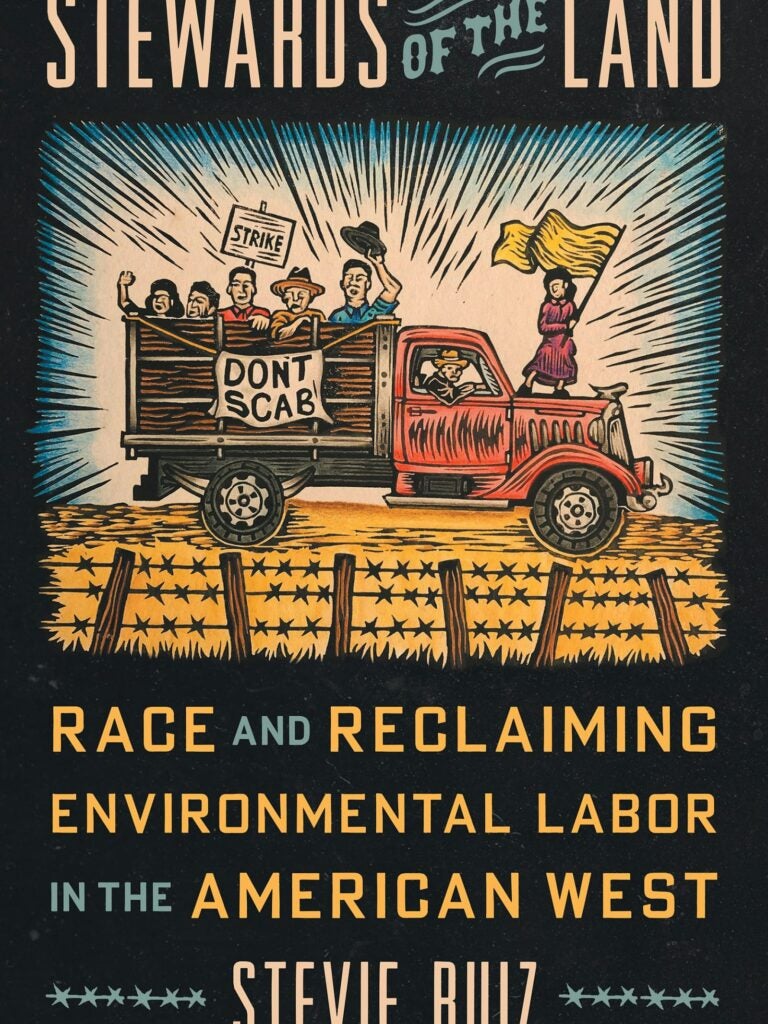
ICW is proud to present Dr. Stevie Ruiz, Professor of Chicana/o Studies at California State University, Northridge, in conversation with Jessica Kim about his new book, Stewards of the Land: Race and Reclaiming Environmental Labor in the American West. Challenging conventional histories that center white environmentalists, Ruiz reveals environmentalism in the American West as a multiracial project shaped by the labor, knowledge, and activism of Asian migrants and Chicana/o communities. Drawing on archival research and comparative ethnic studies, Stewards of the Land: Race and Reclaiming Environmental Labor in the American West traces the deep roots of environmental justice in struggles against land dispossession, labor exploitation, and racial inequality, offering a compelling new account of how frontline communities helped build and reimagine environmental spaces in the United States.
Register Now: https://bit.ly/stevieruiz
Stevie Ruiz is Professor of Chicana/o Studies at California State University, Northridge. His research and teaching focuses on environmental justice studies and critical science studies. He has been awarded prestigious fellowships including the NEH Long Term Fellowship at the Huntington Library and the Institute for American Cultures (IAC) Visiting Scholar Award at UCLA. His recent book, Stewards of the Land: Race and Reclaiming Environmental Labor in the American West was published in April 2026 by the University of North Carolina Press.
Jessica Kim received her PhD in history at USC in 2012, was a postdoctoral fellow with ICW in 2013, and is currently Associate Professor of History at CSUN, where she teaches courses on Los Angeles, California, the borderlands, and public history. Her book, Imperial Metropolis: Los Angeles, Mexico, and the Borderlands of American Empire, 1865-1941 (UNC Press, 2019), explores the rise of Los Angeles and investment in Mexico. The book is the co-winner of the 2020 Kenneth Jackson Award for best book from the Urban History Association. She loves combining her interests in public history and the American West on ICW’s social media platforms.

Racist by Design: In Conversation with Kelly Lytle Hernández & Bill Deverell
Thursday, December 3, 2026, 12:00 – 1:00pm PST
ICW is proud to present Dr. Kelly Lytle Hernández, Professor of History, African American Studies, and Urban Planning at UCLA, in conversation with Bill Deverell about her new book, Racist by Design. Drawing on decades of historical research, Lytle Hernández reveals how generations of lawmakers and law enforcement officials deliberately shaped the U.S. immigration system to encourage white immigration while targeting nonwhite migrants for exclusion, criminalization, and deportation. Exposing the racial foundations of immigration policy and its enduring consequences, this conversation will dive into the immigration system’s origins and how we might reimagine its future.
Register Now: https://bit.ly/icwDec3
Professor Kelly Lytle Hernández holds The Thomas E. Lifka Endowed Chair in History at UCLA. Her major publications are Migra! A History of the U.S. Border Patrol (University of California Press, 2010), City of Inmates: Conquest, Rebellion, and the Rise of Human Caging in Los Angeles (University of North Carolina Press, 2017), andBad Mexicans: Race, Empire, and Revolution in the Borderlands (W. W. Norton, 2022). In 2016, Professor Lytle Hernández established Million Dollar Hoods (MDH), a university-based, community-driven research initiative that maps the fiscal and human costs of mass incarceration in Los Angeles. She served as the MDH director until 2024 and now serves as the initiative’s principal advisor. For her historical and contemporary work, Professor Lytle Hernández was named a 2019MacArthur “Genius” Fellow. She is also a past president of the Western History Association, president-elect of the Society of American Historians, and an elected member of the American Academy of Arts and Sciences, and the Pulitzer Prize Board.

John Doe Chinaman: In Conversation with Beth Lew-Williams and Bill Deverell
Thursday, February 4, 2027, 12:00 – 1:00pm PST
Join ICW for a lively webinar with Bill Deverell in conversation with Beth Lew-Williams about her 2025 book, John Doe Chinaman: A Forgotten History of Chinese Life under American Racial Law. Dr. Lew-Williams will share stories at the heart of her work, examining the challenges of reconstructing lives obscured by the historical record, and what this history reveals about race, immigration, citizenship, and the power of law in the United States.
Register Now: https://bit.ly/icw-bethlewwilliams
Beth Lew-Williams is Professor of History at Princeton University. She is a historian of race and migration in the United States, specializing in Asian American history. Her two prize-winning books are The Chinese Must Go: Violence, Exclusion, and the Making of the Alien in America (Harvard University Press, 2018), and John Doe Chinaman: A Forgotten History of Chinese Life under American Racial Law (Harvard University Press, 2025). She has held fellowships from the National Endowment for the Humanities, Harry Frank Guggenheim Foundation, and the American Council of Learned Societies. At Princeton, her teaching has been recognized by the Phi Beta Kappa Teaching Award.

California Dreams: Higher Education and the History of California – In Conversation with Miriam Pawel
Thursday, February 11, 2027, 12:00 – 1:00pm PST
Join ICW’s Bill Deverell as he is joined by Miriam Pawel, discussing her new book, California Dreams: The Making and Remaking of the University of California. Her book traces the history of the University of California (UC) system from its founding in 1868 at Berkeley through its modern evolution. This lively discussion will examine how the evolution of higher education in California reveals a complex history and growth of the Golden State.
Register Now: https://bit.ly/icw-mpavel
Miriam Pawel is an author, journalist, and independent historian who has written extensively about California. She spent a year as a fellow at the Harvard Radcliffe Institute for Advanced Studies, where she began work that led to her recently published book, California Dreams, a narrative history of the University of California. Her previous book, The Browns of California — The Family Dynasty that Transformed a State and Shaped a Nation, traces the history of California through four generations of the family of Governors Pat and Jerry Brown; it won a Gold Medal in the California Book Awards and was a finalist for the Los Angeles Times Book Prize in history. She received two fellowships from the National Endowment for the Humanities, one to complete an earlier biography of Cesar Chavez and more recently a public scholar fellowship to write California Dreams.
Western Edition Season 5 Podcast: Watersheds West
The infrastructure of water control looms large across the history of the American West. Western rivers and watersheds have long been and remain fundamental sites of contest and power, hope and disappointment. Launching in January 2026, this new season of Western Edition — the podcast from the Huntington-USC Institute on California and the West (ICW) — digs into the complex history of how humans dammed, diverted, and exploited water resources in the region across several hundred years.
While control over water has gone hand in hand with European and American colonization, Western Edition: Watersheds West takes care to engage with Indigenous scholars about Native views of and relationships to western water. The series returns to the critical question: What does the future look like in an era of climate catastrophe? Across its six episodes, the new season invites us all to consider if we are due for a paradigm shift in how we think about our most precious resource.