Research Areas
-

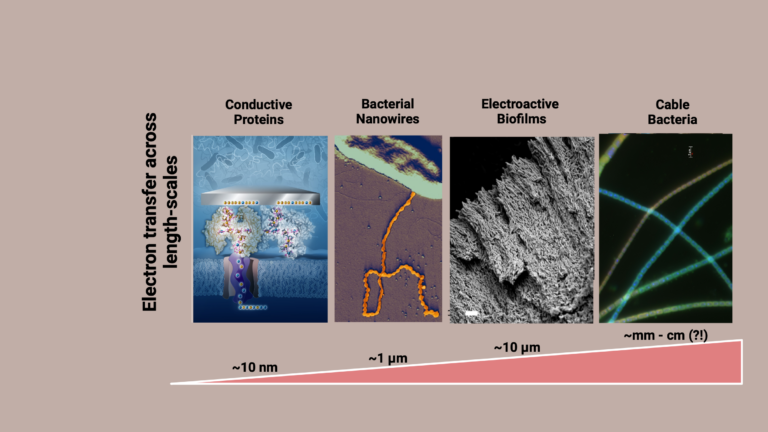
Electron-conducting proteins (also known as electron-transfer proteins) are specialized biomolecules that facilitate the movement of electrons through biological systems. They are critical for processes like cellular respiration, photosynthesis, and other biochemical reactions requiring efficient electron flow. These proteins exhibit electrical conductivity due to their unique structural and chemical properties, such as metal cofactors and conjugated systems.
We research the physical properties of transport in conductive properties such as:
- electron transport mechanism (hopping/tunneling/diffusion)
- electron spin effects
- electron transfer pathways
Techniques used for this research:
- Protein purification
- Surface chemistry (self-assembled monolayers)
- Conductive Atomic Force Microscopy
- Electrochemistry
-

One pathway in which bacteria can carry out extracellular electron transfer is using cytochrome nanowires.
These nanowires are appendages made of protein that allow the cell to transfer electrons from the cellular membrane to exterior surfaces.
The nanowires can reach several microns in length and allow the bacteria to conduct electrons over distances that are vast in comparison to most bioelectrochemical processes. Our lab is interested in characterizing properties in these wires such as:
- Length Dependent Conductivity
- Electron Spin effects
- Mechanisms of Long-Distance Electron Transport
Techniques applied for this research:
- Purification techniques
- Atomic Force Microscopy (Conductive AFM, etc.)
-
 Extracellular Electron Transfer in Biofilms and Electrically Active Oral and Gut Microbes: EET in biofilms involves microbes exchanging electrons with their environment, crucial for metabolic processes.
Bacterial Interactions in Co-Culture: Species interact synergistically or competitively, influenced by community composition, spatial organization, and electron donor/acceptor availability. Understanding their EET mechanisms.Experimental Techniques:
- Electrochemical Measurement
- Membrane Potential Measurement
- Microscopy
- Bacterial Cross-feeding in co-culture
- Mutant Analysis
-

Cable bacteria are the “natural conductive wires” living in various sediments. These filamentous bacteria can reach lengths of more than ten centimeters and possess extraordinary conductivity, comparable to semiconductors. Our lab studies cable bacteria from multiple perspectives, including, but not limited to:
- Conductivity and the mechanisms of long-distance electron transport
- Cell structures and conductive components
- Bioenergetics at the single-cell level
- Electronic properties
- Genomics
- Environmental Microbiology
Techniques applied:
- Atomic Force Microscopy (Conductive AFM, KPFM, etc.)
- Microelectronic characterization
- Electron Microscopy, including Cryo-Electron Microscopy
- Soft X-ray spectroscopy
- Electrochemistry
- Epifluorescence Microscopy
- Fluorescence Lifetime Microscopy
- Genome sequencing
Electric Bacteria Form Nanowires, Shoot Out Electron

“Electric bacteria” pass electrons through cell walls to solid minerals outside the cell.

This Bacterium Shoots Out Wires From Its Body To Power Itself

Public radio program The Academic Minute features “USC Dornsife Week”

Electric Bacteria: Out of the Darkness and into the Light

