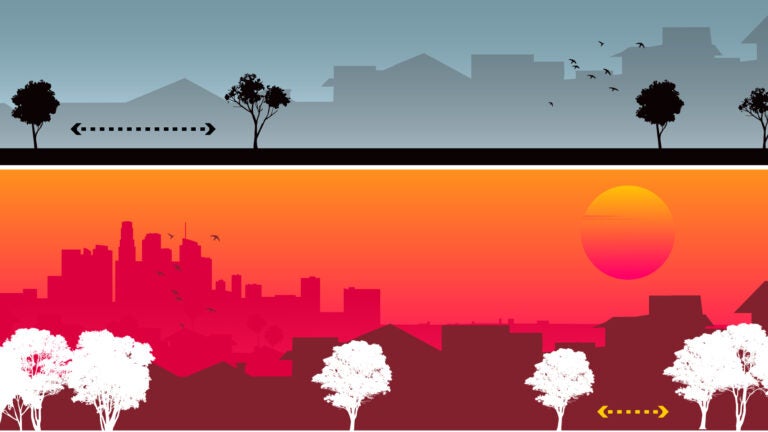
A study by USC Dornsife’s Spatial Sciences Institute and Public Exchange found that relaxing tree planting rules in Los Angeles could create more shade. (Composite: Letty Avila. Image sources: Flickr; Freepik.)
How changing L.A.’s tree rules could cool more neighborhoods
A new USC Dornsife study finds that outdated guidelines are limiting tree growth — especially in lower-income neighborhoods — and offers a path forward.
Key points:
- Los Angeles has some of the strictest tree planting rules in the nation. These policies limit tree growth, worsen shade disparities and don’t improve safety, researchers found.
- When USC Dornsife researchers modeled looser planting restrictions in a lower-income neighborhood, potential tree space increased by nearly 26%. But narrow sidewalks and dense infrastructure still limited where larger, shade trees could thrive.
- Many of L.A.’s strict tree-spacing rules are internal guidelines — not laws — meaning they could be updated more easily to allow for more trees.
- Closing L.A.’s shade gap, however, will require more than policy tweaks; infrastructure investments are also needed.
Expansive tree canopies are crucial for healthy ecosystems and livable cities. Yet, Los Angeles’ strict tree planting rules, originally meant to protect infrastructure and public safety, are now widening shade disparities, particularly in lower-income neighborhoods. A new study published in Landscape and Urban Planning, led by the Spatial Sciences Institute and Public Exchange, both based at the USC Dornsife College of Letters, Arts and Sciences, suggests that easing these decades-old restrictions could significantly grow the city’s urban tree canopy — without compromising safety.