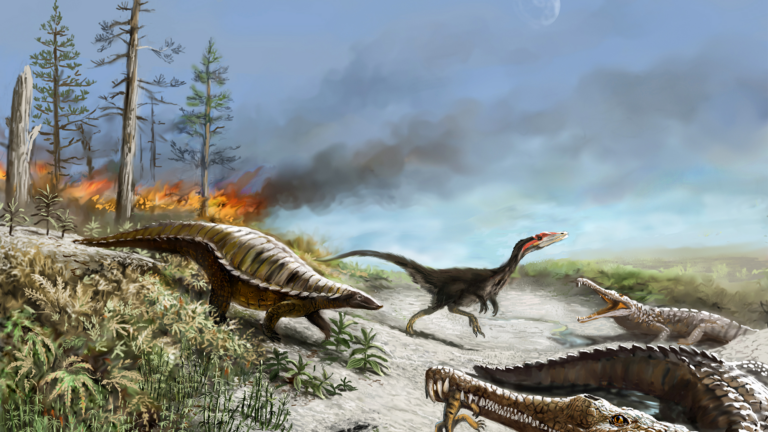
When the Earth’s carbon dioxide level increased at a rapid rate during the Triassic-Jurassic period 200 million years ago, nearly half the ocean’s marine life became extinct. USC Dornsife geologists contributed to… more>
categories: graduate, research, graduate research
tags: alumni, biological sciences, carbon dioxide, david bottjer, earth sciences, fossils, geology, natural sciences, ocean, publication, rowan martindale, sarah greene, study, travel
This week a USC scientist who spent 65 days at sea in search of life hidden beneath the seafloor returns from a successful expedition, which she chronicled in regular blog posts from her ship. Katrina Edwards of USC… more>
categories: research, faculty research
tags: biological sciences, earth sciences, katrina edwards, ocean
David Bowie asked it best in his 1971 song “Life on Mars?” But when it comes to the question of whether there’s currently life on the Red Planet, USC Dornsife professor Kenneth Nealson is fairly confident… more>
categories: research, faculty research
tags: biological sciences, earth, earth sciences, kenneth nealson, mars, natural sciences, planets
Global warming is not a novel phenomenon, and by studying what happened to the planet during a period of global warming about 250 million years ago, one USC Dornsife scientist hopes to discover what could happen to us this… more>
categories: research, faculty research
tags: biological sciences, david bottjer, earth, earth sciences, fossils, global warming, natural sciences
For the first time, an active delamination of continental lithosphere has been found beneath the Colorado Plateau. Meghan Miller, assistant professor of earth sciences in USC Dornsife, and her team’s discovery is… more>
categories: research, faculty research
tags: earth, earth sciences, meghan miller, natural sciences, nature, publication
When four members of the USC College Department of Earth Sciences took a fieldwork expedition to the United Kingdom, they didn’t have to venture out in the middle of nowhere, drive on dirt roads for hours or hike miles… more>
categories: graduate, research, faculty research, graduate research
tags: acidification, canada, david bottjer, earth sciences, england, extinction, fossils, frank corsetti, natural sciences, ocean, travel
If tectonic plate collisions cause volcanic eruptions, as every fifth grader knows, why do some volcanoes erupt far from a plate boundary? A study in Nature suggests that volcanoes and mountains in the Mediterranean can… more>
categories: research, faculty research
tags: earth, earth sciences, magazine, national science foundation, publication, thorsten becker, volcano
Nonlinear partial differential equations (PDEs) are difficult mathematical problems to study. Notice it didn’t say "solve." Ph.D. students researching nonlinear PDEs aren't looking for solutions. They're analyzing the… more>
categories: graduate, graduate research
tags: award, earth sciences, fellowship, geology, math, mathematics, natural sciences, rocks, wise, women in science and engineering
Hang around the Department of Earth Sciences in USC College in the spring and you might notice posters on the walls asking pointed questions. "Enjoy hiking, climbing, and traveling to exotic spots?" one asks. "Curious about… more>
categories: undergraduate, undergraduate research
tags: earth sciences, geology, natural sciences, nature, soar, surf, undergraduate team research
"I believe that this nation should commit itself to achieving the goal, before this decade is out, of landing a man on the moon and returning him safely to the Earth.” These were the remarkable words spoken by President… more>
categories: research, faculty research
tags: biological sciences, earth, earth sciences, grant, katrina edwards, national science foundation, natural sciences, ocean


RSS Feed
facebook
twitter
youtube
photos & videos