
2025 Wrigley Institute Graduate Fellow Josh Beckelhimer, a PhD candidate in the USC Dornsife Department of English, studies the fictional works of writers who narrate possibilities of climate change futures (Nick Neumann/USC Wrigley Institute).
Symbiosis: Merging science, narrative, and cosmology to tell new stories about the environment
As a reader, a literary scholar, and a lover of history, I love following in the footsteps of my idols. Even after five years as a transplant, my eyes still twinkle when I traverse Los Angeles, home to many beloved writers and artists. When I arrived with my parents in August of 2020, we drove to Pasadena. They wanted to admire the L.A. town with sun-baked mansions and the Rose Bowl–a rare destination we could explore despite the Covid-19 lockdown. In the following years I had the privilege to soak in Pasadena’s aura, not as a football fan, but as an admirer of the great writer Octavia Butler.

Butler anchors one chapter of my dissertation, alongside three more on the writers Zora Neale Hurston, Leslie Marmon Silko, and Rita Indiana. I study writers who use the tools of speculative fiction and cosmology to narrate possibilities of climate change futures. Each writer interacts with ecological science, but they look toward the cosmological traditions of African and Native American cultures. Hurston, Butler, and Indiana are interested in variations of African Yoruba cosmology–namely Santeria and Voodoo–while Silko and Indiana engage with Indigenous cosmologies from the Laguna Pueblo, Mayan, and Taino traditions of the American Southwest, Latin America, and the Caribbean.
For these writers, cosmology revises modern ways of thinking about the planet by connecting historical and regional ecological knowledge to wider scales. French theorist Bruno Latour argues that Western society rests on an assumed rupture between nature and culture. Much of modern ecological science has faced an uphill battle, especially regarding how humans have–or have failed to–represent the urgency of climate change. I study writers who reach back to traditions that involve imaginatively representing human relationships to the natural world. Long before Latour, these traditions have argued that no such rupture exists, and that imagining solutions for environmental crises, we need revised understandings of ecological entanglements.
Of course, Black and Indigenous cultures have been resilient and adaptive cultures, evolving with the world around them through what Anishinaabe writer Gerald Vizenor terms “survivance.” Octavia Butler is a prime example. At Pasadena’s Huntington Library I was able to explore her archive, and study her notes, manuscripts, and everyday writings like grocery lists and affirmations. I was able to spiritually walk the streets of Pasadena with Butler, to take the bus downtown (she remarkably never drove) to study at the main branch of the L.A. Public Library with her, and admire agave, live oaks, and California redwoods alongside her loving gaze of her local ecologies.
Her vision of Pasadena stretches beyond the homes of executives and sporting events. She grew up and lived there for many years. She moved to Seattle at the end of her life, but Pasadena was always home. When it came time to bequeath a lucky institution with her life’s work, the Huntington Library came to mind. The gardens are breathtaking, but the Butler archives provide a sprawling perspective on the roles of California’s ecologies for the planet, and the myriad cultural, narrative, and scientific ways that we can interact with them.

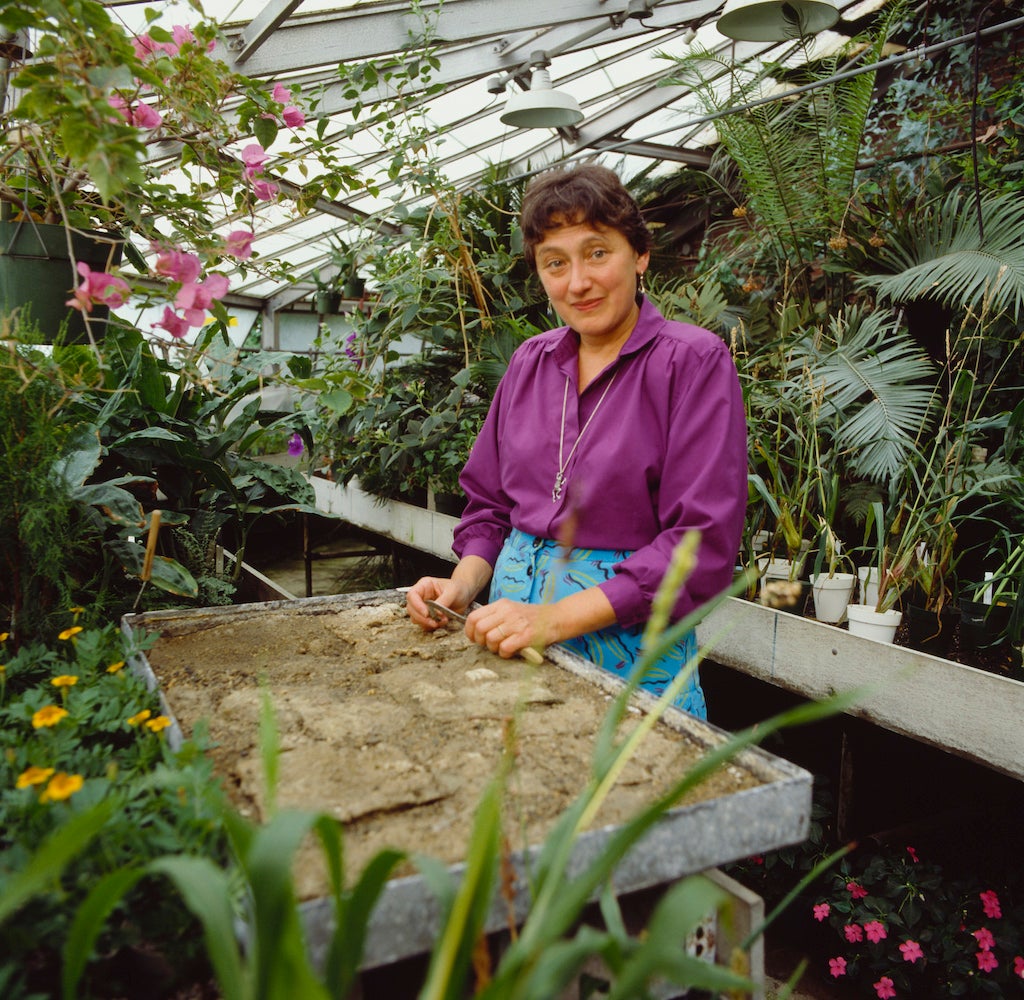
I study Butler’s Parable novels, but her archive provided my chapter’s key insights. I found that she widely read the work of evolutionary biologist Lynn Margulis, particularly about symbiosis. Margulis might be known to some for her brief marriage to Carl Sagan. For others, she’s know as the co-champion of the planetary atmospheric science of Gaia Theory along with James Lovelock. Most importantly, though, Margulis was a trailblazer in evolutionary biology. In 1970, she published an article called “The Origin of the Eukaryotic Cell,” launching her career’s work on what remains a critical insight in evolutionary biology: symbiosis, “the merging of organisms into new collectives” (Symbiotic Planet, 32).
Since 1970, symbiosis’s meaning has evolved as metaphor, storytelling device, and social process. It is a dynamic, usually invisible, ongoing process of merging and evolving that happens across scales.
Since 1970, symbiosis’s meaning has evolved as metaphor, storytelling device, and social process. It is a dynamic, usually invisible, ongoing process of merging and evolving that happens across scales. Humans, for instance, contain symbiotic assemblages of scores of microbes. Our bodies also participate in the symbiotic assemblages of the planet’s atmosphere by collectively regulating–or destabilizing–elements like hydrogen, oxygen and CO2. Symbiosis is a process of interconnection on the smallest and largest scales, crucial for biological evolution and regulation. Butler wrote fictions of symbiosis for decades. For her, it is also a crucial process of social evolution and regulation, with heightened importance as our symbiotic relationship to the planet grows increasingly fractured.
Butler’s Parables utilize what I call “formal symbiosis” and “cosmological symbiosis.” As the genre’s first major Black female writer, she not paved the way for many more to come, but also revamped what the genre could do. She shows how myth-making and narratives of science are not so different–which Margulis echoes. Butler wrote the Parables with a formal symbiosis that combined poetic, scripture-like verses, journal entries, and novelistic narration to narrate an environmentally devastated dystopian future, through a perspective that speaks directly to the reader and to collective audiences.
She used “cosmological symbiosis,” to develop Lauren Oya Olamina’s cosmology “Earthseed,” which melds the social and ecological insights of Yoruba and Indigenous cosmologies, and evolutionary biology. Earthseed draws dialogues between cosmology and science and imagines something new with cosmological symbiosis. Margulis’s science helped Butler confirm and narrate ideas of environmental interconnection long held by marginalized, repressed cosmological traditions. Those cosmologies helped her criticize faulty modern institutions and explore alternative methods of representing a possible dystopian future.

For anybody visiting Pasadena, it is worth studying up on Butler and reading the city with her. Understanding how she built on the important science of Margulis and ancestral cosmologies to approach the crucial questions of our times is even more valuable.
How do we approach something as imposing as planetary climate change? How can varying histories and traditions improve our approaches? How have our narrations and representations of our relationships to science and the earth been mistaken, and how can we find better ways to tell stories about the world we face? How can a theory like symbiosis help us understand the many connections between science, nature, history and storytelling? Stroll through the Huntington Gardens, but gaze at the plants around you with the perspectives of Butler and Margulis in mind. You navigate just one small piece of a symbiotic puzzle comprising the wider planetary environment. What stories does it tell?
Josh Beckelhimer is supported by the USC Dornsife Wrigley Institute Graduate Fellowship.