From community dream to academic force in contemporary Armenian studies
Like members of other small nations, Armenians remembered themselves before the history books did. Prior to the establishment of Armenian studies as an academic field in the United States, Armenians infused their memories into the tapestry of private and public life in their communities — with grocery stores named after towns that no longer existed, churches that served as informal welcome centers for the displaced, and schools that sought to keep language alive.
Nowhere was this more apparent than Los Angeles, which by the turn of the century had become what many would deem “the beating heart of the global Armenian diaspora.” Yet, no academic institution in L.A. existed to study this complex population that, for generations, had grown accustomed to stewarding its own history.
In 2005, a group of prominent community members came together to change that. Their dream was to create an educational hub that would transcend ideological divisions, analyzing the contemporary Armenian experience. Unlike the tradition of other Armenian studies institutions at the time, which focused on classical and medieval Armenian history, the founders of this new institute prioritized the 20th and 21st centuries.
Grass roots movement births new Institute of Armenian Studies
To garner support for the project, entrepreneur and longtime community activist Charles Ghailian assembled a group of distinguished professionals — many of whom were USC alumni — to serve as benefactors for the institute. They would eventually form the institute’s Leadership Council, which remains in place today.
“My wish was always for a collective, unified structure of representation in this community that didn’t have to side politically, didn’t have to choose which is the church of choice, which is the party of choice,” Ghailian said.
The group soon raised the necessary funding to establish the Institute of Armenian Studies at the USC Dornsife College of Letter, Arts and Sciences. “We all stood shoulder-to-shoulder to make this a reality,” Ghailian said.
Under the leadership of inaugural director Hrair Dekmejian, Professor Emeritus of Political Science, the institute’s early years were dedicated to better understanding how it could serve its local audience, with programs focused on current themes. These included symposia on the vitality and relevance of philanthropic institutions in diaspora, and the role of the church in global Armenian society.
Importantly, two Armenian studies courses joined the university curriculum during that time, a major step for integrating the field into USC’s academic fabric.
Institute advances toward contemporary Armenian studies focus
In 2014, Salpi Ghazarian took the helm as institute director, garnering newfound visibility for the institute both on and off campus. A librarian, editor and civil society organizer who had worked at the highest levels of Armenia’s government, Ghazarian’s personal and professional trajectory shaped the institution she had been tasked to lead.
“She both personally connected those bridges between the republic and diaspora and was entirely immersed in all aspects of Armenian diasporic life in America,” said institute Chitjian researcher archivist Gegham Mughnetsyan, whom Ghazarian recruited to join the team. “It all made sense why this person, at that important moment, would be entrusted with the leadership of the institute.”
On the centennial of the Armenian genocide in 2015, the institute debuted Innovate Armenia, an educational festival that assembled Armenian trailblazers in academia, the technology industry and the arts for a day of inspiring talks, performances and community connection. The program reflected a bold vision — the institute would embrace a future-looking orientation, producing scholarship with real-world impact and relevance.
“We look backwards more often than we look forwards,” Ghazarian said in her remarks at the event. “What is it we want from community? … What is it that we want for the future? How are we defining these questions? And these are big questions — they need to be sliced… And we as an institute — today, tomorrow, during the year — will do what we can to try to find the right people to work on the answers.”
Under Ghazarian’s leadership, the institute introduced several innovative programs, including oral history projects that documented pivotal moments in the global history of Armenians. These collections include Understanding Independence, which features interviews with integral figures from Armenia’s movement for independence from the Soviet Union, and the Displaced Persons Documentation Project, which illuminates the stories of Armenians displaced during World War II. Most recently, the state-funded California History Through Armenian Experiences project chronicles more than a century of Armenian contributions to the Golden State.
Armenian studies is in its heyday now. It’s in its most diverse, most expansive, most flexible, most exciting moment.
Before the institute began its work in this realm, oral history accounts of Armenian subjects mainly consisted of genocide survivor testimonies. The institute took a different approach, turning its lens on often-sidelined aspects of contemporary Armenian life.
Capturing interviewees’ entire personal histories using professional techniques, institute experts process the videos in accordance with Library of Congress standards, and make them publicly accessible via the USC Digital Library.
“All other Armenian oral history initiatives have been spearheaded by individuals or organizations that don’t enjoy the benefits of being part of a major research university, which sets the institute apart as an academic home for primary source material,” said institute project manager Manuk Avedikyan.
New leader drives new vision for institute’s contemporary focus
In 2023, Ghazarian stepped down, and Shushan Karapetian assumed the institute directorship. An Armenian studies scholar with expertise in sociolinguistics, Karapetian has embraced what she calls an expansive view of what the Armenian experience can offer the world. This vantage point has informed her goal of propelling Armenian studies to the forefront of global academic discourse.
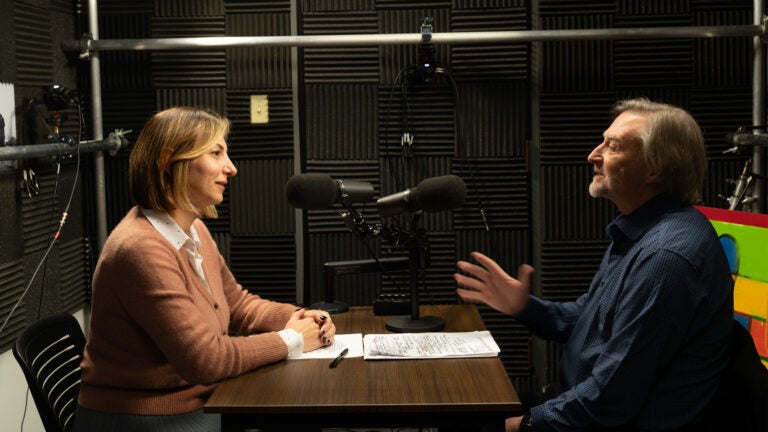
“Armenian studies is in its heyday now. It’s in its most diverse, most expansive, most flexible, most exciting moment,” Karapetian said, tracing how the field evolved from examining Armenians primarily as peripheral subjects in a larger picture centered on other groups to a people worthy of their own spotlight.
The transformation of the field reflects that of the Armenian diaspora — a people ruptured by genocide and subsequent waves of displacement, for whom turning inward became a protective mechanism of sorts. More than a century removed from that catastrophe, Karapetian believes that Armenians now have a lot more to offer than just their past.
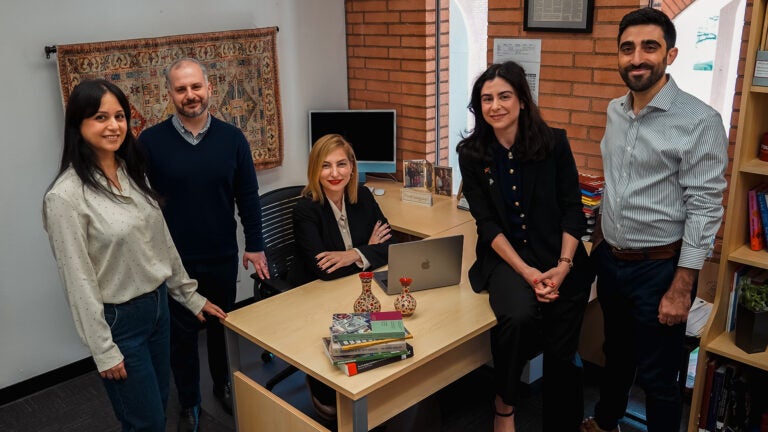




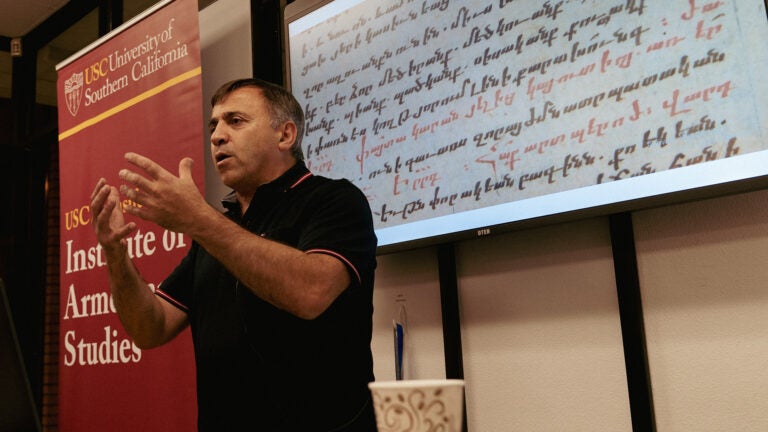

“The fact that things Armenian are of today, of tomorrow, of pragmatic and instrumental value, is very, very new,” Karapetian said, describing how novel the institute’s ethos is for many students. “They come in expecting a very preservationist environment. They come out believing that Armenian experiences are dynamic and relevant on the world stage.”
The institute’s contemporary focus and embrace of fresh, sometimes challenging ideas has created a culture where students of diverse backgrounds feel welcome and intellectually stimulated. Approximately half of the students enrolled in Karapetian’s Armenian studies courses are not of Armenian heritage.
“The institute has broadened my horizons in terms of the way in which I perceive my community. That we are present, that we are here, we are looking forward,” said former student worker Solange Aguero, who graduated from USC Dornsife in 2025 with dual degrees in English and narrative studies.
To advance her vision, Karapetian has grown her team to include specialized roles and embarked on a strategic planning process to define the institute’s trajectory amid seismic shifts in academia and the global Armenian landscape.
“How can we strategically embed ourselves in the university infrastructure, in the communal infrastructure, in the Armenian studies infrastructure, so that we aren’t a series of one-off events but an institution — with institutional memory, with strategic goals?” Karapetian said.
She has organized the institute’s work into three pillars — research, education and public engagement — under an umbrella that includes both the Republic of Armenia and the diaspora, with a particular emphasis on Los Angeles.
Broad array of students benefit from and contribute to institute
Students play a meaningful role in nearly every aspect of the institute’s programming, including in-house research, media production and events. For example, Arman Dzhragatspanyan, who graduated from USC Dornsife in 2022 with a degree in health and human sciences, led a psychological research study that examined trauma and resilience levels among survivors of the 2020 Artsakh (Nagorno-Karabakh) War. The resulting peer-reviewed paper — portions of which he presented in a panel at the institute’s 2024 symposium, Artsakh Uprooted: Aftermaths of Displacement — is slated for publication next year.
“I learned how important research is. I learned how to talk with people. I learned how to network with people. And it was where I gained the most opportunities in terms of my career moving forward,” Dzhragatspanyan said.
It took these personal connections and put them into a more … universal context, in a way that I had never experienced before.
While some students enter the institute with deeply held beliefs about their Armenian identity, Sarkis Tricha, who graduated from USC Dornsife in 2022 with a degree in cognitive science, craved an intellectual lens through which to understand his lived experience. Enrolling in Karapetian’s MDA 330: The Armenian History: History, Arts and Culture course gave him this rigorous framework.
“It took these personal connections and put them into a more global context, a more abstract context, an academic context, but also a more universal context, in a way that I had never experienced before,” Tricha said.
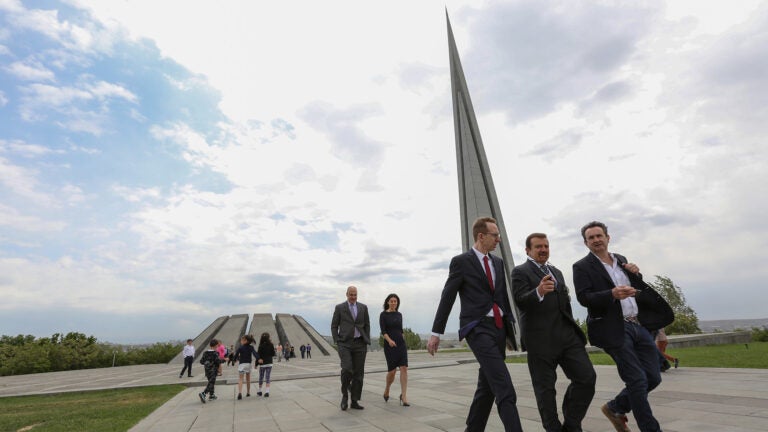
Tricha assisted Karapetian with a multiyear research project that explored how masculinity is performed through language. In 2023, the pair traveled to Armenia’s capital, Yerevan, to present their research at an academic conference — Tricha’s first experience in the republic.
A blueprint for the future of Armenian studies
Now, 20 years after its founding, said Karapetian, the institute has created a blueprint for a different kind of academic research institution — one that brings scholarship into the public square, leaves an indelible impact on young generations, and changes the way a community perceives itself.
“I want to be bold about what Armenian studies can offer academia and what academia can offer Armenian studies,” Karapetian said. “USC is the perfect place to do it, and we’re just getting started.”