Howard Wayne Harris proves his 9th grade teacher wrong. Earning his Ph.D. at the USC Dornsife hooding ceremony May 16, he was…
USC Dornsife issued more than 2,500 degrees during Commencement 2013: 1,959 bachelor’s, 326 master's, 81 graduate…
USC Dornsife students win top prizes at the 15th Annual Undergraduate Symposium for Scholarly and Creative Work. In…
USC valedictorian Katherine Fu and salutatorians Alexander Fullman and Julia Sabo Mangione — all in USC Dornsife — will…
Introducing the 2013 Dornsife Scholars. The six winners will each receive $10,000 to be used for graduate or professional…
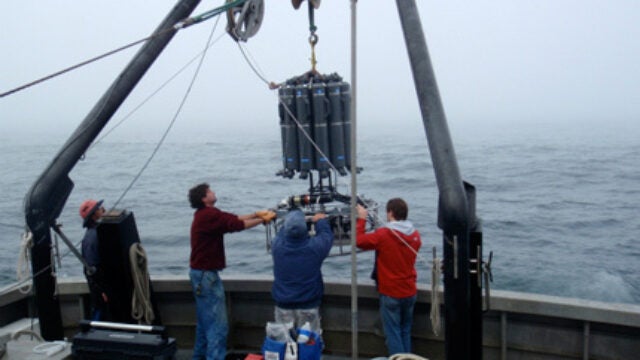
Katrina J. Edwards, professor of biological sciences and Earth sciences in the University of Southern California's College of Letters, Arts & Sciences, has been recommended for an award of a $25 million NSF grant to… more>
categories: research, faculty research, diversity, faculty diversity
tags: biological sciences, earth sciences, grant, katrina edwards, national science foundation, natural sciences, ocean
An enormous plume of freshwater leaves the Amazon River and spreads across the tropical Atlantic Ocean, setting the stage for the symbiosis of some bacteria and algae on a scale that appears to subtly influence the climate of… more>
categories: research, faculty research
tags: award, biological sciences, biology, climate, national science foundation, natural sciences, ocean, oceanography
Iron dust, the gold of the oceans and rarest nutrient for most marine life, can be washed down by rivers or blown out to sea or — a surprising new study finds — float up from the sea floor. The… more>
categories: research, faculty research, diversity, faculty diversity
tags: biological sciences, blog, earth sciences, iron, katrina edwards, natural sciences, nature geoscience, ocean
Seldom has one scientist dived so deep to look at something so small. For three weeks this month, USC College’s David Caron will join an expedition to study marine life around deep-sea hydrothermal vents. His specialty:… more>
categories: faculty research
tags: environmental studies, marine biology, natural sciences, ocean, wrigley institute for environmental studies
The last fish you ate probably came from the Bering Sea. But during this century, the sea’s rich food web — stretching from Alaska to Russia — could fray as algae adapt to greenhouse conditions. “All… more>
tags: carbon dioxide, marine biology, ocean
A USC oceanographer's long-term study shows that the marine food chain depends in large part on atmospheric nitrogen. The finding also demonstrates the oceans’ massive absorption of greenhouse gas. By Carl… more>
categories: research


RSS Feed