Spain Rocks
For some people, rocks are those pesky objects that sometimes find their way into your shoes. But for aspiring geologists, who study how rocks came to be, the aggregate of minerals provide a looking glass into the past. Was the rock produced by an earthquake or liquefied during an extreme heat condition?
“Things which are confusing in lecture become easy to see in the field,” said USC Dornsife senior Max Wagner. “It’s so much easier to understand the concepts we read and hear about when we see them in person.”
Wager had an opportunity to examine rocks in person during USC Dornsife’s inaugural Maymester program in Malaga, Spain. Wagner and six fellow students were tasked with studying rocks and discerning what took place many million years ago.
In Spain, Wagner recalled staring at a gigantic rock and wondering how the peridotite structure — rock from the Earth’s mantle that once resided below the outer crust — made its way to the surface.
“Thinking about the enormous force that occurred in our planet’s past to get these rocks where they are today is why I study geology,” said Wagner, who is majoring in geological sciences major in USC Dornsife with a minor in jazz studies at USC Thornton School of Music.
In May 2012, John Platt, professor of Earth sciences in USC Dornsife, led junior and senior geology majors on a nine-day trip studying bedrock and geological structures in Malaga and three other cities in the country. The course gave them hands-on training in the field.
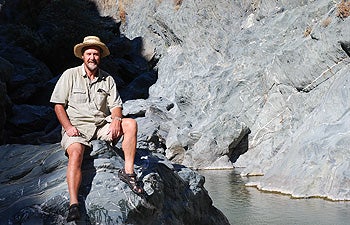
John Platt, professor of earth sciences in USC Dornsife, led junior and senior geology majors on a nine-day trip in Spain during a USC Dornsife inaugural Maymester program. Photo courtesy of John Platt.
“To understand geology you have to be able to look at rocks and interpret them,” Platt said. “We are showing students how to actively look at rocks in their natural environment, make interpretations based on what they see in the field, and we’re teaching them various techniques and skills you need to do that.”
Leading up to the trip, students attended weekly seminars to familiarize themselves with the queries researchers are trying to answer, such as how tectonic plate collisions created mountain ranges spanning large distances.
In Spain, students also studied volcanic rock and faults in Carboneras and examined the evolution of a continental collision zone in Ronda.
In the field, the Trojans observed geological formations and sketched, measured and plotted information on a map. Rather than snapping photos, Platt required the team to draw their observations, which propelled students to focus on the most important aspects of the terrain.
“Learning to draw by hand was so useful,” said Emily Van Guilder, who graduated with a bachelor’s in geological sciences in May 2012. “If you come up to a cliff surface that has interesting geological features that you want to see you can take a picture and look at it later, but when you are forced to draw something your mind immediately goes to what’s important.”
For Van Guilder, the trip helped boost her confidence in taking measurements and mapping. The skills directly relate to her chosen career: exploration geology.
Van Guilder recalled rounding a dirt path and seeing the Mediterranean basin. The images she had been studying in class paled in comparison to the huge column of rock that stood only feet away.
“Southern Spain has a very complicated, interesting geological history,” she said. “It was amazing to see in person what had previously been a speck on a map.”
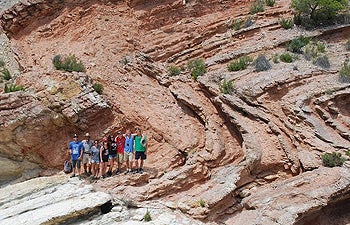
Students investigate rocks in Spain during USC Dornsife’s inaugural Maymester program in Malaga, Spain. John Platt, professor of earth sciences in USC Dornsife, led junior and senior geology majors on a nine-day trip studying bedrock and geological structures in Malaga and three other cities in Spain. Photo courtesy of John Platt.
The timing of the trip served Van Guilder well.
“It was nice to develop more skills in the area right before I went out into the real world,” she said.
For Wagner, the trip reinforced his passion for geology and showed him the diverse set of skills needed to become a field geologist.
“To successfully do geology in the field you must bring together many different areas of earth science with the ultimate goal of understanding a small part of the world around us,” he said.